
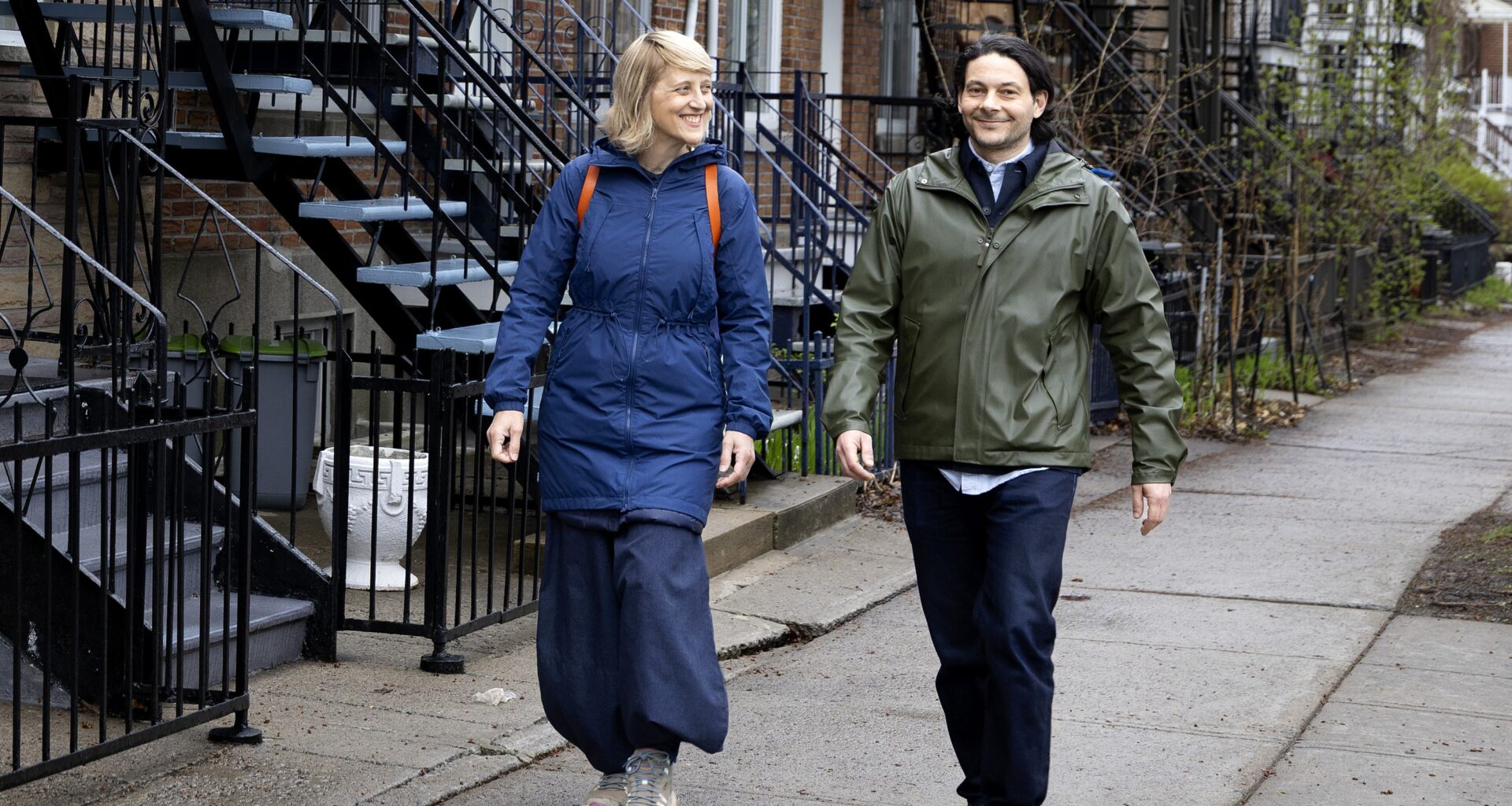
When Raphaël Ettore was young, his Italian grandmother would take him and his brother on public transit to bus and métro terminals around Montreal and they would walk for hours through all kinds of neighbourhoods.
After his grandmother died during the pandemic, Ettore found himself making pilgrimages to some of those same places and retracing their steps.
“It did me a lot of good,” he said.
It also provided an anchor to a topic he had been researching for more than two years: the power of walking. He and his producer friend Ziad Touma were working on a proposal for a documentary on the topic, but had yet to find a hook. They had submitted successive information-laden versions to Quebec funding agency SODEC, but kept getting refused. Then Touma put Ettore in touch with filmmaker Vali Fugulin.
“At the beginning, I wondered if there was really that much to say about walking,” Fugulin admitted. “But we talked for two hours and by the end I was like, ‘OK.’ He was telling me how each person’s walk is unique, how no two humans walk alike, how we express our emotions through walking — things you know intuitively, but that are fascinating. I like subjects that connect people.”
Fugulin was struck by another alarming fact. Despite all the hype around taking 10,000 steps a day, “humans have never walked as little as they do now,” she said — “except during the pandemic.”
While Ettore had been retracing his walks with his grandmother, Fugulin, like so many of us, had begun taking daily walks to escape the monotony and isolation of successive lockdowns.
She and Ettore submitted another proposal focusing on the storytelling potential of the topic, and finally got the green light for Fugulin’s thought-provoking new documentary. Made to Walk (À Pied) takes us around the globe with an absorbing array of people who love to walk, and talk about walking.
“I found the human side (of the subject) was beautiful,” Fugulin said. “I felt we could take the scientific side, which people know less about, and find people who embody that so that viewers learn things through them.”
Made to Walk begins in Brazil, where a food vendor treks up and down the hills of the impoverished favelas selling his wares, sharing his musings on life along the way. Then it’s off to Japan, where an elderly woman shuffles along the pedestrian streets of her neighbourhood, talking to neighbours and observing the daily changes in the world around her.
A Jamaican-American architect walks the blocks of New York, pondering the racism and respite he has encountered during his lifelong love of walking. An Innu surgeon uses walking to overcome depression, connect with his ancestors and inspire indigenous youth.
A Venice Beach mime, a Québécoise trans woman, a robotics engineer, Latvian-British amputee performance artist Viktoria Modesta and iconic Montreal dancer Louise Lecavalier fill out the roster of engaging personalities with no shortage of insights about how and why we walk.
“We wanted people who are ordinary, but extraordinary,” Fugulin said.
The film is peppered with stunning aerial drone shots — taken by Fugulin’s cinematographer partner Sébastien Gros — of people walking over all types of terrain.
“We made a movie for the big screen,” Fugulin said. “It’s cool to see the variety of landscapes that feet traverse — sand, snow, water, ice, rocks.”
The filmmaker’s CV includes a variety of experimental works in different media on everything from tupperware to grief. Made to Walk is her most accessible project by far and to hear her tell it, it just sort of turned out that way.
“It’s about what connects us as humans,” Fugulin said. “It’s a universal subject that touches all kinds of people. It’s a film for a wide audience. My distributor told me to embrace that. It’s a feel-good movie. At the same time, people say it makes them think about their breath and the rhythm and speed at which the world moves.”
“It’s something so fundamental to our species,” Ettore offered. “Everything is linked to walking.”
AT A GLANCE: Made to Walk is opens Friday at the Cineplex Forum and in French at Cinéma Beaubien. Fugulin and Ettore will be at the Forum following Sunday’s 7 p.m. screening to talk about the film.