
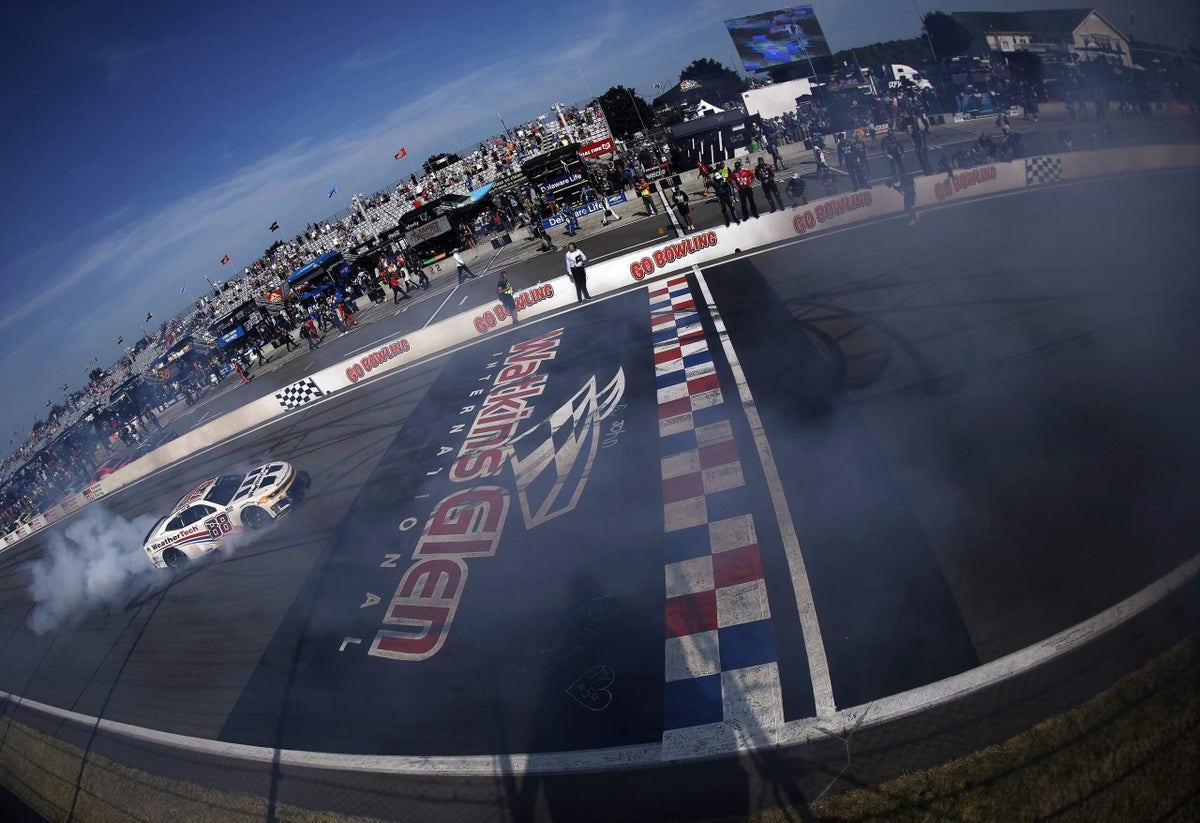
DUNDEE, N.Y. — Building the NASCAR Cup Series schedule is like taking 38 mismatched pieces and trying to make them all fit sensibly.
Like any puzzle, you start with the easiest pieces. Certain race dates are locked in place on the calendar — for instance, the Coca-Cola 600 (which always falls on Memorial Day weekend) and the Southern 500 (Labor Day weekend). Other dates can be shifted around. From there, you start filling in the open dates, taking into account factors such as weather, travel logistics and other events in the market.
NASCAR chief operating officer Ben Kennedy is tasked with crafting the schedule. He has previously told The Athletic that he has a dry-erase board in his office where he workshops various concepts for the schedule. Some years, everything comes together rather easily; other years, not so much.
One of the new quirks of the 2026 schedule involves Watkins Glen International, site of this weekend’s Cup Series race, shifting from its longstanding late summer date to Mother’s Day weekend.
The repositioning generated widespread curiosity when it was announced last year. A track located in Upstate New York would now hold its race weekend in early May, when inclement weather is more likely. Much of Watkins Glen’s ticket sales is based on camping, so it was hard to see how this weekend would prove more successful than its typical date in August.
Although the forecast for Sunday afternoon calls for a high temperature in the upper 60s, according to the National Weather Service, the low is expected to dip into the 40s throughout the weekend with a decent chance of rain all three days. Watkins Glen has attempted to mitigate the new challenges it is facing.
“When we saw the date, we said, ‘OK, we need to shift our merchandise from all T-shirts and tank tops to long sleeves and things like that,’” Watkins Glen track president Dawn Burlew said. “But then again, we did some really cool stuff for Mother’s Day with our merchandise. We just took a whole different twist to it getting ready and planning for this weekend. Instead of just doing traditional flowers, we did more mulch and tulips that my team planted last fall, which normally we wouldn’t do. So we just embraced it that way.”
Still, few would argue that cold and wet are idyllic conditions for camping.
Why then did NASCAR mess with what had been a good thing? One of the hurdles Kennedy and his team encounter each year is constructing a weather-suitable schedule when there aren’t enough viable tracks in warm-weather locations. To fill in all the dates, NASCAR has to make some concessions and hope for the best.

Normally a summer race, Watkins Glen draws a big camping crowd. (Orry Perce / Icon Sportswire via Getty Images)
NASCAR this season moved its race in Homestead, Fla., from March back into the playoff rotation, removing the race at New Hampshire Motor Speedway. This created an open date in the early part of the schedule, with Watkins Glen, Michigan (currently scheduled for June) and Iowa (August) among the candidates to move up. (NASCAR does not own the New Hampshire track and had limited options to move its date.)
Another candidate was one of NASCAR’s most historic short tracks.
For several years, Richmond Raceway in Virginia’s capital city had struggled with attendance so much that it became impossible to justify the track continuing to have two dates — one was almost always in the spring, with the other later in the year. In 2024, NASCAR relocated one of Richmond’s two dates elsewhere. For the 2025 season, Richmond’s lone Cup race was in mid-August.
Due in part to the consolidation, Richmond had its best-attended race last August, which made NASCAR reluctant to shift Richmond to another spot on the 2026 calendar, even though there was that open spot in the spring that needed a race.
Taking Richmond off the table left no good alternative. Any option had pros and cons. NASCAR eventually settled on Watkins Glen as the track that should move to Mother’s Day weekend, even though its Cup race had been held in August all but one year since 1986, when it was added to the Cup schedule. (The lone exception was 2024, when its race was held in early September.) New Hampshire’s race will be in August, in Watkins Glen’s usual spot.
A race in Upstate New York in early May is less than ideal, but NASCAR’s decision-makers also saw this as essentially a one-year stopgap, with the likelihood Watkins Glen would be given a proper spot on the 2027 calendar.
On Thursday night, NASCAR did just that, announcing next year’s Watkins Glen race will be held sometime in September. The exact date is still to be determined, but it will be included as one of 10 races in the Chase playoff that determines the season champion, a notable distinction that further enhances the race’s stature.
That NASCAR is making this known now is notable. The league rarely announces an individual race date outside of a marquee event, like its signature Daytona 500. Making the announcement now is a tacit acknowledgement that keeping Watkins Glen in May would have long-term negative ramifications, potentially alienating a loyal fan base that has routinely packed the venue.
“I think (fans) are going to be thrilled that we’re at the first part of that and really kind of set the stage for the rest of the Chase,” Burlew said.
With Watkins Glen, an area renowned for its many wineries, getting its race back in late summer starting in 2027, the conditions will likely be much more fan-friendly.
“September is a beautiful time up here as well,” Burlew said. “The leaves are all in and it’s just when they’re starting to harvest the grapes. It’s just a great time of year in the Finger Lakes. … And it will be a little warmer than it is probably right now.”