
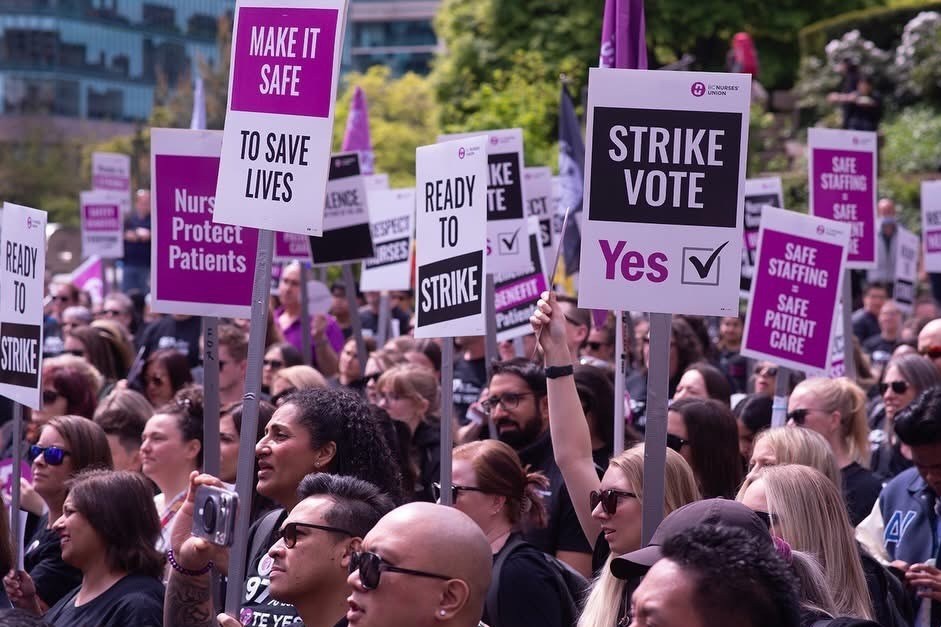
Nurses from across BC, including those in the Northern Health region, rallied in Vancouver as part of a demonstration organized by the British Columbia Nurses Union (BCNU) on Thursday, April 30.
The rally saw more than 500 nurses attend, with approximately 50 nurses from the Northern Healthcare region attending to represent the North.
Representatives from the Canadian Federation of Nurses Unions, Nova Scotia Nurses’ Union, United Nurses of Alberta, BC General Employees’ Union and the Health Sciences Association, among others, also attended.
The rally was organized to bring attention to a critical time for nurses in BC and to protest workplace conditions.
Danette Thomsen, regional council member for the Northeast region of the BCNU, spoke to The Citizen about attending the rally.
“I think the key moments for me are just how united the nurses are right now and that we are saying, that enough is enough,” she said.
An upcoming strike vote could facilitate future job action, she said.
As stated in a BCNU press release, this strike vote was planned after the Nurses’ Bargaining Association (NBA) provincial bargaining had declared an impasse between themselves and the Health Employers Association of BC (HEABC) and stepped away from the bargaining table on April 20.
Now more than 50,000 BCNU nurses are gearing up for a strike vote that will take place on May 8-11. This vote, if passed, will give the union the legal authority to initiate province-wide job action.
Thomsen said that the bargaining stage has been ongoing for months and that nurses are getting nowhere.
“They’ve been at the table for eight months negotiating, and the health employers have rejected the majority of proposals that have been put forward. We’re focusing on compensation, workload, violence in the workplace, occupational health and safety, and all the key issues nurses are facing. It has to be addressed to stabilize the health care system. And there’s just no movement,” she said.
Thomsen added that nurses in the North are not eager to strike but feel pushed into it by a lack of results and workplace improvements.
“I want to assure you that nurses don’t want to be on strike; they’re being forced into this by the government. No nurse wants to be on strike. We want to be taking care of our patients but this is what we’re going to have to do to fight for ourselves and to advocate for ourselves as we do for our patients,” said Thomsen.
Thomsen herself has been an outspoken advocate against violence in the workplace, an issue she said has not gotten any better in her region.
The BCNU, in a media release, also shared that since 2019, injury claims across healthcare have risen by nearly 25 per cent, with psychological injuries having tripled.
Improved conditions for nurses don’t just mean better workplaces; they also mean better hospitals, as Thomsen explained during her interview with The Citizen.
“This isn’t just about nurses; this is about the patients we care for. Those patients deserve better, more dignified care. A nurse, say on a med-surg ward, should be giving care to four patients and they’re seeing many more patients at times. That is so morally distressing for our members. They’re done. They just need to be able to provide the care that patients deserve. They’re ready and they’re ready to strike,” said Thomsen.
Other issues include a lack of staff, with the BCNU stating that there are more than 4,500 nursing vacancies across the province, with thousands more expected in the coming years.
Thomsen also believes that burnout and overwork are also issues with nurses, often being overworked trying to fill positions left vacant, or having to move patients alone, when two or more nurses are needed.
Besides violence, nurses also have to worry about their health. Thomsen says that they are regularly exposed to illnesses that they are not protected against and often need to pay out of pocket.
“There are also many things that nurses are exposed to at the job. For instance, for shingles, the vaccine isn’t even provided. And yet, they’re exposed routinely,” said Thomsen.