
 10 min read
Everybody loves a breakthrough story, and the bike industry loves selling one even more.
Right now the hot one is the “radial” tire: a new crop of rubber promising more grip, more comfort, a bigger contact patch, and a calmer ride through a different approach to casing construction. Maybe some of that is real. I think some of it probably is. But there’s a catch: these tires are not radial in the neat, textbook, car-tire sense.
That matters because casing ply angle is not some newly discovered trick. Tire makers have always used it as a tuning tool. What is new is that some brands are pushing farther toward more open ply angles, building product stories around the resulting ride feel, and marketing it under a sexy name.
So the real question is not whether these tires truly deserve the word “radial.” It is whether they will actually make your bike ride better, or just differently, and whether that difference is worth paying for.
What a True Radial Tire Actually Is
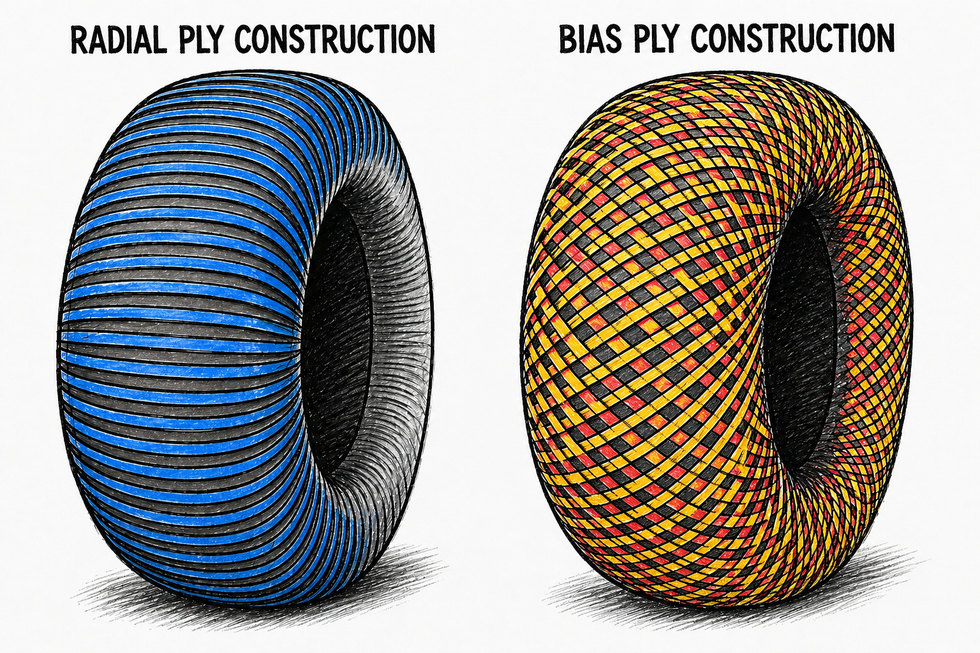
In classic tire engineering, a true radial has carcass cords running 90 degrees to the direction of travel, with a belt under the tread to stabilize the crown. Bicycle tires stayed bias-ply because that construction made more sense for bikes’ lower loads, lower speeds, and lighter weight.
 Matt Phillips
Simplified versions of radial (without the cap belt) and bias ply tire construction.
That history matters because it keeps this whole conversation honest. Bicycle tires did not stay bias-ply because the industry somehow missed radial construction. They stayed there because bias construction was, for a long time, the rational bicycle answer.
Bias-ply tires are older and were used in the original pneumatic bicycle tires. Radial construction is a newer design that has been around for roughly 80 years, giving bicycles plenty of time to adopt it if it was significantly better. However, most did not, as the added belt material, complexity, and weight of a true radial did not provide enough benefit for bikes due to their lower loads, speeds, and high sensitivity to rotating mass.
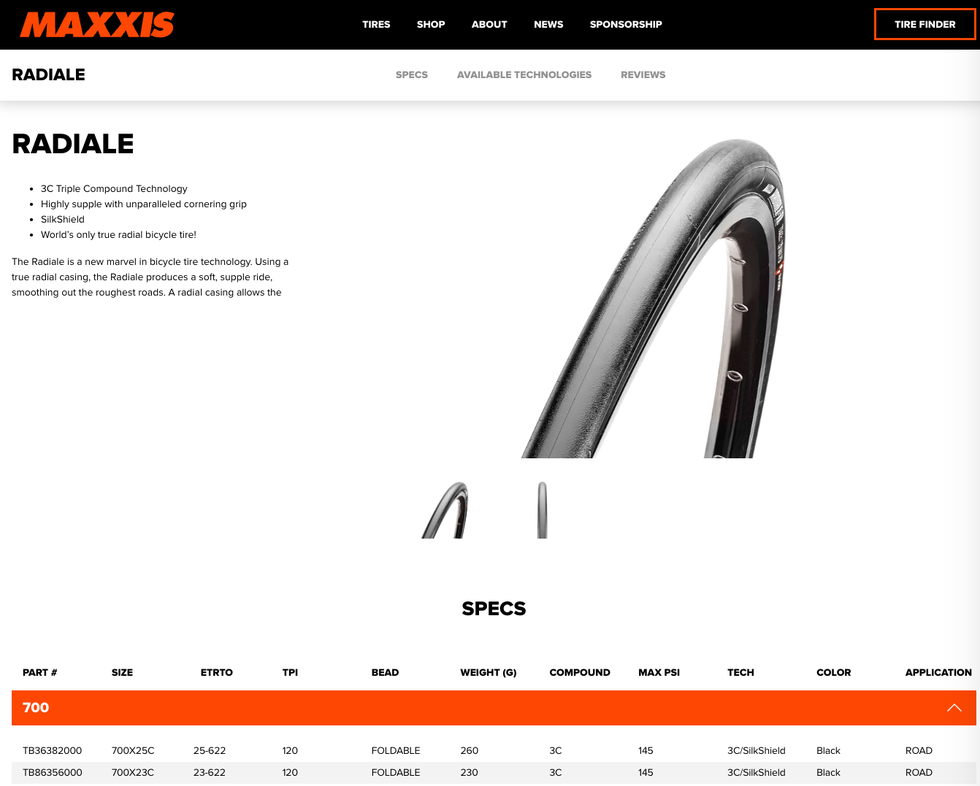
A few brands, Vittoria and Maxxis among them, have tried lightweight, bicycle-specific radial tires over the years. But those products came and went because they did not prove superior overall to well-executed bias-ply tires. As Ken Avery, senior vice president of product development at Vittoria, put it, “In the end, we found other ways to achieve and even surpass the performance these tires provided.”
What is different now is not the arrival of a full radial, but the rise of bicycle-specific hybrid radial constructions that push casing angles more open, then use reinforcement to capture some of the benefits without taking on all the baggage of a true radial.
How Bicycle Tire Brands Are Building Their “Radial” Tires
If you strip away the launch language, Schwalbe, Specialized, e*thirteen, and Vee all seem to be chasing the same basic goal: a casing that deforms more easily under the tread so the tire conforms better to rough ground.
For now, that idea is showing up in one corner of the market: heavier-duty tires for longer-travel trail, enduro, and gravity bikes, where compliance, damping, and terrain conformity are most likely to matter. That makes sense. But it is also clear brands are already thinking beyond that category, weighing whether some version of the same idea could make sense for gravel, and maybe even road.
The challenge is that a more-open, more radial-style casing can also give away support, especially when cornering loads rise. So the construction story is not just about opening ply angles. It is about opening them, then adding reinforcement to keep the tire from getting vague and floppy.
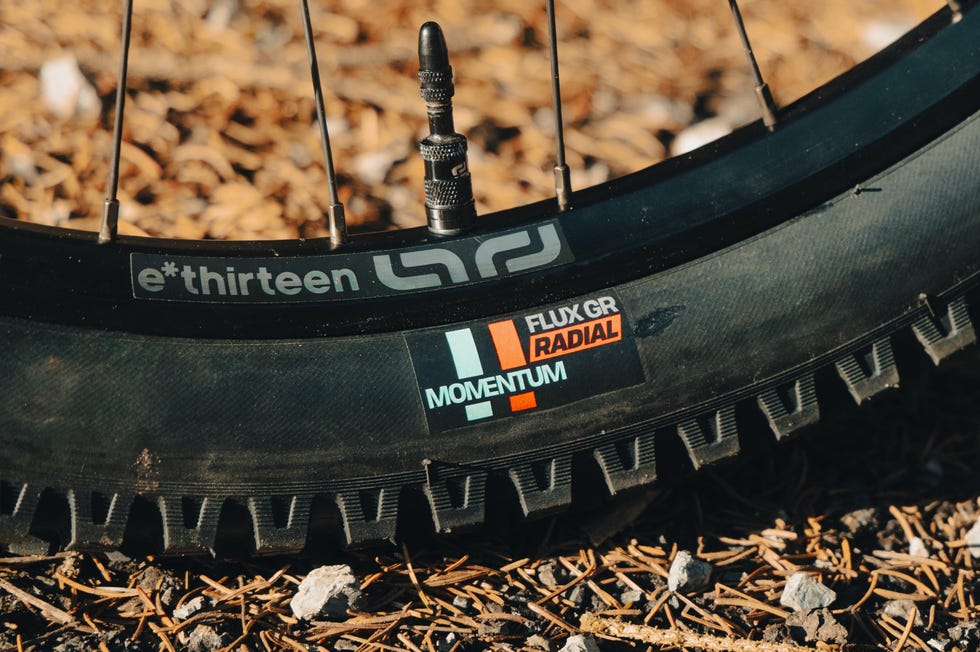
Chris Costello of e*thirteen put that most plainly. Asked whether a bead-to-bead radial-style casing without extra sidewall support would work well, he said it would not. Without reinforcement, “the casing would deform too much under cornering load, knob deflection would increase, and the tire would feel vague and unpredictable.” That is why, he said, e*thirteen pairs its shallower-angle casing with inserts in the casing that “recover the lateral stability a shallower casing would otherwise give up.”
 Specialized
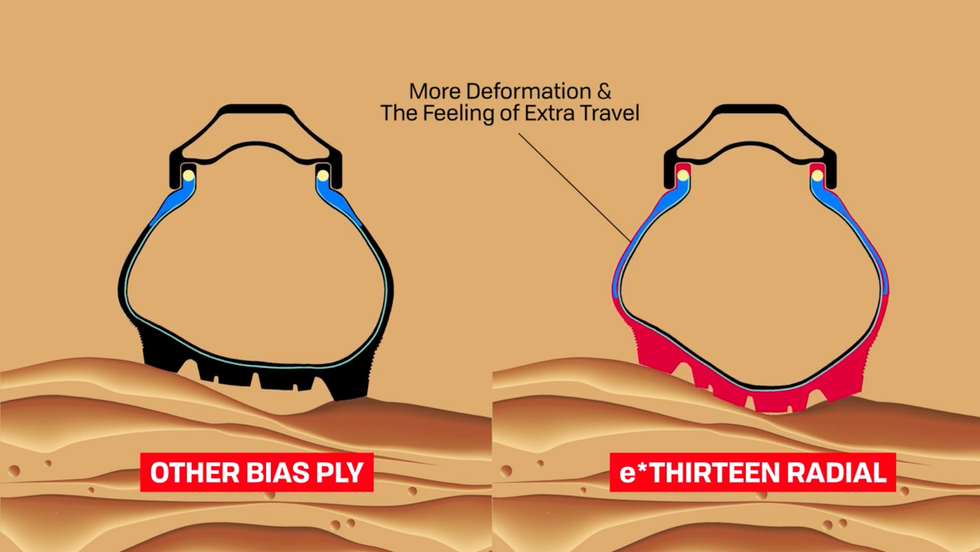
What brands say ‘radial’ construction does: compared with a standard bias-ply casing (left), the more open casing layout (right) is claimed to increase contact patch size and trail conformity under the tread.
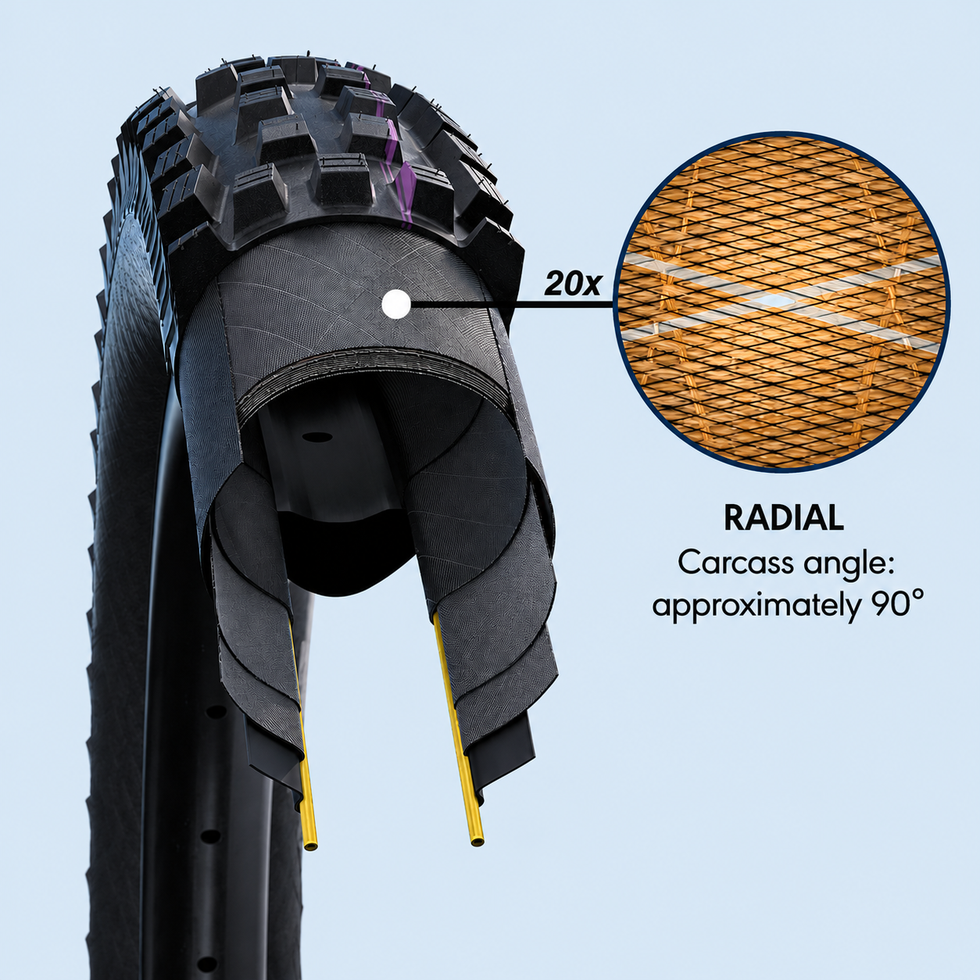
Schwalbe describes the construction a little differently, but the theme is similar. Sean Cochran, the company’s marketing manager, said the real story is not just thread angle relative to the direction of travel, but thread angle relative to each other. “In our radial construction, the crossing angle between threads exceeds 150°,” he said. “This significantly reduces interlacing and creates a fundamentally different deformation behavior.” But Schwalbe also had to control the downside. Cochran said the company ultimately used a fabric-reinforced apex at the bead so the tire could keep lateral stiffness close to a diagonal tire while retaining compliance under the tread.
Specialized is more explicit about this being a tuned bias-ply design. Sam Benedict, the brand’s leader of equipment marketing, said the company’s target was to “maximize grip while maintaining the structural integrity of the tire.” He described the result as a “Sweet Spot Ply” angle: open enough that “the radial stiffness of the tire, measured at the tread contact patch, drops allowing the tire to more easily conform to the ground,” but not so open that the tire loses the support riders need when they are “pushing hard into a berm.”
 e*THIRTEEN
“Radial” construction is claimed to let the center tread conform more closely to the ground for added grip and comfort.
Vee, at least in its public materials, is making the boldest claim of the bunch. Its RAD CORE tech explainer describes a perpendicular-thread construction, and launch coverage elsewhere has characterized it as a true 90-degree radial layout. But because I have not interviewed anyone at Vee, I have less clarity on how the company is managing the drawbacks the other brands were willing to discuss in detail.
The important part for riders is where the likely benefits show up. The more-open or more-radial casing behavior appears to matter most under the crown of the tire, where brands are chasing more vertical compliance, a larger contact patch, more damping, and better terrain conformity. Then they use sidewall or bead reinforcement to keep the tire from folding over when loads move outward in a corner. In other words, the big change seems to be under the tread cap first, not out at the cornering knobs.
e*THIRTEEN
What Counts as “Radial”?
Once you understand how these tires are built, the argument gets simpler. It is not really about whether brands are changing casing behavior. They plainly are. The fight is about whether that change deserves the word “radial.”
Vittoria’s Avery takes the strict-definition view. “Our friends at the brands which currently offer ‘radial’ MTB tires would be the first to tell you that these are bias ply tires by definition,” he wrote. Then he tightened the screws: “Changing the angle from 45-degrees (to something slightly more or less) does not change the fact that the plies still bias one another. These are simple facts.”
Alexander Hänke, Continental’s product manager for bicycle tires, MTB and gravel, lands in basically the same place. He said the current crop are “more accurately described as bias-ply casings with more open ply angles” and “radial-style bias constructions rather than true radial tires.”
 Schwalbe
Schwalbe’s “radial” construction. Bias ply, it says, has approximately a 45-degree carcass angle.
Schwalbe pushes back. Sean Cochran, the company’s marketing manager, told me that while a true radial would theoretically imply a 90-degree angle, “the accepted definition typically includes a range of approximately 75 to 90-degrees. Our tires fall within that range.” In other words, Schwalbe is arguing less about textbook purity than behavior: if the structure is open enough, and behaves differently enough, the term still fits.
Chris Costello of e*thirteen lands in the middle. He said the brand’s early “true radial” language was “imprecise—an artifact of how the message moved from engineering to marketing.” But he also said e*thirteen is using radial in the motorcycle sense, where the term “typically refers to any casing with a ply angle of 65° or greater,” not in the automotive sense of a 90-degree steel-belted radial.
Specialized mostly sidesteps the semantic knife fight and questions whether the automotive definition is even very useful here. Sam Benedict, leader of equipment marketing at Specialized, told me, “Cars don’t lean/roll much when they corner, while bicycles constantly lean well beyond 30 degrees.” Then he cut to the point: “It doesn’t make sense to have a flat tread on a mountain bike… so a ‘true’ radial isn’t necessary.”
Vee, at least in public, leans hardest into the literal version of the claim. Its RAD CORE materials describe a perpendicular-thread, 90-degree radial construction. But because I have not yet interviewed anyone there, I do not have the same level of detail about how the company defines the term internally, or how it thinks about the tradeoffs.
The disagreement breaks down pretty cleanly: Vittoria and Continental are focused on the textbook definition, Schwalbe is focused on how the tire behaves, e*thirteen is leaning on motorcycle terminology, Specialized is focused on ride outcome, and Vee, at least publicly, is making the most literal “radial” claim.
Specialized
Does “Radial” Construction Make Tires Roll Faster? Or Slower?
Then there is rolling resistance, which is where this category gets especially slippery.
Costello said that on rough ground, the more compliant casing conforms to the terrain instead of deflecting off it, “keeping the wheel moving forward instead of bouncing,” so rolling resistance can be meaningfully lower. On smooth surfaces, though, “that compliance becomes a tax.”
Cochran made a similar case from Schwalbe’s side. Continental is much less bullish. Hänke told me that while a more open casing angle can theoretically improve rolling efficiency, “real-world mountain bike applications often see these gains offset by the weight of extra reinforcements and energy loss through deformation.”
Avery added another wrinkle. A true radial bicycle tire, he said, may roll faster over bumps that directly oppose the rolling direction, but on rough surfaces where impacts come from multiple directions, that benefit may shrink.
So the rolling-resistance story depends on where you ride, how you ride, and which engineer you ask.
What This May Mean for Road and Gravel
Disagreement also shows up when you ask whether this construction belongs anywhere else.
Costello told me road use of this construction is “probably limited” because smooth pavement is where radial-style compliance makes its weakest case, and road riders are hypersensitive to weight and rolling resistance. Gravel, he said, is “more interesting,” especially as events get rougher and faster.
Avery pointed in a slightly different direction. In theory, he said, traditional radial construction should work best in an application with “constant and uniform casing deformation, primarily in the direction of rolling.” That sounds more like road than rough trail. But he also made a useful point: bicycle brands have other ways to get more deformation and grip without leaning on radial construction at all.
Gravel seems like the most plausible next stop. Road, at least for now, looks like a weaker case.
Matt Phillips
My Experience Riding Radial Tires
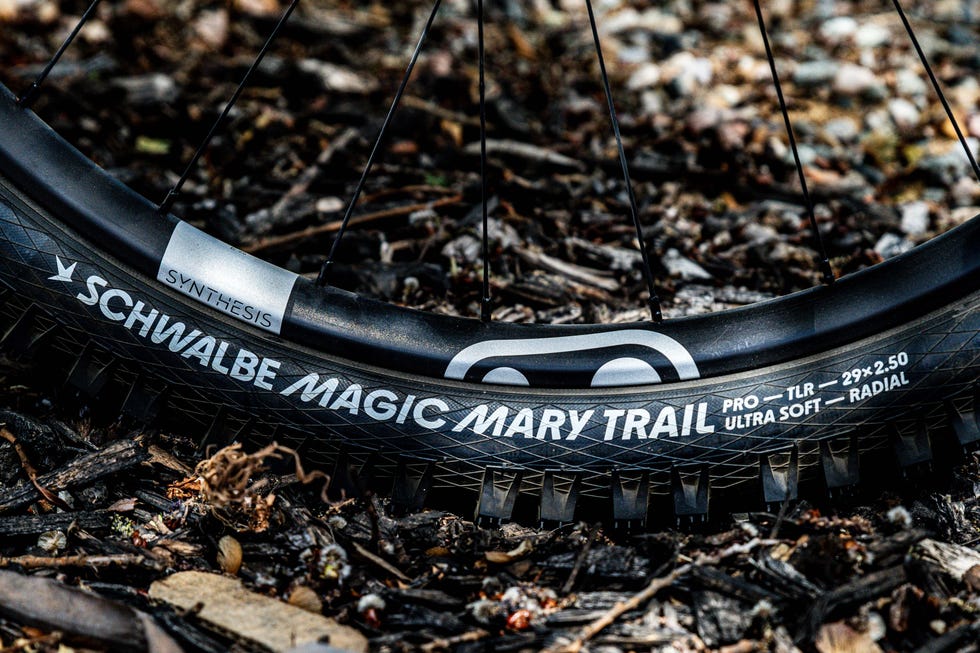
After reading the marketing materials (“30-percent more grip!”) and seeing the early reviews, I was genuinely excited about this new casing technology. I ride around Durango, Colorado, where traction is often a nasty little negotiation with dry dirt, rock, loose rock, slippery rock, and that hateful kitty litter over hardpack. I like slower-speed technical riding as much as faster flow, and I already prefer soft, slow, heavy-ish tires on my trail bike. On paper, these “radial” tires sounded like they were built to flatter my preferences.
So I mounted a set of Schwalbe’s radial tires and went riding, expecting a meaningful jump in grip.
On trail, though? Meh.
What I noticed most was a pleasantly soft, quiet ride. But mostly, it felt a lot like what I already get from my usual trail setup: aggressive soft-compound tires, lightweight inserts, and a bit less pressure.
The traction improvement I care about most is cornering traction, and there I did not notice a gain. What the radial tires did offer, for me, was a simpler and slightly lighter way to get to a similar place. I was getting roughly the same calm, damped feel from the tires alone that I usually get from my normal tires with an insert.
That is not nothing. But it also is not the same as a major performance breakthrough.
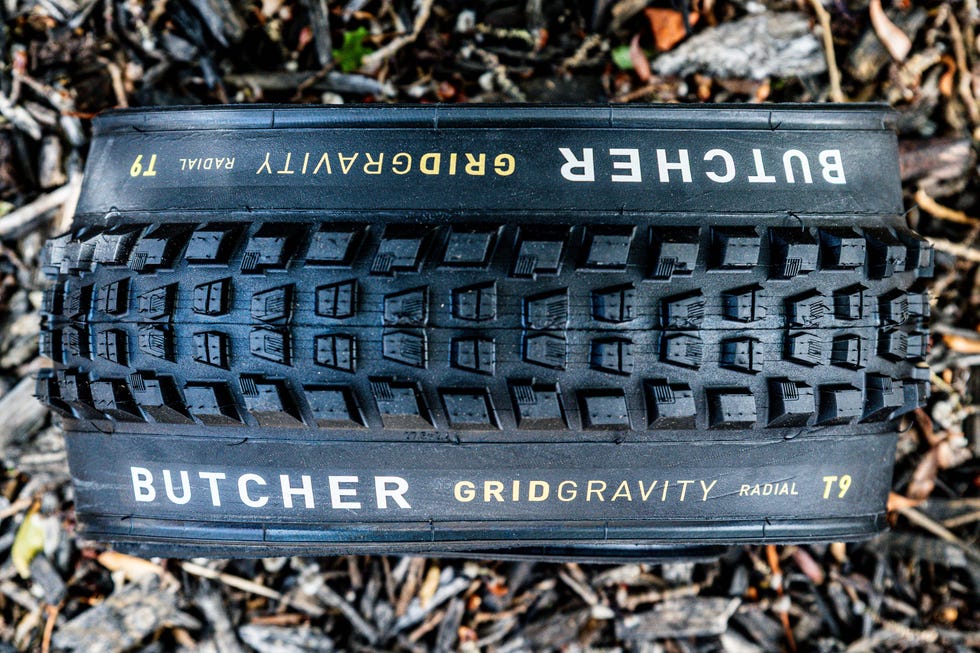
For me, the move felt more lateral than transformational. I did not come away thinking that spending more than $200 on a set of radial tires unlocked some meaningful new level of on-trail performance, certainly not enough to make me ditch the trail tires I already love.
That does not make the category bogus. It just makes the real benefit sound a lot smaller and a lot more specific than the marketing. The most believable gains seem to be in small-bump absorption, braking traction, climbing traction, and overall ride quietness, because the crown of the tire conforms more easily to rough terrain. That is useful. But it is a narrower benefit than “30-percent more grip” makes it sound.
Matt Phillips
Should You Care?
Maybe. But probably not because of the word radial.
If you ride rough, natural, technical terrain and want more damping, more conformity, more braking and climbing bite, and a calmer ride without relying as heavily on inserts or ultra-low pressures, these tires may make a lot of sense. Sam Benedict said Specialized sees this kind of construction as especially useful for natural and technical trail riding, while many bike-park riders may still prefer a more supportive standard casing because “lateral support is more prioritized.”
Who should be skeptical? Riders who prioritize precision, firmer support, smoother-trail speed, or who already have their setup really dialed. Alexander Hänke put the anti-hype version most bluntly: “A common misconception is that ‘radial’ represents a universal quality upgrade; in reality, it is simply a design direction shifting performance toward damping and comfort.”
That is the real takeaway. This is not a story about cycling discovering a new technology. It is a story about brands pushing casing-angle tuning further into the spotlight, finding some real gains, and then wrapping the result in a word with more marketing power than consensus behind it.
The engineering may be real. The marketing is definitely real. Your job, as a rider, is to care less about what they call it and more about whether that particular mix of compliance, support, and tradeoffs is something you actually want under you when the trail turns ugly.
Member Exclusive: Check Out Our Top Cycling Stories


A gear editor for his entire career, Matt’s journey to becoming a leading cycling tech journalist started in 1995, and he’s been at it ever since; likely riding more cycling equipment than anyone on the planet along the way. Previous to his time with Bicycling, Matt worked in bike shops as a service manager, mechanic, and sales person. Based in Durango, Colorado, he enjoys riding and testing any and all kinds of bikes, so you’re just as likely to see him on a road bike dressed in Lycra at a Tuesday night worlds ride as you are to find him dressed in a full face helmet and pads riding a bike park on an enduro bike. He doesn’t race often, but he’s game for anything; having entered road races, criteriums, trials competitions, dual slalom, downhill races, enduros, stage races, short track, time trials, and gran fondos. Next up on his to-do list: a multi day bikepacking trip, and an e-bike race.