
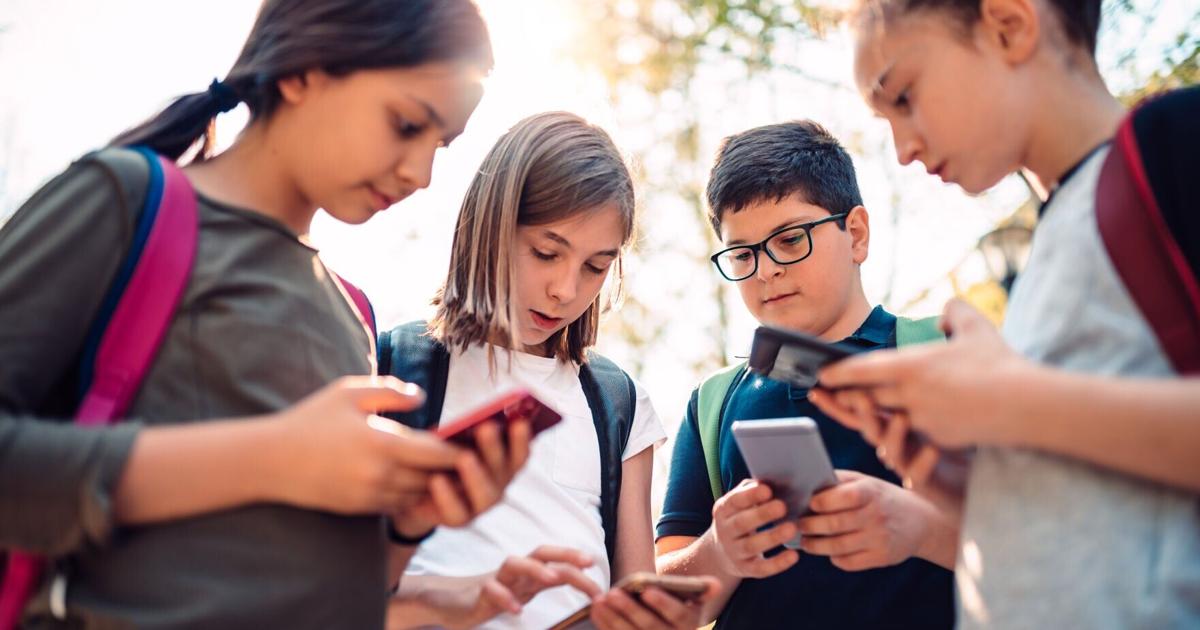


A group of kids playing on their phones after school.
Klein Meida stock photo by Zivica Kerkez
Wab Kinew wants Manitobans to believe children under 16 are too vulnerable and immature to handle social media. At the same time, his government supports policies allowing children much younger than that to self-identify their gender at school without parental involvement. Those two positions cannot logically coexist.
If a child is not mature enough to manage Instagram or TikTok, how can that same child be considered mature enough to make deeply personal identity decisions that schools are expected to affirm immediately, even if parents disagree?
That contradiction matters because this is not an abstract political debate. It affects families sitting around kitchen tables in Winnipeg every day. Parents are already struggling with rising grocery bills, mortgage payments, rent increases, and crime in their neighbourhoods. They expect the government to focus on practical priorities and to apply common sense consistently. Instead, Manitobans are getting political theatre designed for national headlines.
Kinew’s proposed social media restrictions sound reasonable on the surface. Many parents are worried about what endless scrolling, online bullying, and addictive algorithms are doing to kids. Australia introduced similar restrictions for users under 16, and supporters pointed to it as a model.
But the results tell a different story.
Reports from Australia show young people continued accessing social media platforms despite the ban. Millions of underage accounts were reportedly removed or restricted, yet surveys showed many children simply found ways around the rules. Existing accounts stayed active, older friends helped create new ones, and basic workarounds made enforcement difficult. Even before the ban, most Australian children under 13 were already using social media despite existing platform age limits.
The lesson is straightforward. Government bans are rarely as simple or effective as politicians claim during press conferences.
There is also a serious privacy concern. Enforcing these restrictions requires age verification systems, facial scans, or identification checks. That creates a new layer of surveillance for ordinary citizens and raises legitimate questions about where government control over online access ends.
Yet while Kinew argues government must step in because children are vulnerable online, Manitoba’s school policies take the opposite approach on gender identity.
Current provincial guidelines state that students of any age can self-identify their gender at school, and schools are expected to use preferred names and pronouns without requiring evidence or parental approval. In many cases, schools are instructed not to inform parents unless the student consents.
That means a Grade 4 student can ask to socially transition at school, and parents may be deliberately excluded from the conversation.
For most Manitobans, that makes no sense.
Parents are responsible for feeding, clothing, protecting, and raising their children. They know their child’s mental health history, developmental challenges, family circumstances, and emotional struggles better than any government policy manual. Removing parents from major decisions involving identity is not progressive. It is reckless.
Supporters of these policies argue that children must be protected from unsupportive households. Serious situations do exist, and schools should always protect children from abuse or harm. But those cases should not become the justification for treating all parents as obstacles rather than partners.
There is also growing international caution around youth gender policies. The Cass Review in the United Kingdom concluded evidence supporting medical transition pathways for minors remains weak and incomplete. Countries once viewed as global leaders in gender affirmation, including Sweden and Finland, have moved toward more restrained approaches focused on psychological assessment and parental involvement.
That shift happened because governments recognized something obvious. Children and teenagers are highly influenced by peer pressure, social trends, emotional development, and online culture. The same argument used to justify social media restrictions applies directly here.
If the government believes young people are vulnerable to harmful online influence, why would it simultaneously insist children are fully capable of independently navigating complex identity questions with long-term consequences?
Manitobans deserve consistency and honesty from their government.
Instead, this debate increasingly looks like political branding. Kinew received national attention for discussing social media bans while avoiding harder conversations closer to home. Manitoba families are still paying some of the highest fuel costs in Western Canada. Grocery prices remain high. Violent crime continues to concern residents across Winnipeg. Healthcare wait times remain a frustration for countless households.
Those are the pressures dominating family budgets and dinner table conversations.
Government should focus on making life more affordable and communities safer instead of chasing national media attention with policies filled with contradictions. Parents do not need politicians replacing them. They need leaders willing to respect families, apply common sense consistently, and focus on policies that improve everyday life.
Right now, Manitobans are getting mixed messages instead of clear leadership.