
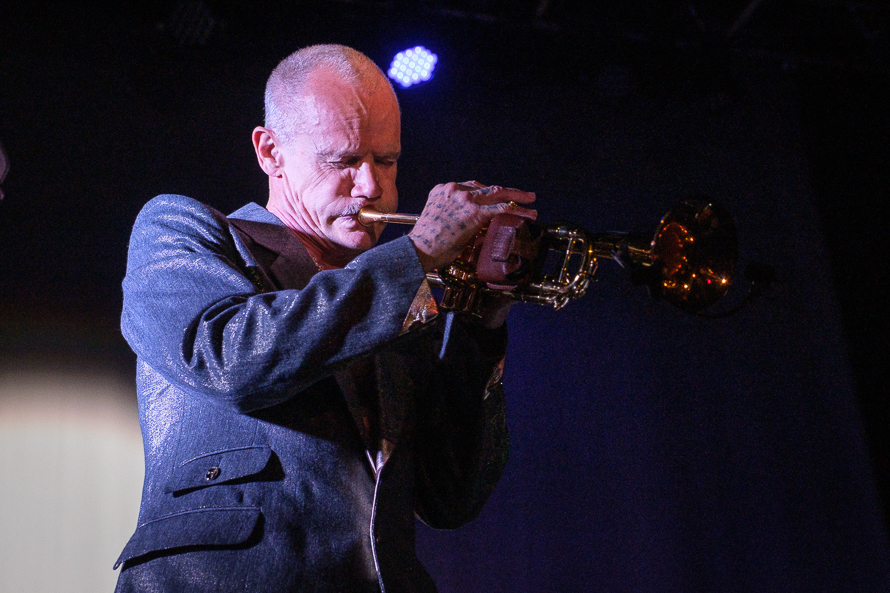
The last time Flea played Toronto, he headlined two nights at RBC Amphitheatre (capacity 16,000 per night). The time before that, it was Rogers Centre (concert capacity 55,000). But for his first-ever solo show in the city, the bassist sold out the Opera House, with a capacity of under a thousand — a number seemingly reflecting how many Red Hot Chili Peppers fans are devoted enough to check out one of the members’ jazz side project.
Then again, maybe some of the folks who showed up were simply there for the jazz. That was certainly the case for Exclaim!’s publisher Ian Danzig, whom I brought along as my plus-one, and who was much more excited to see Flea’s crack band than the leader himself.
For those in the know, Flea’s Honora band is a who’s who of elite modern jazz players — including bassist Anna Butterss (of SML), who proved up to the task of hanging with rock music’s most famous bassist of his generation. In fact, as Flea pointed out when he introduced the band close to the end of the set, he once took bass lessons from Butterss — something that’s very sweet to imagine, since Butterss is only 35, and was born the same year Blood Sugar Sex Magik came out.
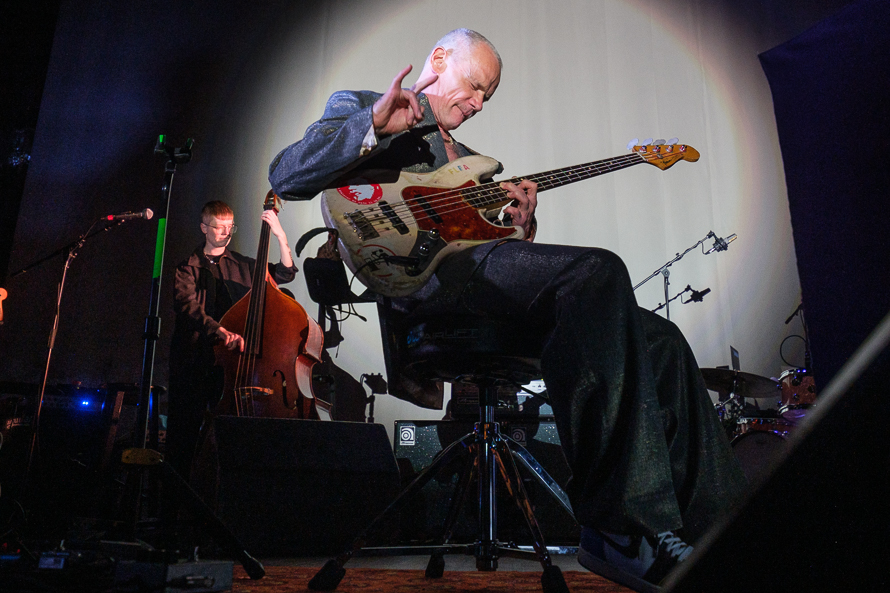
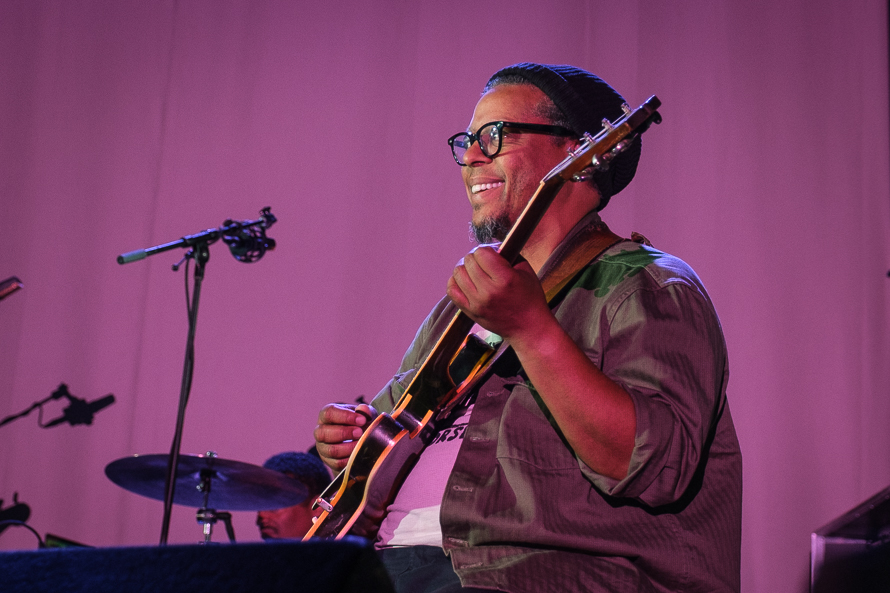
The fact the 63-year-old Flea took bass lessons from someone barely half his age reflects a deferential perspective that he made explicit several times, taking the mic to call himself “humble” to appear alongside Butterss (electric and upright bass), SML’s Josh Johnson (keyboards and saxophone), KUDU’s Deantoni Parks and Tortoise’s Jeff Parker (guitar).
Flea has been a world-famous rock star for decades, but he considers himself a student of jazz, and this year’s Honora is his first-ever solo LP. Sometimes atmospheric and haunting, someone fast and fidgety, evoking Miles Davis one moment and Funkadelic the next, covering country classic “Wichita Lineman” and then Frank Ocean the very next song, it’s the work of veteran rebranding himself as a rookie, still figuring out exactly what identity he wants to adopt.
But if the album has multiple personalities, the live show emphasized the cohesive vision behind it all. Like true jazz cats, the band took the recorded versions as starting points, going on jammy detours over the course of an 11-song setlist that lasted nearly two hours, including nearly all of Honora plus a couple of other tunes.
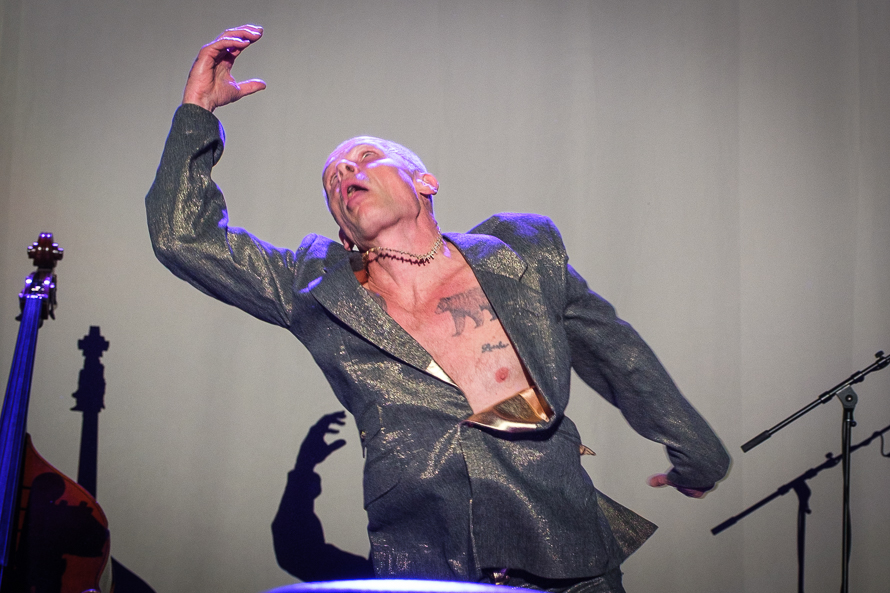
Take “Traffic Lights” — on record a slinky, slithering vehicle for Thom Yorke’s cryptic incantations, it was performed here as a feverish instrumental, Flea setting aside his trumpet to dance manically in his oversized sliver suit (which conspicuously lacked a shirt).
Without Nick Cave’s guest vocal, “Wichita Lineman” was also done as an instrumental, B-roll footage of Flea wandering around a field (and doing a headstand) setting a pastoral mood for the vibey mood piece.
“A Plea” was particularly remarkable, a two-bass groove from Flea and Butterss played with frenzied abandon, providing a canvas for Johnson’s dense, melodically dizzying sax solo. After several minutes of this, I was sure Flea was going to omit the spoken monologue of the album version — but he eventually stripped off his jacket to perform it shirtless. The intensity of the live rendition far eclipsed the album take, Flea’s urgings for “peace and love” conveying anger and desperation rather than hippy-dippy simplicity.
And speaking of love, Flea also told a story about meeting his first wife, Loesha, 39 years earlier at Chili Peppers show at Lee’s Palace (which he referred to as a “Chinese restaurant”). The marriage didn’t work out, but they’re still friends, and Flea noted that their daughter Clara is Canadian.
Compared with Parker’s sax wizardly, Flea’s trumpet playing was simpler but just as affecting, a vehicle for plaintive lead melodies, and he soloed amidst a dense cloud of echo on a cover of Funkadelic’s “Maggot Brain” that closed the main part of the set.
It was here, nearly at the end of the show, when a glimpse of the familiar rocker finally emerged: for the finale, Flea switched over to his bass, cranking up the fuzz for a Hendrix-esque solo, Parks smashing the drums and joining in a climactic crescendo.
Whether conjuring rock gods as he’s done so many times before or kneeling at the alter of jazz, it was evidence of the passionate intensity that continues to guide Flea after so many decades, from headlining a stadium with his rock band to indulging his first love as a humble jazz man.
After that, the show ended with an encore in which Flea sang a simple lullaby about death, chocking up with tears as he told the audience that someone in his life was close to dying. Musically, this sweet yet morbid nursery rhyme didn’t fit at all with the rest of the set, and yet it was entirely in the spirit of the show: raw, curious, and open to the endless possibilities of the unknown.