
Warming oceans are eating away at Antarctic ice shelves from below at a much faster rate than current models predict. A new study has identified the mechanism behind it.
Grooves on the underside of the ice are trapping warm water and concentrating its destructive effect in exactly the places where it does the most damage. The implications for sea level rise are significant.

The study comes from the iC3 Polar Research Hub in Tromsø, Norway. The research was led by Tore Hattermann and Qin Zhou.
Hattermann has spent hundreds of days camped out on Antarctic ice shelves, gaining deep and intimate knowledge of their mechanics.
Antarctic ice shelf importance
Ice shelves are the floating extensions of massive glaciers – huge slabs of ice that reach out over the ocean.
Their job, in effect, is to act as a brake. They slow the flow of the glaciers behind them, holding back gigatons of ice that would otherwise slide into the sea.
When ice shelves weaken, that brake fails. The glaciers behind them accelerate, ice cascades into the ocean, and sea levels rise faster than projections based on stable shelves would suggest.
This dynamic has already been observed in parts of Antarctica. The IPCC has flagged polar ice shelf instability as one of the most serious and least understood risk factors in sea level science.
Grooves under the ice
What the Norwegian team found is that the underside of ice shelves isn’t smooth. It’s channelled, with long groove-like structures running along the base of the ice.
Those grooves, it turns out, behave in a way that nobody had fully accounted for. When relatively warm ocean water flows beneath an ice shelf, the channels can trap it.
Instead of passing through and moving on, the water gets caught in small circulation cells within the grooves, sitting against the ice and transferring its heat continuously.
In those channels, melt rates can increase by roughly an order of magnitude compared to smoother sections nearby.
The geometry of the ice shelf base is, in effect, deciding where the ocean’s heat goes, and is concentrating it precisely where it causes the most damage.
“We found that the shape of the ice shelf underside is not just a passive feature. It can actively trap ocean heat in exactly the places where extra melting matters most,” Hattermann said.
Even cold ice shelves aren’t safe
The study focused on the Fimbulisen Ice Shelf in East Antarctica, a region that is generally colder than the rest of the continent and has therefore been considered less immediately at risk. That assumption may need revising.
“We observed beneath the Fimbulisen Ice Shelf that even small amounts of warmer water can substantially increase melting within the channels,” Hattermann said.
“As a result, the channels can grow and, in the worst case, weaken the stability of the entire ice shelf.”
“What is striking is that even modest inflows of warmer deep water can have a large effect when the ice shelf base is channelled,” Zhou added.
“That means some ice shelves that scientists usually think of as cold may be more fragile than expected.”
In other words, the parts of Antarctica that researchers have been least worried about might deserve more attention than they’ve been getting.
How the study was conducted
The team combined a detailed map of the Fimbulisen ice shelf’s underside with a high-resolution model of the ocean cavity beneath it.
They compared scenarios with a smoother ice base against a more realistic channelled one, under both cooler and slightly warmer ocean conditions, allowing them to isolate the specific effect of the channels on water flow, mixing, and melting.
The work also drew on long-term field observations from the region, some of them collected by Hattermann himself during extended stays on the ice.
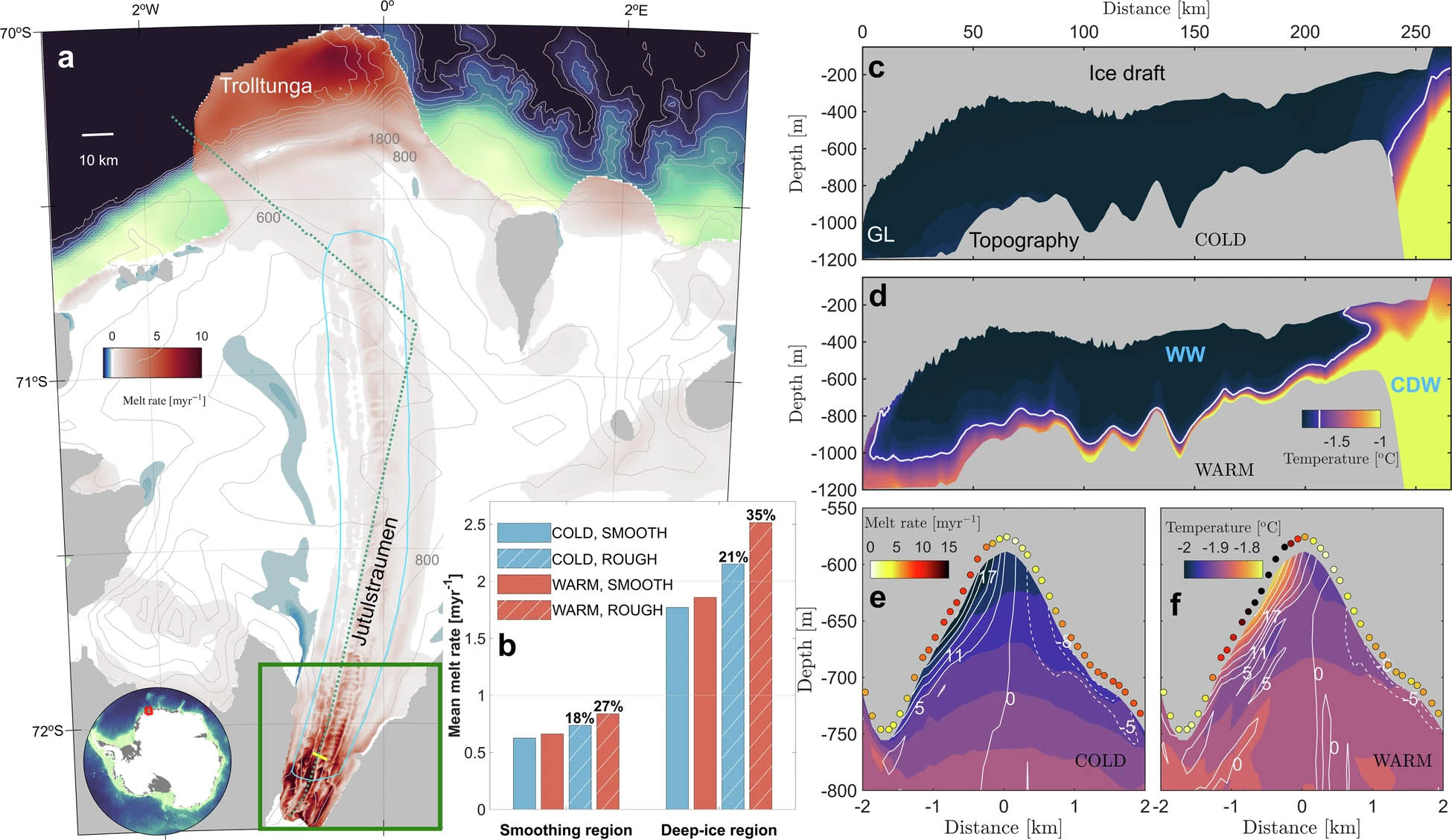 Overview of Antarctica’s Fimbulisen Ice Shelf and main findings about basal melt rate and global sea level rise. Map of the Fimbulisen Ice Shelf showing simulated basal melt rates for the present Fimbulisen and bottom bathymetry (thin gray lines). Credit: Nature Communications. Click image to enlarge.Why models are getting it wrong
The bigger concern here isn’t just that the ice is melting faster than expected. It’s that the models scientists and policymakers rely on for sea level projections aren’t capturing this mechanism at all.
“Current climate models do not capture this effect,” Hattermann warned. “This means that they risk underestimating the sensitivity of the ‘cold’ ice shelves along East Antarctica’s coastline to small changes in warming in coastal waters.”
That matters enormously. Coastal planning, flood defences, infrastructure decisions – all of it depends on credible projections of how fast sea levels will rise and by how much.
If the models are systematically underestimating melt rates in East Antarctica because they’re missing small-scale features beneath the ice, the projections feeding into those decisions are too optimistic.
Finally, there are also ecological consequences. Changes in how much meltwater reaches the ocean affect circulation patterns and marine ecosystems around Antarctica in ways that ripple outward.
The study is published in the journal Nature Communications.
—–
Like what you read? Subscribe to our newsletter for engaging articles, exclusive content, and the latest updates.
Check us out on EarthSnap, a free app brought to you by Eric Ralls and Earth.com.
—–