
“We’re behind in building new ferries,” said one government official, in a story about growing delays on B.C. Ferries sailings, and frustrations on whether there was an adequate plan to build for the future.
“They don’t even have the backups, if one were to break down,” said an expert at the University of British Columbia.
“B.C. Ferries is at a crossroads. The decisions made now are crucial, because once the [organization] sets on a new course, there’ll be no turning back,” said the CBC reporter.
The year was 1990. But all stories about B.C. Ferries eventually repeat themselves.
“The challenge we have right now is that we’ve got such a backlog of investments that is needed,” said B.C. Ferries CEO Nicolas Jimenez, in a wide-ranging interview with CBC News about the province’s marine transportation system, as the corporation gears up for its first long weekend since the one at Easter was dogged by major cancellations and criticisms.
WATCH | A deep dive into how B.C. Ferries evolved and now faces an infrastructure deficit:
How decisions made about B.C. Ferries 30 years ago led to problems today
B.C. Ferries is gearing up for another long weekend, hoping to avoid the delays and cancellations that plagued them over the Easter weekend. But is this a common story? The CBC’s Justin McElroy takes a deep-dive look at the history and evolution of the marine passenger system that British Columbians both love and complain about.
“The system runs better than people think, and it is also true that when it lets people down it’s really frustrating,” Jimenez said.
Transportation Minister Mike Farnworth echoed the CEO’s vote of confidence.
“Ninety-nine per cent of the time, B.C. Ferries runs on time, on schedule,” Farnworth said. “But I totally get when you’re waiting to go somewhere and something breaks down, you’re going to be frustrated.”
But why is it so frustrating when the ferries let people down? And is what both of them said about the system true?
To understand that, you almost have to go back to the beginning of B.C. Ferries, 66 years ago.
Ships built, traffic rises
“In 1960, thousands of tourists used a speedy sea link between the southern part of Vancouver Island and the British Columbia mainland,” intoned the narrator in a government documentary, Highway on the Sea, made to mark the completion of the first boats for the new Crown corporation.
“Prior to this, the area was served, it is true by sea transport, [but the government] found the systems inadequate to meet the increasing demands of commerce and tourist traffic,” the narrator continued.
Over the next 21 years, B.C. Ferries built a total of 12 boats that could hold more than 1,000 passengers, meeting those increasing demands. Yearly passengers went from two million in B.C Ferries’ first year of operation to 20 million by the early 1990s, a football stadium’s worth of people every day. Fares rose steadily — from $7 in 1960 for a car and driver on a Tsawwassen-Swartz Bay sailing to $23 in 1990 — but less than the rate of inflation.
But by that 1990 CBC News story, there hadn’t been a new large vessel completed in nine years, and there started to be strains in the system.
“We’re scrambling,” admitted then transportation minister and future premier Rita Johnston.
In the years following, B.C. Ferries built two Spirit Class vessels, its first big boats in more than a decade — but also invested in the infamous FastCat catamarans that were immediate white elephants, part of the reason the B.C. Liberal government created a new hands-off governing structure for the organization in 2002.
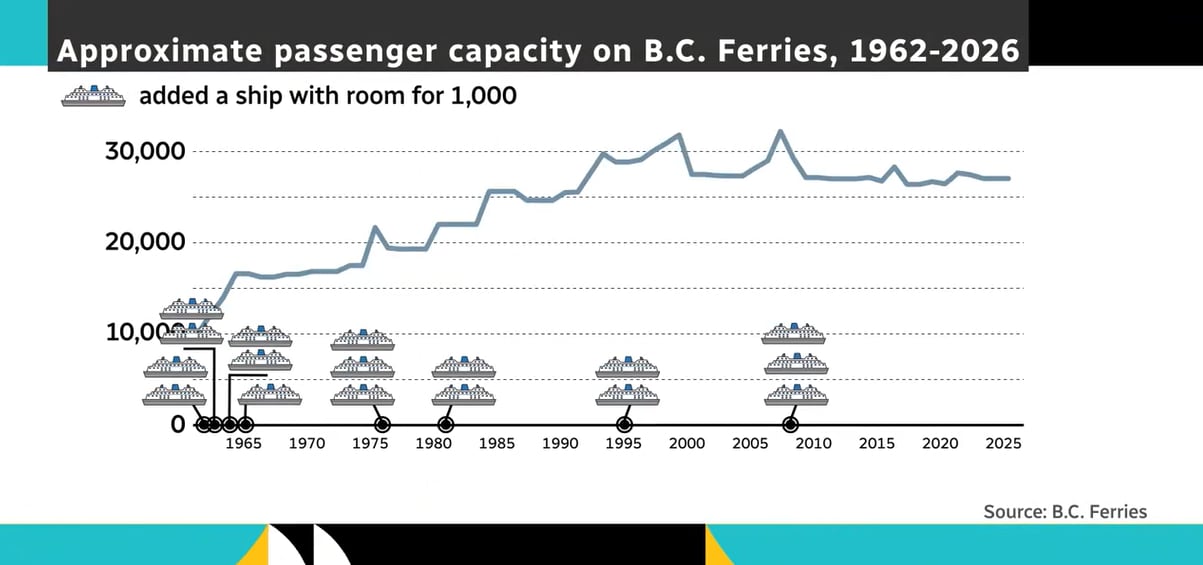 After building 12 major vessels in its first 21 years of operation, B.C. Ferries has only managed to build five major vessels that managed to consistently work in the 45 years since — resulting in stagnating capacity as older ships have retired. (News Graphics)
Since that tumultuous decade, only two new large vessels have been built in the last 32 years. Ridership has mostly stagnated.
It’s led to the current situation, where B.C. Ferries is still reliant on vessels that are more than 50 years old to help keep things afloat in the summer time, on routes that require hourly sailings to keep up with demand.
And with an aging fleet, the number of cancellations and late ferries have doubled in the last decades, with vessels more than 10 minutes late more than 15 per cent of the time since 2023, contrary to Farnworth’s claims.
Today, a new round of investment is under way, with four large vessels on their way and four smaller Island Class vessels scheduled to enter service by early 2027
But Jimenez is sympathetic to the argument that the organization failed to keep up with the times and worries that these additions could be the same stopgap measures that the ferry system has added over the past three decades.
“I think the expectations have always been high. I think what’s different today is the system has more underlying pressures and underlying weaknesses than may have been true 20, 30, 40 years ago,” he said.
“What we have to do now is not necessarily bemoan what came before us in terms of decisions made or not made. We have to lean into the investments required now.”
Will that happen though?
Who does the buck stop with?
Bowen Island Mayor Andrew Leonard argues the weakness of B.C. Ferries, in part, is its four-headed governance structure: B.C. Ferries may operate the system, but the B.C. Ferry Authority oversees the strategic direction, the B.C. Ferry Commission approves fare increases and capital expenditures, and the provincial government has the ultimate power of the purse.
“There’s a real dilution, I think, of responsibility where no one can point to a single entity and say the buck stops there,” he said.
Jimenez admits that the governance setup makes it hard to say where the buck stops.
“All I can do is put forward the case that says the system desperately needs investment. It’s the commissioner with a legislative mandate that says, ‘Well, the system can’t afford that.’ And so that’s when you get stuck a little bit … there’s tension inside [various] propositions. And that’s where the renewal and the reinvestment gets complicated,” he said.
When asked what the biggest thing he’s learned in his three years as CEO, Jimenez’s answer — after first highlighting the dedication of staff — is telling.
“The other thing that is really clear to me is the structural problems inside the ferry system,” he said.
“It’s unambiguous. There are real challenges inside the ferry system and we need people to understand that and connect to it. It’s one thing to complain about wanting to pay less for more. It’s another thing to understand what the system looks like, how it’s being funded, and how much it costs to deliver the service that we have.”
Whether Jimenez will get his wish is unclear. When asked if reforms and additional funding would happen, Farnworth was circumspect.
“Well, the provincial government has already invested significantly in B.C. Ferries,” he said.
“You can always change governance, but at the end of the day, what people care about is the ferry system: Is it reliable? Is it dependable? Is it getting me where I want to go? And I think that’s what matters to people,” Farnworth said.
But what matters to Jimenez is ensuring that the same mistakes of the past aren’t repeated again.
“We’ve got a regulatory filing that has to go before our regulator in the fall. That’s going to set out what the system is going to look like [until 2032],” he said.
“And in that conversation there’s going to be some very real choices that I think that this province has to make in terms of how much service do we want, how much reinvestment do we want, and how much are we willing to pay for that.”