
The Laurentian Elites can’t help themselves. Their condescension for Western Canada always finds a gap in the floodgates of the Rideau Canal. The May 4, 2026, announcement to shield the heavily tariffed major manufacturing industries is just another example. They left forestry off the list.
When questioned, cabinet ministers had a simple answer: softwood lumber tariffs are different.
Softwood lumber tariffs are not the only resource industry grievance have compounded over decades, and the Department of Fisheries and Ocean’s licensing program has hollowed out British Columbia’s commercial fishery. Today, Ottawa’s newest target has a resource newest target is salmon farming.
Commercial fishery licensing
Commercial fisheries licensing by the Government of Canada has expanded since the late 1960s, when “open access fisheries” were ended. It started with efforts to reduce overfishing, and by the 1980s, the goal of industry efficiency was added.
Over the years, the United Fishermen and Allied Workers’ Union, now known as UFAWU-Unifor, along with the Native Brotherhood of British Columbia, sent many delegations to Ottawa to fight policies they saw as harmful to fishers and fishing communities.
The Survival Coalition
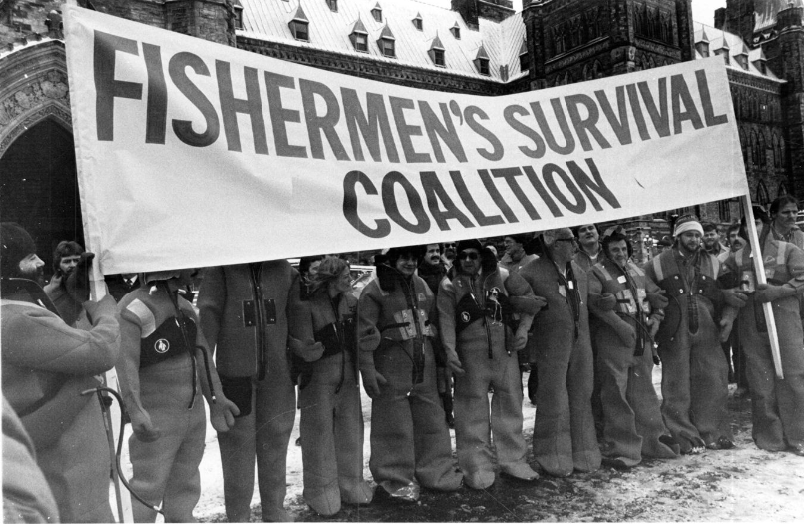
The Survival Coalition’s 1984 delegation to Ottawa was one of the largest of its kind. Well over 75 fishermen, shoreworkers, municipal politicians, First Nations leaders and coastal business owners spent a week in Ottawa, with a single goal — to sit with every MP and Senator in town that week. They did.
The delegation’s goal was to stop the DFO’s push to create additional licenses and permits that were transferable, without owner-operator provisions, in the West Coast fisheries. In simple terms, the path DFO was on would have rewarded holders of paper assets over the people who actually caught the fish — the vessel owners and fishermen whose labour gave those licenses any value at all.
Species, area and quota licenses could be accumulated through purchase or lease by any individual or corporation, without any attachment to the fishing industry. All licenses but the vessel license could be separated from a vessel and leased annually or sold to whoever was willing to pay.
It was hard for the Survival Coalition to convince many Liberal MPs from Central Canada to even take a meeting. That changed when Opposition Leader Brian Mulroney arranged for the entire Conservative Caucus to meet jointly with the West Coast delegation.
To be fair to the Liberals, the Conservatives were elected a few months later and carried the same policies through.
A modern day feudal system
The outcome was obvious. The fleet, crews, processing plants and support businesses began a steady migration to southern urban areas that continued for 30 years, gutting coastal communities.
A practical owner-operator policy designed for BC’s coast would have protected fishing communities just as it did on the East Coast — and demonstrated that federal policy meant the same thing from one ocean to the other.
Decades later, the consequences of those licensing decisions are still being felt. A 2020 investigative report in Victoria’s YAM Magazine captured exactly where the current licensing policy landed BC fishermen — describing the situation as a modern-day feudal system.
The East Coast contrast
The DFO implemented many of the same policies on the East Coast, except one. East Coast fishermen and communities have had the protection of owner-operator regulations since the 1970s — the single provision that changes everything.
The East Coast licensing policy has its own problems, but they tend toward industry concentration rather than the community destruction seen on the BC coast.
The salmon farming phase out
Ottawa’s policy on salmon farming tells an even starker story.
DFO’s core salmon‑farming policy in British Columbia is a managed reduction of ocean‑based production, leading to an outright ban of traditional ocean-net pens in 2029.
The public-facing communication strategy is that there is a transition to alternative salmon farming techniques underway. Never mind that none of the alternatives promoted for decades have proven to be economic or scalable.
On key migration corridors, licenses are not being renewed, nor are they allowed to be transferred to suitable locations, unlike in other jurisdictions. With the ban approaching, companies are not investing in change as they are in those other jurisdictions.
If carried out, the ban will deal the same blow to coastal communities — municipalities and First Nations alike — that the licensing decisions of the 1980s did.
The Social Credit Government in 1984 did not support the owner-operator provision, which the UFAWU, Native Brotherhood and Independent fishers were fighting for. Just as the current NDP government is not supporting the workers and First Nations fighting to improve and save salmon farming.
The lesson of ignoring B.C.
Even a grassroots effort as large and determined as the Survival Coalition couldn’t move the needle, despite being the buzz of Parliament Hill for a week. Thursday night, most MPs returned to their ridings, and that was it. The province hid behind the shield of federal jurisdiction, essentially leaving the coalition on its own.
WAC Bennett showed there was another way.
No one can seriously deny the role of WAC Bennett’s government in creating the British Columbia of today. He understood that Ottawa’s attention had returned to Central Canada — and once in power, he didn’t wait.
He nationalized BC Electric. He inserted himself in the Columbia River Treaty negotiations and spoke directly with the Americans. He built railways into the interior and north against the wishes of the national railroads. He built massive hydroelectric dams. Ottawa was opposed on some fronts, annoyed on others. Much like Alberta today.
He didn’t passively accept Ottawa’s policies because of jurisdiction — and Ottawa has never hesitated to take action against policies it disapproves of, taken by provinces.
A polite theory of confederation is not enough
Premier Eby’s frustration is understandable — softwood lumber was excluded from the latest round of relief for manufacturers facing high tariffs.
It is time to repurpose the WAC Bennett strategy for today’s political environment. Soft diplomacy was never enough for BC. In a world where the economic ground is shifting under everyone’s feet, where governments and families alike are scrambling to hold what they have, polite patience is a luxury BC cannot afford.
British Columbia has already identified the goals. The Look West document sets two to fifteen-year targets for the province across resources, energy, business and manufacturing. It is also a call to the rest of Canada — look west, through our maritime ports and airports, to Asia, to the fastest-growing markets in the world. That is what nation-building looks like.
Experience shows us — it is hard to get Ottawa’s attention, and trading one industry off on another doesn’t help.
If we are to be front of mind in Ottawa, we will have to be proud and put ourselves there.
Jim Rushton is a 46-year veteran of BC’s resource and transportation sectors, with experience in union representation, economic development, and terminal management. Reach him at [email protected].
Resource Works News