
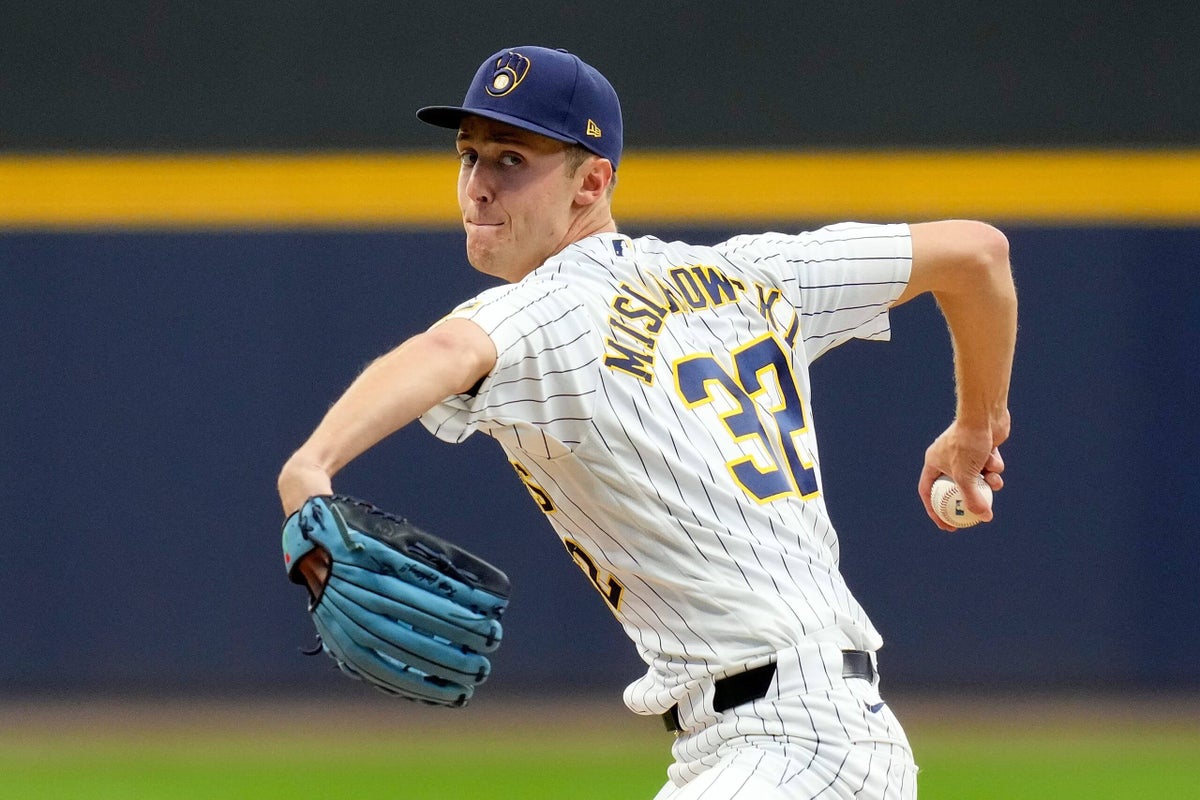
Jacob Misiorowski is a mild-mannered hurler of ferocious force, a gangly stick of dynamite who is exploding past previous notions of what is possible for starting pitchers. Even in an age where 100 mph fastballs are norms rather than outliers, he is doing things baseball has never seen before.
In his most recent outing, Misiorowski threw 10 pitches at 103 mph or greater. On three occasions his fastball clocked at 103.6 mph, the highest velocity any starter has reached in the Statcast era. New T-shirts just dropped reading, “Miz Limit: 104.”
Perhaps the most befuddling thing about this trivia, though, is the fact that its originator was not always some otherworldly prodigy. He was never a dynamo with an action-figure build. He did not hail from a glitzy SEC program and was not drafted out of high school.
This long-armed Milwaukee Brewer, who starts Wednesday against the San Diego Padres, was long hailed as an intriguing player — but he was never considered the best pitching prospect in the sport.
Only four years ago, Misiorowski was grinding with his brethren at Crowder College in Neosho, Mo., a town with a population of 12,590 on the western edge of the Ozarks.
The junior college baseball experience tends to be one of grit and misadventure, a long way from the bright lights of the show.
“Those 10-plus hour bus rides, they’re tough,” Misiorowski said. “It was the grind I needed.”
One morning this season, the man they call “The Miz” summed up his JUCO experience with the perfect whimsical anecdote: a winding story about the time a snow drift blocked his door. He and a couple of roommates escaped their apartment through a window, racing across campus in the dark and barely making a grueling 6 a.m. workout. They later returned and clawed the snow away from the door, only to realize they all left their keys inside.
“Our dumb—es forgot,” Misiorowski said, “that we broke open a window.”
Eventually, they all crawled back into the apartment. They slammed the window shut and laughed so hard they couldn’t breathe.
It was another day at Crowder. This unpretentious place happens to be where baseball’s most menacing flamethrower started his ascent.
Misiorowski went to Grain Valley High School in Missouri, 23 miles east of downtown Kansas City. The first time Crowder coach Travis Lallemand saw Misiorowski play was in a tournament way over the state line in Atoka, Okla. He was a junior at the time and still uncommitted. His fastball was touching the 90s, and though the stuff was raw, it was hard to ignore.
“Sprayed the fastball around a little bit,” Lallemand said, “but the velo was there.”
Misiorowski eventually committed to Oklahoma State, a Big 12 school with a shining new stadium. But his senior year of high school was 2020. When COVID hit, the ripple effects were numerous. Misiorowski’s senior season was cut short, limiting his exposure. Only three MLB teams had watched Misiorowski throw a bullpen session at a KC-area facility that winter. The draft was then cut to five rounds, limiting the pool of players who would be selected.
The pandemic also changed the calculus for colleges and players alike.
In some cases, scholarships were cut or players wanted to stay home. Misiorowski ended up decommitting, and rather than seek out another Division I program, he turned his attention to Crowder, a mere three hours away in southwestern Missouri.
“He became available with scholarship numbers being log jammed and things like that,” Lallemand said. “We got on him, got him down here and visited. … It was the right fit for him. Obviously, the right fit for us.”
For Misiorowski, the junior-college route provided one obvious benefit: If things went well, he would be eligible to enter the MLB Draft after his freshman year. If he sought out another Division I school, he would have to wait a minimum of three years before going pro.
When Misiorowski moved in at Crowder, there was a thought his stay there might be short. Lallemand once told an assistant: “This kid is going to throw 100 some day.”
The Sunday before school started, players headed to the field for an unofficial workout. In the words of catcher Adamo Stornello, “You compare yourself to the new guys on campus.” Stornello, a year ahead of Misiorowski but granted an additional year of eligibility because of COVID, still remembers when teammate Logan Chambers pointed at Misiorowski, who was throwing in the outfield with another pitcher.
Misiorowski was 6-foot-7, built like a telephone pole with loose wires dangling down the sides.
“It looked like he could scratch his kneecaps just standing up,” Stornello said.
Stornello turned to Chambers and asked: “Who the hell is that?”
He quickly got the rundown. The kid had a funny last name. He had been committed to Oklahoma State. He threw harder than anyone else on the field. Stornello had a feeling this pitcher was going to be a force. Another thought also crossed his mind: “God, I really hope this guy can command the baseball.”
In Misiorowski’s first fall, command was indeed an issue. He was pumping gas but too often spraying it outside the tank. Perhaps a place like Crowder — “the definition of us is we have a very blue-collar mentality,” Lallemand said — was exactly what he needed to find his command and find himself.
Players marveled at the way Misiorowski seemed to make the baseball jump into light speed — by this time he was sitting 95 mph or above — but they didn’t always know what to make of Misiorowski away from the field. He was reserved. He collected Pokemon cards. Misiorowski roomed in the dorms with right-handed pitcher Zach Voss, who came from the small Missouri town of Iberia.
“When you talk to him, he’s just soft spoken,” Voss said. “Just a goofy guy. You wouldn’t think that he would throw as hard as he does.”
Misiorowski also had family and a girlfriend not too far away, a lot different than Stornello, who had come all the way from Montreal and made the rag-tag baseball team his selected family.
“I think it was hard for him to identify with the grittiness of who we were,” Stornello said. “A little foul-mouthed, JUCO baseball group was maybe not his typical style.”
And though it was far from arrogance, Misiorowski operated with a level of seriousness not everyone had.
“A lot of us were trying to move on to Division I baseball,” Stornello said. “He was trying to move on to professional baseball.”
In 21 years at Crowder, Lallemand has won Region 16 Coach of the Year honors nine times and made it to the JUCO World Series in five different seasons. He has had big-time players come through Neosho before, including 41 players who eventually became MLB draft picks. Even fellow Brewers pitcher Aaron Ashby dominated for the Roughriders in 2017-18.
To hear Stornello — who later coached one year at Crowder and is now an assistant at Southern Illinois University Edwardsville — describe it: “Crowder is not an easy place to play.” For a junior college, the facilities are actually quite nice. The field has lights and big, green walls. There’s an indoor facility down the third-base line with enough room to replicate a full infield.
But the schedule was demanding, the standards set high.
On the field, Lallemand likes to refer to his practices as a pressure cooker. There are lots of live situations. A fast pace. And, players said, lots of yelling. No one is immune, not even 6-foot-7 pitchers who throw 95 mph.
Lallemand, Stornello said, once let Misiorowski have it in front of the whole team as the pitcher struggled to throw the ball over the plate. In summary, the coach told Misiorowski that if his goal was to play professional baseball, his performance needed to start aligning with the dream.
Sometimes there was tough love. But it was love all the same.
“In my head it was like, ‘OK, I have to actually learn how to pitch,’” Misiorowski said. “And then Lalle was like, ‘Keep doing what you’re doing and trust it.’ He was a big, big part of my journey.”
It was still February when Misiorowski made only his second college appearance and his first start. The way Lallemand remembers it, there was a 2-1 count. Misiorowski threw another pitch for a ball. He landed awkwardly upon his release. He limped off the field after 1 2/3 innings and went to see the trainer, who was Lallemand’s wife. The diagnosis was soon clear: Misiorowski tore his meniscus. He would need surgery. He would miss the entire season.
The Roughriders went on to make the JUCO World Series. They finished third in the country. Misiorowski was back home completing rehab when Lallemand asked for his ring size.
Misiorowski responded: “I’ll earn mine next year.”
Looking back now, the knee injury that confined Misiorowski to a second season at Crowder changed his career.
“A humility moment,” Lallemand said.
Voss, Misiorowski’s freshman year roommate, had a firsthand glimpse at how the adversity altered the pitcher’s mindset.
“I don’t know that he was necessarily wanting to come back for another year,” Voss said. “But I think that grounded him and shifted his focus to realizing there wasn’t a different timeline for him. I think him accepting that and growing and learning, I think it honestly helped him in the long run.”
The changes started physically.
That summer and the fall that followed, Misiorowski started, ever so slightly, to grow into his gangly body. Part of it was natural maturation. Part of it was targeted work to strengthen his legs and his core, altering his delivery and helping him stay stacked as he moved down the mound.
“Watching his delivery,” Lallemand said, “it was a lot more controlled.”
One day, a video of Misiorowski hit the team group chat. There he was in the weight room, fellow pitchers gathered around him on the squat rack, four 45-pound plates stacked on each side of the bar.
“Miz, you can’t squat that much,” someone said.
“Yeah, watch this,” he replied.
Misiorowski did the squat. The room went wild.
“A good camaraderie thing,” Stornello said.
From the start of fall ball, it became clear Misiorowski had evolved. Voss still remembers Misiorowski throwing three innings in the team’s final fall scrimmage, striking out nine batters.
“He came back, and there were just some things that were clicking different,” Lallemand said.
Misiorowski ended up starting 15 games. He went 10-0 with a 2.72 ERA and struck out an eye-popping 136 batters in 76 innings.
He committed to LSU but also had MLB scouts flocking to the field at Crowder. Once during a road game, Stornello went to the bathroom and had a horde of scouts stop him, wanting to know what Misiorowski was like.
“I’d go down to warm up with him pregame,” Stornello said. “You turn around and there’s 10 scouts watching us play catch.”
By then, Stornello had developed a tight bond with his ace. He caught every inning Misiorowski threw that year. When people ask him what it was like catching such filthy stuff, Stornello has an easy answer. “Man,” he says, “I just reacted.”
Off the field, too, Misiorowski started meshing with his teammates like never before. He was both more invested and more comfortable. Stornello swears more teammates started making diving plays behind Misiorowski as a result.
“At that point, it was, ‘Hey, come out with the guys,’” Stornello said. “He started really coming out of his shell.”
Said Voss: “You could just tell he was a different player and different person.”
The real breakout came at that year’s JUCO World Series. Before the first game, Lallemand remembers being worried about Misiorowski. He asked his pitching coach: “‘Is he OK? He just doesn’t look right.’”
Then Misiorowski’s first pitch hit 101 mph.
“I go, ‘Yeah, yeah, yeah, he’s gonna be fine,’” Lallemand said.
The game against Central Arizona was a wild one. There was a two-hour delay before a hail storm in the eighth inning. Stornello ended up hitting a walk-off in the 10th. Before all that, Misiorowski pitched six innings and held Central Arizona, the eventual national champion, to three runs.
The 101 mph fastballs are the stuff of legend. But Stornello best remembers the slider Misiorowski threw early in the game. Playing on dirt fields across the plains, players rarely had in-game access to radar readings. It was different in the World Series, and Stornello couldn’t believe it when he looked up after one nasty Misiorowski slider.
The scoreboard said 93 mph.
“I got goosebumps,” Stornello said. “I’m literally telling myself, ‘I am catching Jacob deGrom right now.’”
At Crowder, they refer to alums as “Ghostriders.”
When Misiorowski’s time at Crowder ended, the Brewers drafted him in the second round. Command concerns lingered, and some evaluators viewed him as a reliever. But Misiorowski slowly refined his mechanics and found even more power in his ethereal arsenal. He debuted last June, stunned with his sheer stuff and even got a spot in the All-Star Game.
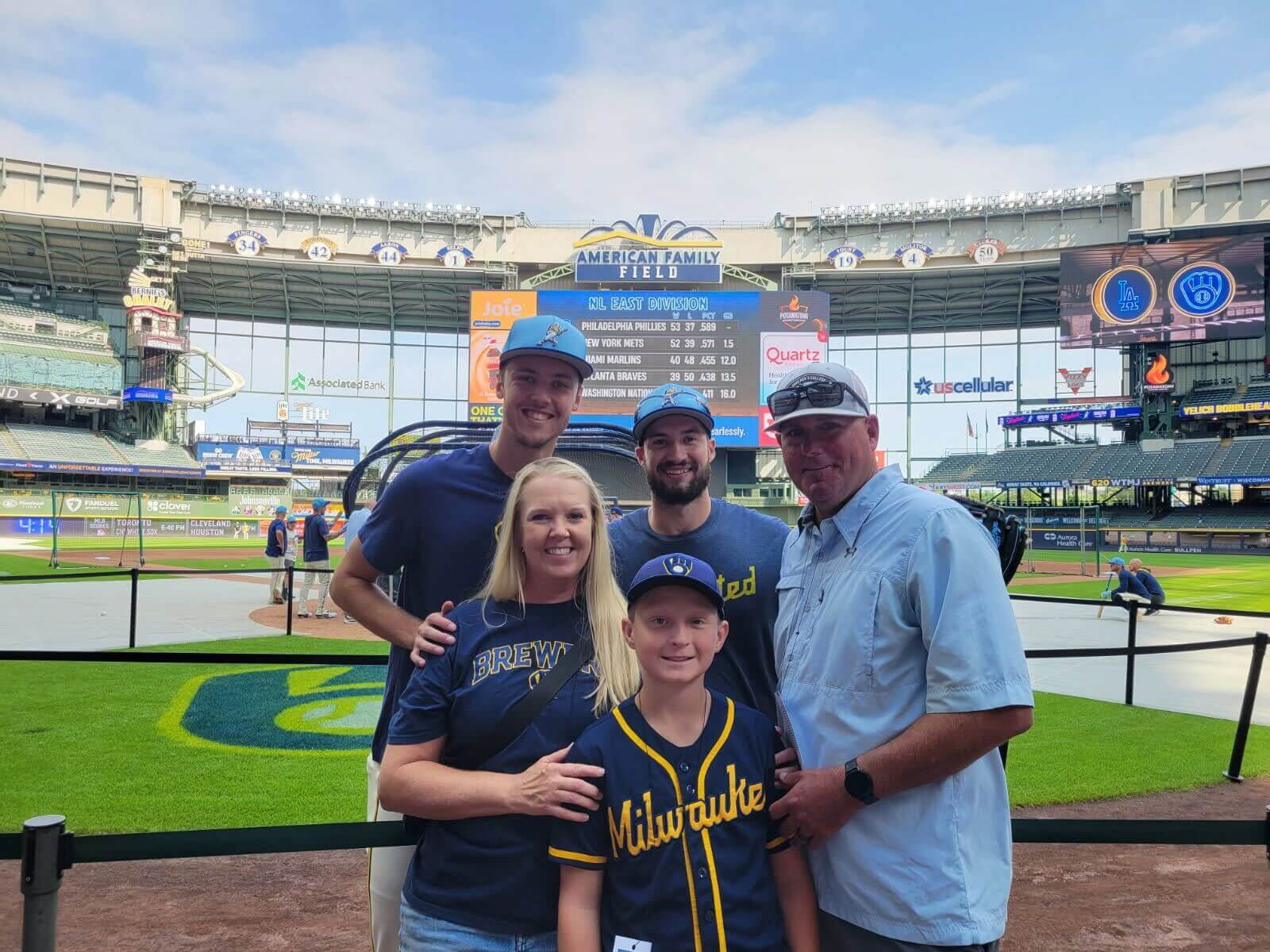
Crowder College baseball coach Travis Lallemand visiting with former players Jacob Misiorowski and Aaron Ashby in 2025. (Courtesy of Travis Lallemand)
Sitting at his locker now, the hardest-throwing starter in baseball would not change the path he took. Had he been drafted out of high school, he fears he might still be asking himself, Do I deserve to be here?
“I think Crowder gave me a whole different mindset,” Misiorowski said. “Now it’s understanding that I do deserve to be here, I worked my way through it and got to where I am now. I think without it, it would have been a whole different story.”
Last summer, Lallemand traveled to a game to see two of his old players. Ashby approached first. Then came Misiorowski. On the trip, Lallemand had marveled over Milwaukee’s hysteria with its new budding ace. Everywhere he turned there was another T-shirt paying homage to Misiorowski’s alter ego: “The Miz.”
But down the field, he was quickly reminded that not much has changed with the player he watched pitch in places like Atoka and Neosho. Misiorowski told a story about getting stopped at Target. Lallemand asked Misiorowski what in the world he was doing at Target on the day of a game.
“Buying toilet paper,” Misiorowski said.
Lallemand responded: “You’ll have endorsement deals for Charmin one day.”
Now at SIU-Edwardsville, Stornello has a player from Milwaukee named Brennen Grams. Grams is a big Brewers fan. One day this spring, he showed up to the team’s clubhouse in one of those shirts that read simply: The Miz. Stornello stopped him. He wanted to take a picture, and he wanted to send it to The Miz himself. Grams could hardly believe it.
“To them, he’s MLB All-Star Jacob Misiorowski,” Stornello said. “To me, it’s just Miz. Just trying to make it through practice at Crowder was half the battle.”
Now, as Misiorowski sets the league on fire with a 2.45 ERA, 97 mph sliders and fastballs beyond belief, his Instagram bio reads simply: Rhp || GhostRider.