
The narrative of the 2026 San Francisco Giants can still shift without warning and head in a different direction. It takes only a couple of wins against the Los Angeles Dodgers to pull the Giants back into the land of the living and put thoughts in your head. What if the hitters who were supposed to produce actually produce? What if the pitchers who were supposed to prevent runs actually prevent runs? After all, the Giants are closer to the San Diego Padres and postseason position right now than they were on Aug. 25, 2010.
If you need to cool off, the playoff odds are right there. There’s been so much damage done to those hopes already, and a very modest winning spree can’t undo all of it. Still, a couple of convincing wins against the seemingly invincible Dodgers fill you with chemicals your body isn’t used to. Let it ride.
The timing is perfect because the Giants’ ample and varied long-term contracts have entered the discourse. MLB Trade Rumors had a thoughtful article on it, possibly inspired by a Bob Nightengale article that suggested the Giants want to trade their biggest contracts, quoting “rivals” and “one executive.” It’s a classic progression: Team wants to win with veterans, team can’t win with veterans, team trades veterans.
A general fixation on “bad contracts” is a particular pet peeve of mine, though, especially when they’re used as evidence of incompetence or poor planning. As far as pet peeves go, it’s below the Alex Avila Rule obsession, but not by much. It misses the point of free agency and why teams need free agents. It forgets what teams expect from the free agents they sign, and how much of a player’s decline is baked into the original thinking. And it completely ignores what the Giants would do without these long-term contracts, which is probably sign other players to long-term contracts.
So let’s dig into what the Giants’ long-term contracts really mean for the state of the franchise and how desperate they should really be to move any or all of them.
The first and most important thing to remember is that free agents are a “So, You Didn’t Develop a Player Tax,” nothing more. A team that develops a third baseman will have an underpaid player in his prime, and if they develop another third baseman behind him, they’ll keep the cycle going. When the cycle stops, well, now you have to make some painful trade-offs. You can trade prospects for a third baseman, further hurting your chances as a conveyor belt of underpaid young players. You can spend too much money on a third baseman, with the last third of his contract extremely likely to be a problem. Or you can make do with internal options and lesser free agents, with the lowered expectations that accompany them.
Those are the options when a team doesn’t develop a player, and those won’t change. The Giants announced the Matt Chapman extension on Sept. 5, 2024, and it’s not a coincidence that Casey Schmitt was hitting .209 at the time, with a .225 on-base percentage — video game numbers, but the wrong kind. The Giants figured Chapman was their best chance at third base production for a long time, and they’ve only come to question this in the last month and a half, with Schmitt showing signs of a breakout season.
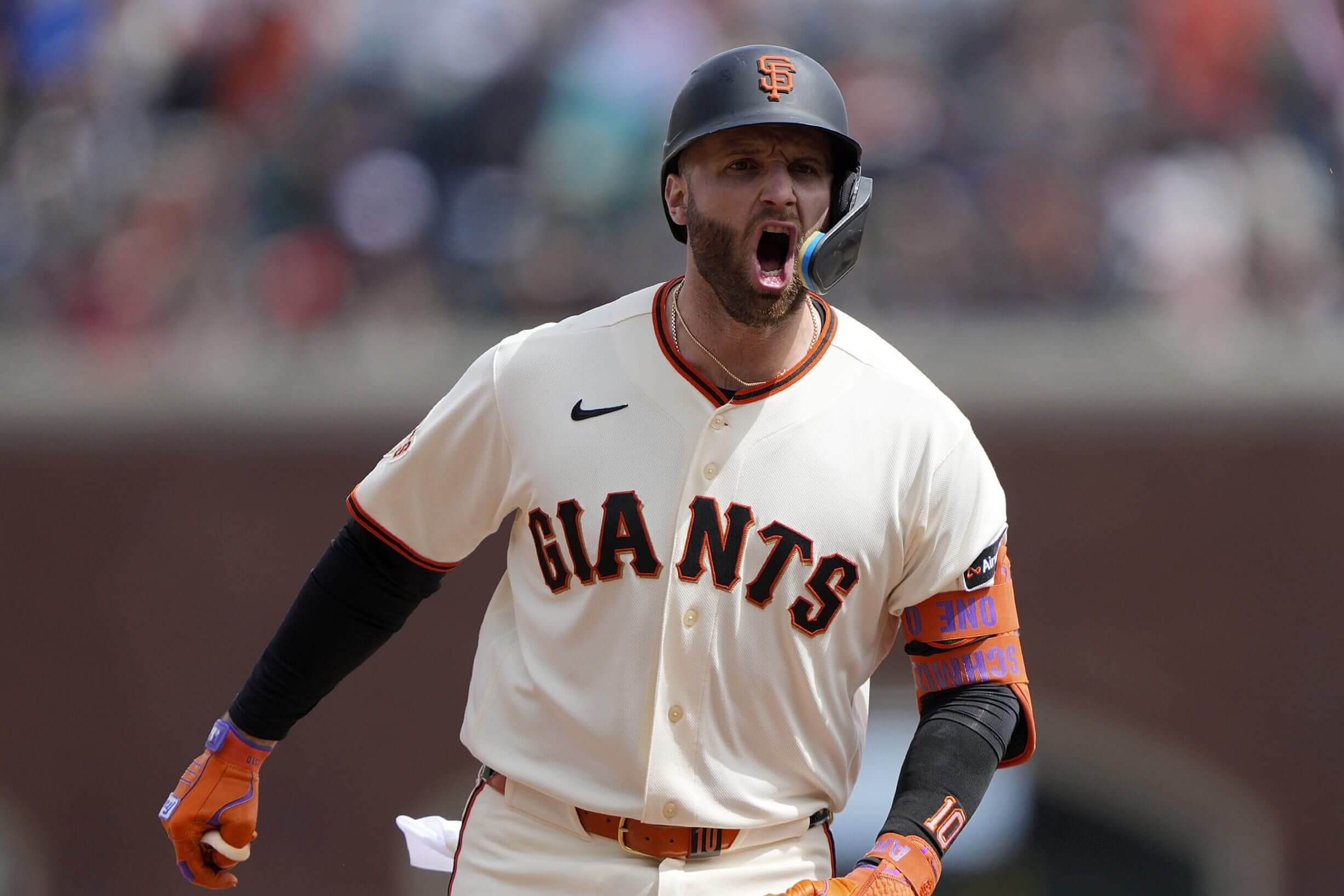
Casey Schmitt looks like he could be the Giants’ long-term answer at third base now, but when Matt Chapman signed his extension, Schmitt didn’t look like an everyday MLB player. (Thearon W. Henderson / Getty Images)
And once a team has paid the “So, You Didn’t Develop a Player Tax,” they circle the calendar at a point a few years in the future and make plans for when they start to stink on that big contract. Because it’s going to happen. Free agents have enough leverage to make teams pay them for their decline. This is the tax, and the only alternative is to search for different, cheaper and likely worse players. The Giants didn’t rub their hands together in glee because they were excited to watch a 34-year-old Willy Adames play shortstop in 2031; they wanted the best version of Adames in 2026. That’s true for everyone else, from the cornerstone contracts to the two-year deal they gave Adrian Houser. Anything positive that happens in the second half of the contract is a bonus. It’s the first part they really want.
Through the first seven weeks of the season, the Giants have been burned by an inexplicable hastening of the timeline. Chapman, Adames and Rafael Devers weren’t supposed to be in the albatross phase of their contracts yet. Maybe in a couple of years, and maybe in 2027 if you’re extra cynical, but not this season. That’s what’s so baffling about the 2026 Giants. It’s like someone went into the settings and moved their ages up a few years.
Let’s take Jung Hoo Lee out of the long-term contract discussion for now — he’s an outlier whose youth and possible development factored into his cost — and focus on the big three: Adames, Chapman and Devers. The Giants owe them something close to a combined $481 million, with Adames’ contract running through 2031, Chapman’s through 2030 and Devers’ through 2033.
Sounds bad, but all three players have been remarkably steady compared to the typical veterans. Their combined WARs from Baseball-Reference since the 2021 season, along with the average MLB rank among the three players in WAR:
2021: 3.7 (average overall rank 58th)
2022: 4.2 (45th)
2023: 3.6 (60th)
2024: 4.7 (36th)
2025: 4.0 (45th)
Out of all three players, the worst season was Adames’ 2023 campaign, when he was worth 2.9 WAR and was the 84th-most valuable player in baseball. That’s the worst season out of 15 examples: a rock-solid, extremely helpful player who helps his team win.
These players are still supposed to help. This shouldn’t be the bad parts of the contracts yet. All three players have been among the most consistent in baseball for several seasons, and only Chapman is at an age where he should get extra scrutiny. A front office that panics and treats these players like ticking time bombs is a front office that’s far too reactionary, because the organization needs to get these players to match their past and projected production.
Getting back to the old normal is the extra-boring Manhattan Project for the Giants. There’s been positive movement on that front, with Devers’ strong May and Adames’ improving at-bats, even if there’s a long way to go. This isn’t a story about bad contracts, though. This is a story about reliable players turning unreliable before they were supposed to. It can actually be a much scarier story than simply bad contracts if you have a good imagination (which I don’t recommend).
Let’s say the Giants wiped some of these contracts off the books with a wave of a wand. Poof, gone. There’s a decent chance that Giants ownership would pocket the money and get you hyped for a You Gotta Like These (Underpaid) Kids! Revolution, but there’s also a good chance they would reinvest the money into other free agents, hoping to win a few extra games and keep fans interested through the fall.
If the Giants kept struggling offensively, they would want to sign a power bat in this offseason scenario. Someone with enough power to overcome Oracle Park. Someone who wasn’t too old, but who had a strong offensive track record. Someone to hit dingers and keep the Giants in games until they develop more hitters to bolster the lineup.
Congratulations: You just signed Devers again. As in, if the Giants have extra money, they’ll just spend it on players like the ones they have now. And, again, the three biggest contracts were given to players who were as consistent and reliable as any players in baseball. If they can be unreliable, well, good luck with the free agents you’re picking out of a hat.
The biggest problem with the Giants is, was and will continue to be a lack of prospects and development. The money on the books isn’t the problem, especially when it’s absolutely a choice to keep the payroll around the 10th- to 15th-highest every season. Nobody will be talking about “what the Dodgers have to do with Freddie Freeman’s contract” if he starts acting his age. He’ll either keep hitting, or they’ll find someone who will. It’s not complicated if the money is infinite.
You are, however, seeing the beginnings of an actual problem with the Giants’ long-term contracts: opportunity cost. If Schmitt keeps hitting, and Chapman keeps flailing, there will be discussions about how the Giants can best allocate playing time. And if Schmitt, Adames, Chapman, Devers and Luis Arraez all keep producing, there won’t be room for Bryce Eldridge in the lineup. This is a problem that will be fixed by Arraez leaving in the offseason or at the trade deadline, with Schmitt moving to second, but it’s a glimpse of a more complicated situation in the future, perhaps.
These are the Cepeda-McCovey kinds of dilemmas, where there are simply too many good players for too few spots, and they’re real. The Giants aren’t there yet. And while their farm system is ascending, it’s spit out only a few players so far. It’s a roster that still needs veterans. Veterans with a consistent track record, perhaps. Veterans like …
The other option is to become the Rays or the Brewers, which sounds like a lot of fun, but there would be growing pains. You’d never get to keep a player you liked, either. It’s perfect that those two teams are the current standard-bearers for winning on the cheap, because they’re the ones that used to employ Adames. The Giants still might have a Willy Adames Day one of these years, and those teams likely won’t. Yet those teams probably got the best versions of Adames, so it’s not like their fans are too sad about it. Continuity has value too, though. There’s no wrong answer, just different baseball experiences for different fan bases.
It’s been a rough season so far, but it hasn’t been a rough season because the Giants spent their money on expensive free agents. It’s been a rough season because those players forgot how to play baseball, at least temporarily. Pointing at the past doesn’t make sense, especially when the Giants will (and should) continue to pay players too much money for their declining years. Freeing up money is only an invitation to start the process up again. The real answer is to develop prospects who are so good that they start asking for real money one day. That’s a few years off, though. Until then, get the previously helpful players helping again, and keep developing. It’s not complicated, even if the Giants spent the first few weeks of the season making it seem that way.