
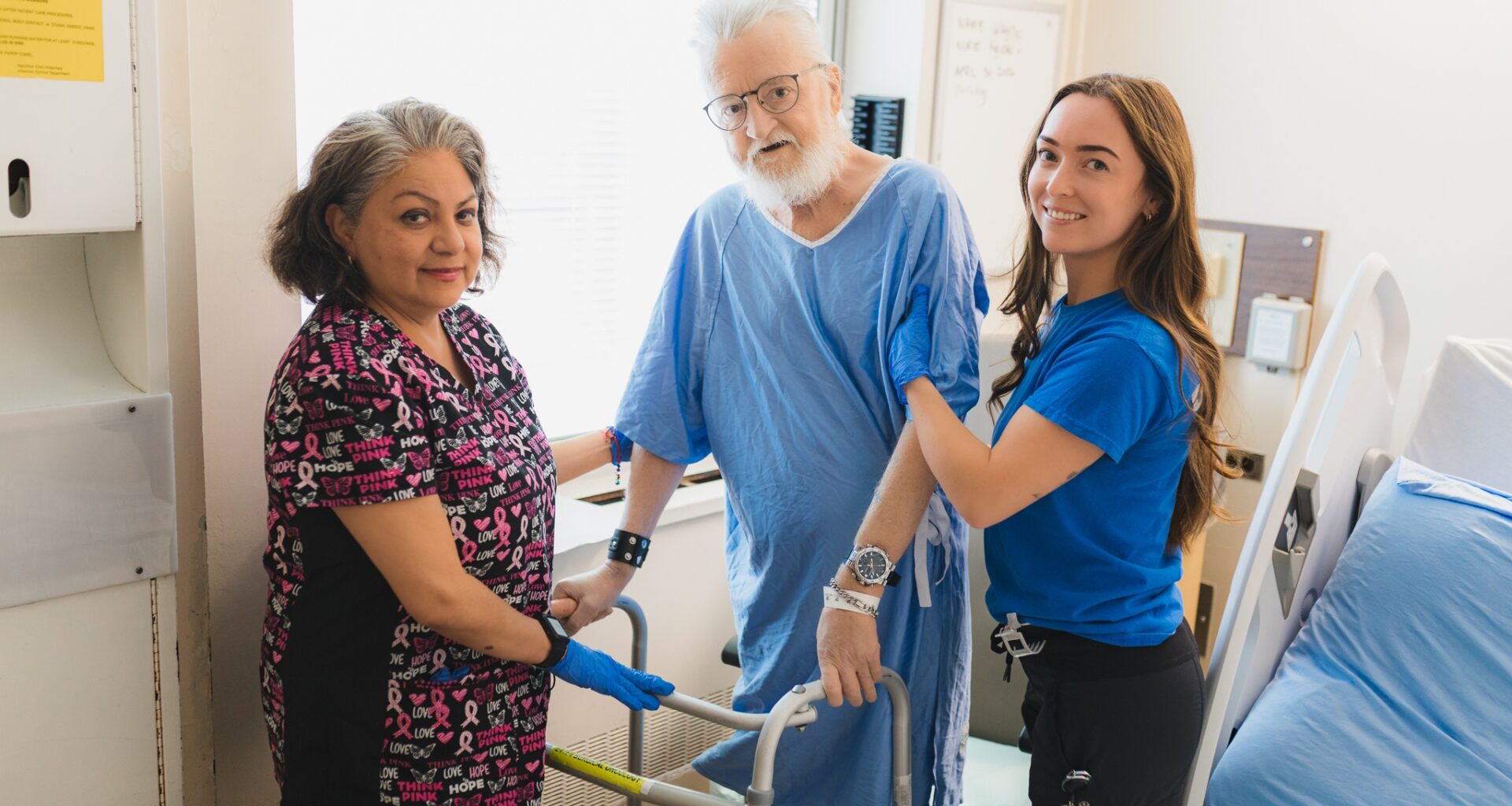
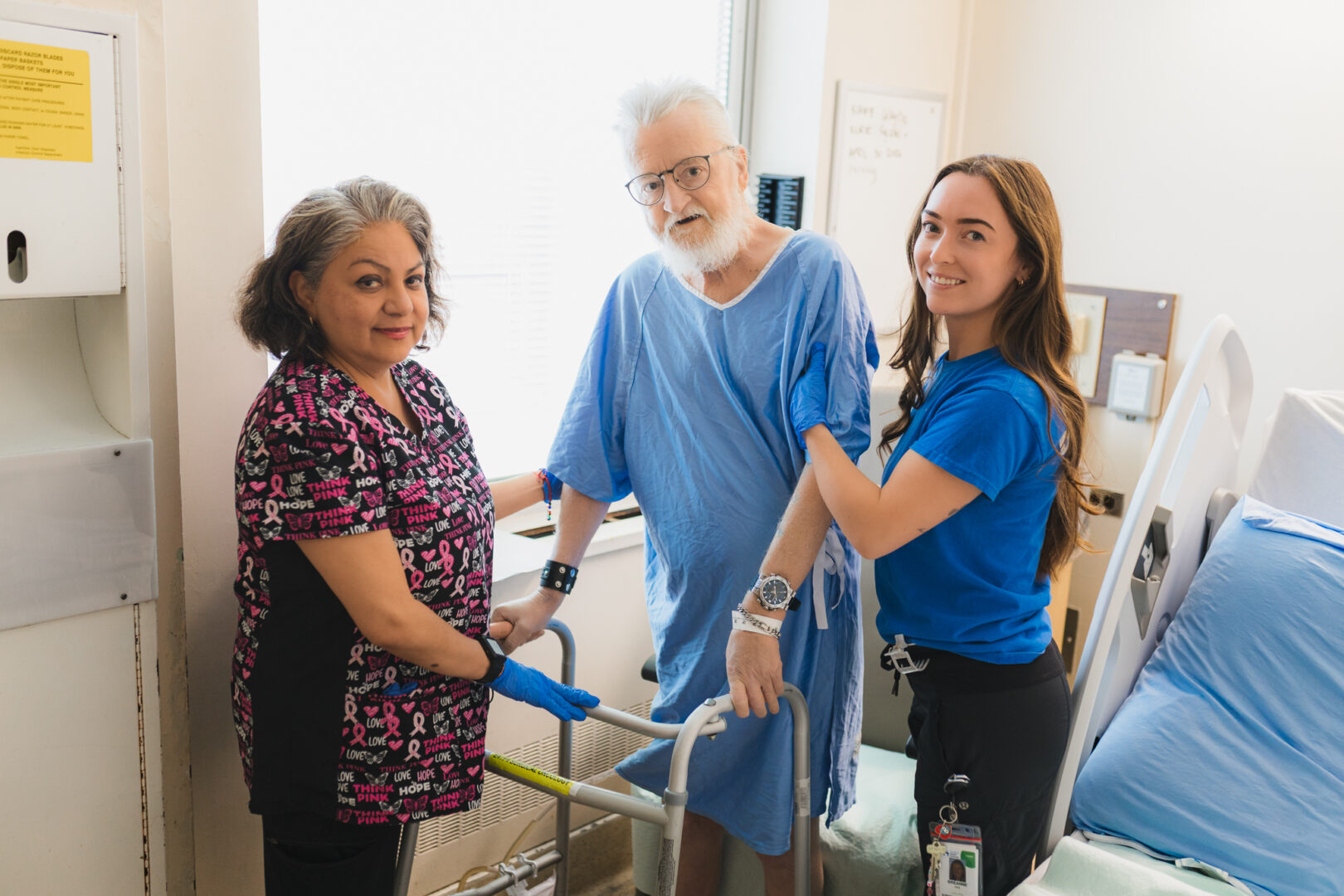
Health care aide Angelica Rivera and Occupational Therapy Assistant/Physical Therapy Assistant
Breanne Nye help Wayne Hockley shift from his bed to a chair in his room at Juravinski Hospital to get him set up for breakfast. The “Bed to Better” program helps patients heal faster by avoiding issues that can come with being in bed for too long.
At Hamilton Health Sciences, a simple idea is making a big difference for patients at the Juravinski Hospital and Cancer Centre: get out of bed, sit up, and start the day moving.
The program is called Bed to Better, and it is changing how care teams think about recovery in hospital.
For many people, being in hospital feels like a time to rest. It is natural to think that lying in bed will help the body heal. But too much time in bed can actually slow recovery and lead to new health problems.

Charge Nurse Cavan Stoddart
“Even moving from the bed to a chair can make a big difference,” says Cavan Stoddart, charge nurse for unit EF4 at Juravinski Hospital and Cancer Centre. “If you spend just two hours out of bed, that still means 22 hours in bed. The more time patients can safely spend up and moving, the better it is for their overall health.”
A simple morning routine with big impact
Each morning between 7:30 and 8:30, an occupational therapy/physiotherapy assistant partners with a health care aide to help selected patients get out of bed and into a chair for breakfast.
Spending too much time lying down can lead to serious health issues. Two of the biggest risks are pressure injuries, sometimes called bed sores, and pneumonia.
It may sound small, but this one-hour window is one of the busiest times on the unit. By having a dedicated team focused on mobility, patients get the support they need right at the start of the day.
“These are hands-on roles,” explains Stoddart. “You have two people right there who are trained to safely help patients move. That support makes a real difference. Having therapy support is the main reason we can put the program in place.”
On average, the team helps between five and 15 patients each morning, or about 230 per month. To date, more than 1258 patients have benefited from the program.
Why getting out of bed matters
Spending too much time lying down can lead to serious health issues. Two of the biggest risks are pressure injuries, sometimes called bed sores, and pneumonia.
When patients stay in bed for long periods, pressure builds on certain parts of the body, reducing blood flow and damaging the skin. At the same time, lying flat can make it harder for the lungs to fully expand.
“When you’re sitting up, your lungs aren’t being pushed on as much, and it’s easier for your diaphragm to work,” says Stoddart. “That helps reduce the risk of pneumonia.”
Movement also helps with circulation, digestion and strength. For patients recovering from abdominal surgery, even sitting in a chair can help “wake up” the bowels and get the body working again.
“Mobilization sends a message to your brain that it’s time to get going,” Stoddart says.
Preventing setbacks
One of the most surprising risks of staying in bed is how quickly the body can lose strength.
“Better blood flow, better breathing, less swelling. All of it helps patients heal.”
“After lying in a bed for just two days, it can take a couple of weeks to rebuild your strength back to where you started,” says Stoddart.
This loss of strength is known as hospital-associated deconditioning. It can make it harder for patients to return home and get back to their normal lives.
By helping patients get up early in the day, Bed to Better sets the tone for what follows.
“We’re building expectations,” Stoddart explains. “If patients are up for breakfast, they’re more likely to sit up for lunch and dinner, walk to the washroom, or even take a short walk down the hallway.”
Expanding beyond surgery patients
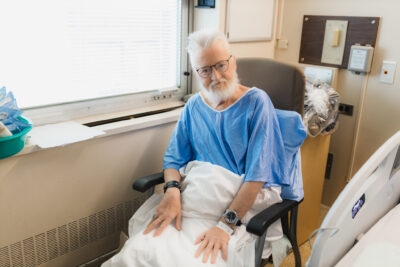
Wayne Hockley, a patient at Juravinski Hospital and Cancer Centre, sits in a chair beside his bed, all set for breakfast.
The idea of early movement is not new. It has often been used for patients recovering from surgery. But since September, the Bed to Better approach has expanded to include more patients on medicine units.
This includes people admitted with conditions like chronic obstructive pulmonary disease (COPD), pneumonia, or heart failure.
“These patients often have breathing challenges,” says Stoddart. “Getting them sitting up can really help their lungs and overall recovery.”
Patients on these units typically stay in hospital for three to four days. Even in that short time, increasing mobility can have a meaningful impact.
Early results are promising
While the program is still growing, early signs show it is making a difference.
Since October, there has been only one reported stage 3 pressure injury linked to patients on the unit, a positive sign for patient safety.
“There are many things we do to reduce risk,” says Stoddart. “But this focus on early movement is a key part of that.”
A team effort
Bed to Better depends on teamwork. Nurses, physiotherapy staff, occupational therapy/physiotherapy assistants, and health care aides all play a role.
The program also helps ease staffing pressure during a busy part of the day, allowing nurses to focus on other important aspects of care while knowing patients are being safely supported.
“It’s about working smarter together,” says Stoddart.
Changing how we think about recovery
At its core, Bed to Better is about changing expectations, for both patients and care teams.
Instead of seeing the hospital bed as the centre of recovery, the focus shifts to movement, independence, and daily activity.
“It does so many small things that add up,” says Stoddart. “Better blood flow, better breathing, less swelling. All of it helps patients heal.”
For patients at Juravinski Hospital and Cancer Centre, recovery is no longer just about rest. It is about getting up, getting moving, and taking that first step from bed to better.
May 11-17 is National Nursing Week.
Related Posts