
Breadcrumb Trail Links
Health-care transformation was part of the discussion during the National Nurses Week event
Published May 14, 2026 • 3 minute read
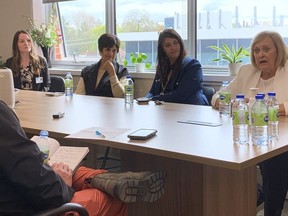 Elizabeth Callaghan, lead nurse practitioner for the Homeless Access to Care Program at the Huron Perth Healthcare Alliance; Karima Velji, Ontario’s chief of nursing and assistant deputy minister of health; Lynanne Mason, the Huron Perth Healthcare Alliance’s chief nursing executive and vice-president of partnerships and transformationl and Donnalene Tuer-Hodes, past chief nursing executive and director at the local hospital group, speak at Stratford General Hospital to mark National Nurses Week Thursday morning. (Bill Atwood/Beacon Herald)Article content
As a local part of National Nurses Week, four women who have made an impact on the profession were at Stratford General Hospital Thursday to share their experiences and thoughts on how to make this year’s theme, “The Power of Nurses to Transform Health,” into a reality.
Advertisement 2
This advertisement has not loaded yet, but your article continues below.
Article content
The chat, which also focused on health system transformation and integrated care, featured a presentation from Karima Velji, the province’s chief of nursing and professional practice and assistant deputy health minister. She was joined by Lynanne Mason, the Huron Perth Healthcare Alliance’s chief nursing executive and vice-president of partnerships and transformation, Elizabeth Callaghan, the lead nurse practitioner for the Homeless Access to Care Program at the alliance, and Donnalene Tuer-Hodes, the hospital group’s past chief nursing executive and director.
Article content
Recommended Videos
Article content
Speaking to a few dozen health-care workers, Velji, noted the week’s overarching theme focused on health – not just health care
“For me, it’s one of the most meaningful so-called slogans that we’ve used for nursing week because I’ve always believed it. We are the highest number of health-care professionals who touch patient care,” Velji said.
“There are 200,000-plus nurses now in Ontario. #e touch that care on a 24-7 basis in many sectors. We are in all sectors of care, including schools. We are everywhere. We are often the first point of contact for patients when they are interacting with the health-care system.”
Advertisement 3
This advertisement has not loaded yet, but your article continues below.
Article content
During a panel discussion, Velji was asked about the essential characteristics of health-care teams that are able to adapt successfully to change, compared to those that struggle with transformation. For Velji, she said the key is to recognize that care goes beyond the walls of a hospital.
“The four walls are not your responsibility only. The responsibility is the person you are serving, regardless of where they find themselves People who interact with the people they serve in that way, I think, are already living and breathing integrated care,” she said.
Callaghan, whose work focuses on addressing the social determinants of health for individuals of low socioeconomic status, echoed that sentiment, saying that underserved and marginalized populations often avoid hospitals or clinics, but instead look for help at “a couch at the connection centre shelter.”
“The greatest opportunity for nurse practitioners is to redesign our health care. . . . It should be where patients are already feeling safe, and so working with patients in shelters like I do, that’s the biggest opportunity for innovation right there. You bring care to the patient instead of the other way around,” she said.
Advertisement 4
This advertisement has not loaded yet, but your article continues below.
Article content
Asked about how to build relationships across teams and agencies, Mason, whose career included a stop at Ottawa’s Children’s Hospital of Eastern Ontario, noted that “nurses are never alone.”
“We are always talking to others, supporting each other. We’re the connecting thread. We are the advocates for all of our health-care team. We’re always there. We’re always with our patients. We’re pulling in others when we need to,” Mason said.
“We’re recognizing signs early, and we’re really addressing and advocating all the needs that our patients need and our families need in the time that they’re here. So you’re critical, right? Every single one of you is critical in that.”
Tuer-Hodes, whose career spanned more than four decades, mostly focused on acute care, also founded the agency’s annual awards following her retirement. She said one of the main lessons she learned in her career was the importance of building a rapport with others.
“You have to build a trusting relationship that is open and you have to listen to what people are saying to you, because it’s important that you have input that everyone’s heading in the same direction,” Tuer-Hodes said.
Article content
Share this article in your social network