
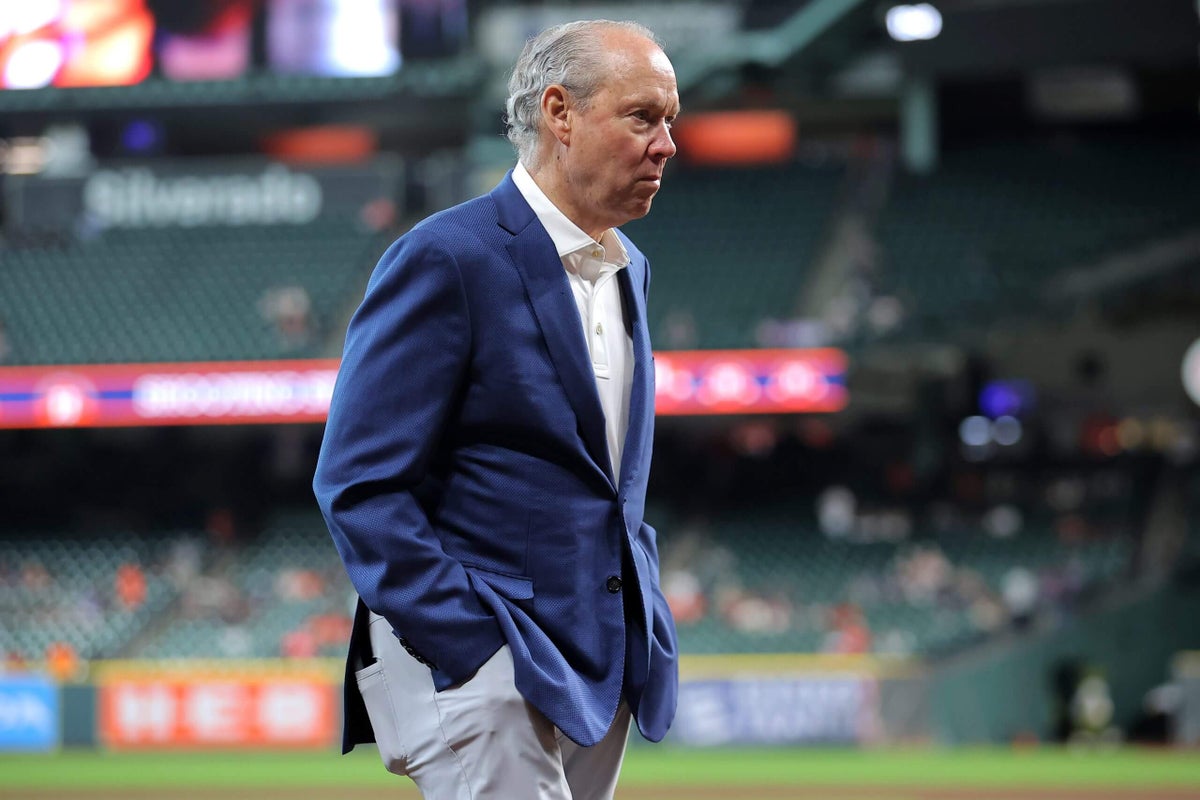
HOUSTON — A celebration prompted Jim Crane’s last public comments. After he sat atop a dais in January and introduced Tatsuya Imai, Crane allowed a group of reporters to gather around for a rare on-the-record interview session.
Within it, Crane praised Imai’s arrival and promised a bigger presence in the Pacific Rim. Asked about the status of manager Joe Espada and general manager Dana Brown — both of whom are in the final year of their contracts — Crane did not offer a vote of confidence and claimed there “probably” wouldn’t be any extension talks.
“We’ve been focused on getting what we need to compete this next year,” Crane said in January.
This can’t be the type of competing Crane had in mind, prompting questions about how the 72-year-old owner will react to a 17-28 start. Losing three of four games against the Seattle Mariners left the Astros 6 1/2 games behind in the American League West but, somehow, just five games back of a playoff spot.
Perhaps that proximity to the postseason, coupled with the copious injuries impacting the 26-man roster, will prompt patience. Jeremy Peña, Josh Hader and Jake Meyers are on minor-league rehab assignments. Hunter Brown is throwing bullpen sessions. Getting them back will provide a boost, but the Astros must have a somewhat decent record to benefit from it.
“I would like to get some consistency (in) back-to-back games where we get rolling and we could create a winning streak,” said Espada, whose team has not won three consecutive games since April 1. “We know the length of this season, right? We know how long it is. We just have to continue to do the little things better.”
Dana Brown already gave Espada a vote of confidence last month, but given his own contract uncertainty, it’s worth wondering how much weight that carries. On multiple occasions, Brown said both he and Espada want to “retire here” — a wish that seems to grow more unrealistic as this season continues.
Crane spent a portion of Tuesday and Wednesday afternoon around the Astros’ clubhouse, but that is not uncommon when the team is at Daikin Park. He did not acknowledge reporters in the area.
In January, Crane said, “We’ll go through this year like we always do, evaluate and make a decision at the end of the year.” Unless he either takes action or takes questions, those comments remain the only definitive answer to these delicate questions.
Crane has never fired a general manager midseason. With Crane’s blessing, former general manager Jeff Luhnow dismissed manager Bo Porter on Sept. 1, 2014, as Houston sat 25 games back in the American League West with a 59-79 record.
Porter’s firing is the closest thing to precedent that exists for any shakeup during Crane’s ownership. Standards and expectations have shifted in the 11 seasons since. Whether that will also cause Crane to alter his operating procedure — and walk back his words from January — is a mystery.
Tatsuya Imai’s struggles could force tough decisions
Though he has done nothing to earn such security, Tatsuya Imai’s spot in the starting rotation is safe for at least one more turn. Presuming the Astros keep him pitching every fifth day, Imai should start Monday’s series opener against the Minnesota Twins at Target Field.
Imai has a 9.24 ERA across four major-league starts. In two minor-league rehab appearances, both of which Imai made with a clean bill of health, he walked eight batters and surrendered six earned runs across five innings.
Because of Imai’s salary and status as a heralded free-agent addition, along with the Astros’ scarcity of other realistic options, the team has little choice but to maintain the status quo while hoping Imai’s struggles subside.
Imai has failed to finish five innings in five of his six professional starts. If that trend continues, it may force the Astros to reverse course, if for no other reason than to protect their bullpen.
Prospects such as Ethan Pecko or Miguel Ullola distinguishing themselves in Triple A — or even Bryce Mayer doing the same at Double A — may further force the Astros’ hand with Imai.
Imai has minor-league options remaining, but according to the terms of his contract, he can’t be demoted without his consent. New York Mets right-hander Kodai Senga has a similar provision in his contract — and he agreed to a demotion last season amid his struggles.
If team officials want to avoid that conversation, moving Imai to the bullpen may be a solution, but doing so would already acknowledge defeat on a deal that Brown handed out. In a season when the embattled general manager can ill afford awful optics, few would be worse than that.
Bryan Abreu’s improvement
Be it to climb out of this hole they’ve dug or to be a part of a possible trade-deadline sell-off, the Astros need Bryan Abreu. Espada has reiterated it each time the embattled reliever’s name is brought up, as a manager backing a struggling player and as a matter of fact.
“We know it’s in there,” Espada said Wednesday night. “It’s just a matter of time and opportunities.”
Might that time be near? Abreu earned the win after throwing a scoreless 10th inning Wednesday against the middle of Seattle’s order, continuing an encouraging stretch following a pitiful start.
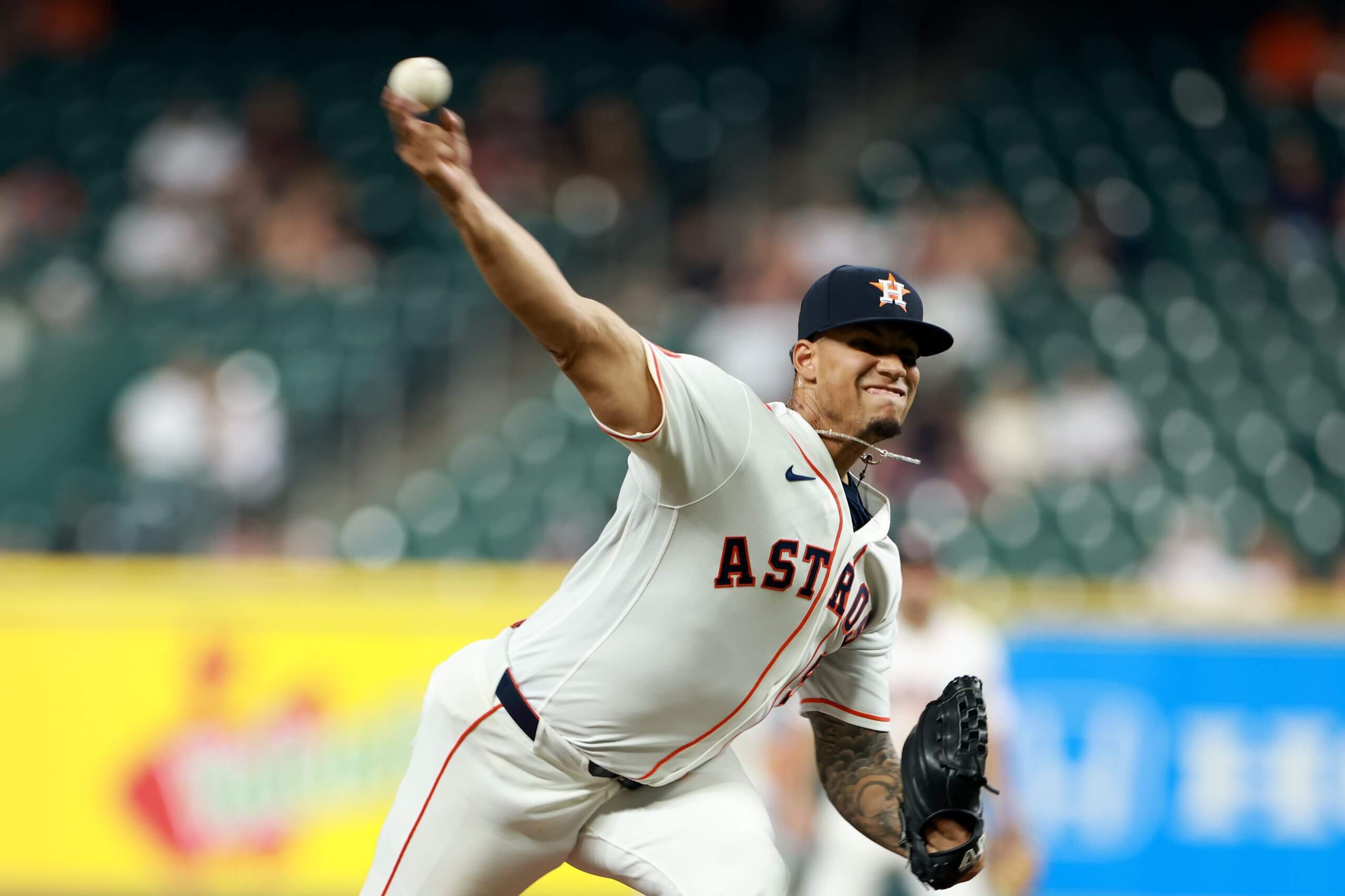
Bryan Abreu pitched a scoreless 10th inning against the Mariners on Wednesday. (Kenneth Richmond / Getty Images)
Abreu hasn’t allowed a run in four May appearances. The 4 1/3-inning sample size must be mentioned, but given the gravity of his April struggles, any incremental progress must be celebrated. Abreu entered this month with a 12.54 ERA. It now sits at 8.56.
To help fix Abreu, the Astros have eliminated flat ground work and transitioned all of Abreu’s pregame throwing to off the mound. Doing so allows Abreu to have a better feel for the mechanical changes coaches are making to help increase his velocity and improve command.
Abreu is still searching for his standard velocity — his four-seam fastball touched 96.6 mph Wednesday but is still averaging 2.3 mph slower than it did last season. But better feel for his slider has helped increase his chase rate from 20.4 percent in April to 32.4 percent in May. On Wednesday, Seattle whiffed at three of the six swings it took against Abreu’s slider.
Abreu has walked just two of the 17 batters he’s seen this month. After throwing just 51.7 percent of his pitches for strikes in his first 11 appearances, Abreu has thrown 62.9 percent strikes in his past four.
In the grand scheme, it is a small sample size. Abreu isn’t all of a sudden going to reassume closing duties in Hader’s absence, but at the very least, he is earning back some trust to pitch in close games. Espada’s understandable unwillingness to use Abreu in leverage spots had been hamstringing the team for the past few weeks.
Abreu’s improvements are arriving at an ideal time. Kai-Wei Teng’s move to the starting rotation leaves just Enyel De Los Santos and AJ Blubaugh as right-handed relievers with any sort of track record in leverage situations.
Houston’s bullpen is otherwise left-handed heavy. It boasts baseball’s seventh-lowest average fastball velocity, too. Abreu’s absence as a reliable, hard-throwing right-hander is glaring. Now, it appears he is on a path back.