
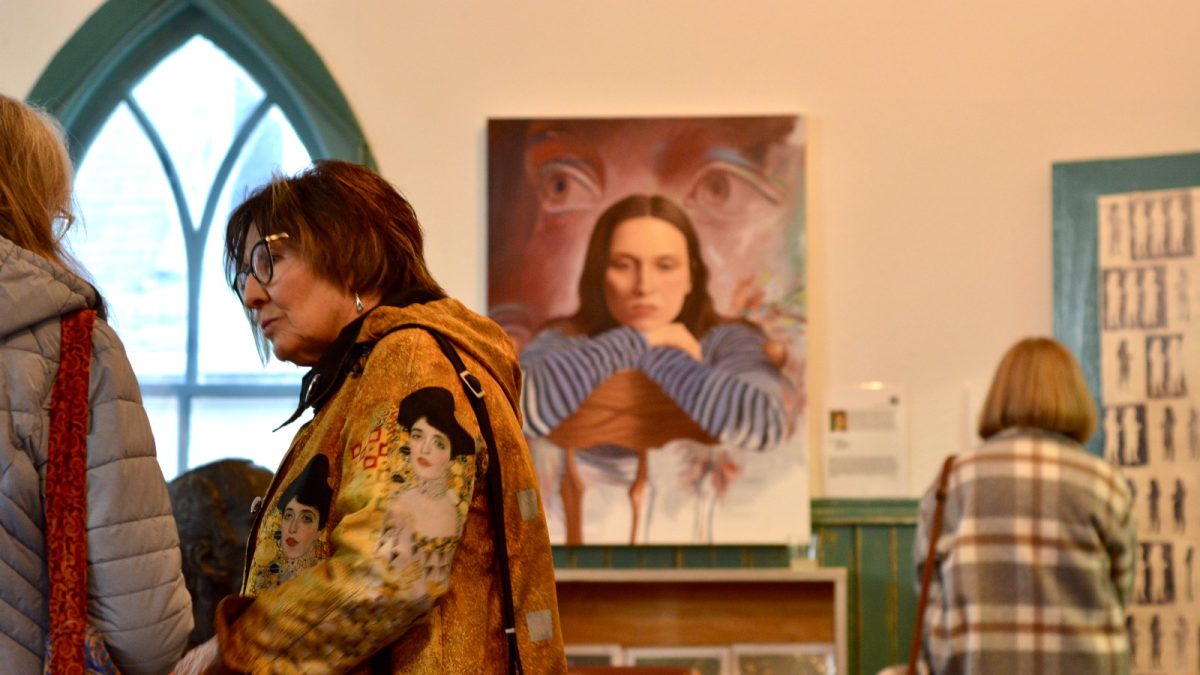
Some stop to scan QR codes and listen to artists describe their experiences. Others simply stand in silence.

“We’ve had a lot of comments today and a lot of comments in the last few days, and most people need to come back,” said Deb Kerr-Goodfellow, co-founder of the Susan Velder Gallery and More.
“This is just so heavy that they need to come back and just without a big crowd and just spend some time.”
(Video credit: Kenneth Cheung/battlefordsNOW)
The gallery is currently hosting Invisible Winds: Stories You Can Not See, Journeys toward Wholeness, the first stop of a travelling Saskatchewan exhibition curated through the Organization of Saskatchewan Arts Councils (OSAC). Featuring work from 19 local artists, the exhibit explores the emotional realities people often carry quietly beneath the surface of daily life.
The exhibition guide invites viewers to “slow down, listen closely, and notice what is not immediately visible.”
For North Battleford mixed-media artist Holly Hildebrand, that invisible weight takes shape through layered fabric, dangling thread and fragmented portraits rooted in personal history.
“I was thinking about thread and the threads that hold us together, those kinds of things, and things that stitch us together and how we’re all sort of held together in different ways,” Hildebrand said.
Her two featured pieces – Ghosts and Shadows: Heather and Ghosts and Shadows: Teanna – explore adoption and post-traumatic stress disorder through tactile, heavily textured works built on raw canvas.
One portrait surrounds an adopted woman with repeating silhouettes, reflecting feelings of disconnection and the search for belonging across generations. Another confronts the exhausting emotional reality of PTSD through fractured imagery, spiderweb patterns and handwritten reflections on fear, isolation and survival.
“Living with PTSD can be debilitating and exhausting, and it often feels like much of it is beyond my control,” reads part of the written reflection accompanying Ghosts and Shadows: Teanna.
“The triggers and flashbacks invade my thoughts.”
Hildebrand said the pieces are intentionally personal, but never meant to remain only about the individuals portrayed within them.
“I hope that people look at them and have some kind of sense of how it relates to themselves,” she said.
“I think that’s what art does, as you look at it and you think, oh, I like this because of that and this symbol, this whatever, speaks to me because it reminds you of something about yourself.”
The rough textures and exposed stitching seem to mirror the emotional themes woven throughout the exhibition itself.
“You can feel the depth of the tragedy and the pain and the sorrow and all the frustration that goes along with whatever issue they were talking of,” Kerr-Goodfellow said.
“But I think you also come away with hope and resilience.”
Elsewhere in the gallery, a large mixed-media storyboard titled Pearl drifts between soft yellows, blurred figures and dark spirals.
Created by local artist Mary Anne Baxter with writing by Susan Gordon, the piece reflects on a woman the pair knew decades ago while working in Vancouver’s Downtown Eastside.
Rather than painting a literal portrait, Baxter said she wanted to capture the emotional experience of living with schizophrenia and bipolar disorder.
“I feel that what I was trying to capture was the emotional state of Pearl and not so much that I wanted her image to be attached to a particular recognizable form,” Baxter said.
“I wanted to be more of a sensation, a gesture of what was happening in her and with her.”
The accompanying written story describes Pearl explaining her illness through invisible strings connecting her to the earth.
“I float up into the sky. I can see everything: puffy clouds around me, people are small and funny and dogs are racing in the park. I can do anything I dream of. But then, I get scared. I can’t see my friends. It gets stormy. There is lightning and big winds shake me too much and suddenly— I come crashing back to the ground,” the text reads.
“Friends find me and take me to the hospital. At first I feel strange and slow but now I am getting better.”
Baxter said memories of Pearl stayed with her for decades, particularly during a time when conversations around mental illness were often hidden behind shame or misunderstanding.
“I think people… the family even treated it like an embarrassment,” she said.
Now, she hopes the work encourages viewers to pause before judging what they cannot immediately understand.
“Listen more, think more, think about when you see somebody who’s maybe not conventional,” Baxter said. “Allow some time to try to sort out what’s going on, who’s this person and what’s happening?”
That same idea echoes quietly throughout the old church gallery, in the stitched portraits, unfinished outlines and stories carried through thread and shadow.
In an essay included in the exhibition guide, author David A. Robertson reflects on his own experiences with mental health struggles and the healing he found through community and storytelling.
“Art is Story, and stories save lives,” Robertson wrote. “I know this as an incontrovertible fact.”
Inside the walls of the former church in St. Walburg, those stories now hang in silence and colour, visible at last to anyone willing to slow down long enough to see them.
The exhibition reception took place Thursday and the show will remain in St. Walburg for another week before travelling to other communities, including Prince Albert, North Battleford, and Hudson Bay.
—
Kenneth.Cheung@pattisonmedia.com