
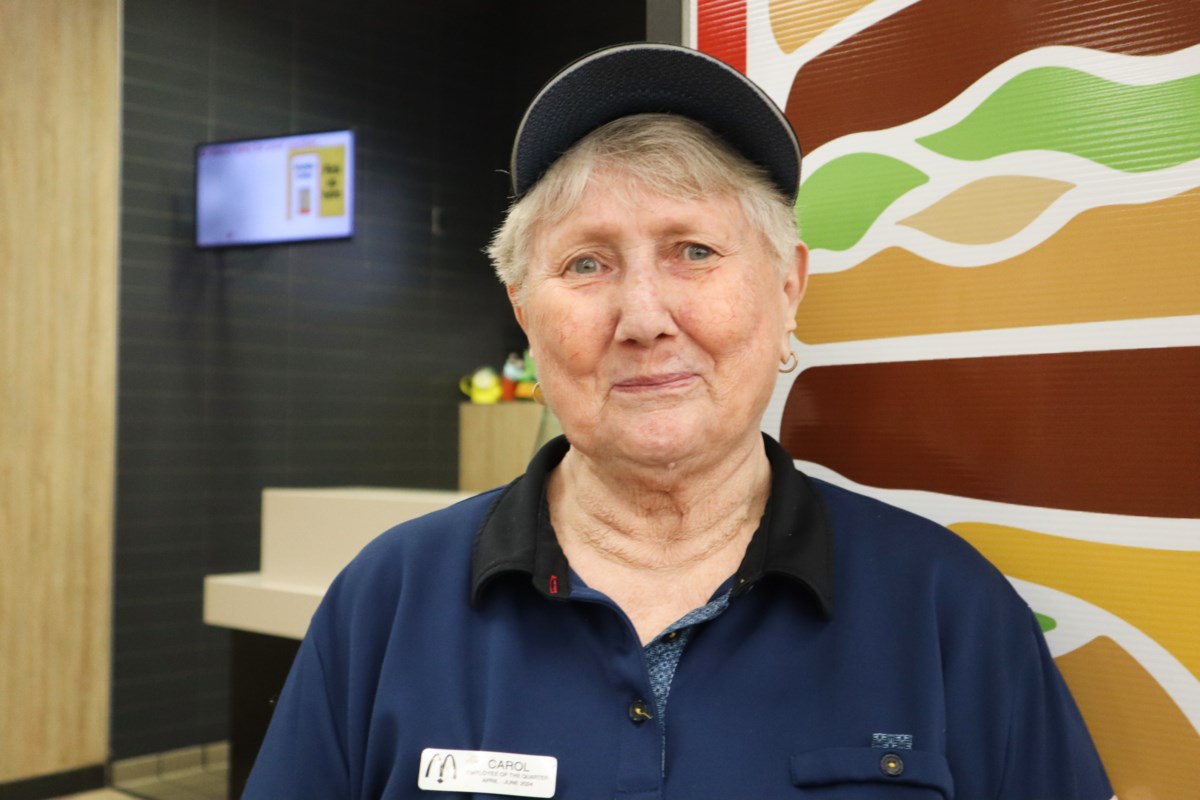
At 76-years-old, Carol Ferrier is still working, taking part-time shifts at a local McDonald’s alongside people a third her age.
Ferrier plans to work until she’s 80, and it’s by choice. The joy it brings her is partly why she came out of retirement. It’s also helped her overcome the depression that set in when her husband died.
But for other older people, working isn’t a choice, it’s a necessity.
Last year, Canada’s participation rate (those working or looking for work) in the 65 plus age group was 15.2 per cent, the highest on record since the Labour Force Survey started tracking it in 1976. Locally, of the roughly 30,000 people 65 and older in the Guelph area, an estimated 3,000 to 4,500 are working, said Charlene Hofbauer, CEO of the Workforce Planning Board of Waterloo Wellington Dufferin.
While the social aspect can be a driving force for older adults to work, Hofbauer doesn’t think it is as big of a factor as the financial one.
In the last couple of months, at 2nd Chance Employment Counselling (Wellington) Inc., the front desk noticed an increase in people over 65 coming to use its services.
It’s often those who have been laid off from labour and construction-type jobs looking for another job in the same field.
“A lot of it’s older people that are saying ‘I have mortgages to pay, I have a child, I have a wife. I don’t know what to do,’” said Gabriel Costa, resource and information staff at 2nd Chance.
Often, they worry about the stigma of being older and don’t want to reveal their years of experience on a resume because it shows their age. They are sometimes hesitant to apply because they think the employer may think they are going to work for a couple of months, then retire.
“I think we’ll see that constant flow in and out of that older population into the workforce,” said Hofbauer.
Hofbauer thinks there is potential to tap into the skill sets of older workers, but this requires employers to be flexible. Just like a younger person or parent might have flexibility needs, so do older workers.
August will be three years since Ferrier started working at McDonald’s.
When she applied, she was hired on the spot and said it was because of her decades of customer service experience.
She’s treated the same as any other crew member, although she isn’t allowed to use a ladder or carry anything over than 10 lbs.
One person isn’t thrilled about it, though.
Her 100-year-old mom still sees her as her little baby girl.
After a morning shift last week, she explained to GuelphToday why she’s still working.
She was asked if she got bored at home. She told them she was in a deep depression after her husband died and knew she had to do something about it. Working takes her mind off things, and she gets to meet people.
They told her it’s nice to see her smiling.
“There is a social aspect to work that I think more of us are recognizing,” said Hofbauer.
It’s why Linda Hamilton is still working.
“There’s life after 58, I’m here to attest,” Hamilton told someone who she said looked shocked to learn she’s turning 75 in December.
She’s an extrovert who loves people. Working keeps her mind engaged.
About 12 years ago, she and her husband moved from Markham to just south of Rockwood.
Her career was in teaching, and her last stint in the field was at Conestoga College. She left when she wasn’t offered another class.
It wasn’t long until she was working again.
These days, she is a chiropractic assistant, and earlier this year, the chiropractor she works for asked if she plans to retire. Not that he wanted her to, but so he could make plans for the future.
“I’ll retire when you stop wanting me to work,” Hamilton told him.
The data around the 65 and up age group should be taken with a grain of salt, since it is not captured in the unemployment rate.
It’s a very small pool of those in this age group who are looking for work. Most of them coming back into the workforce are employed, said Hofbauer.
Last year, locally, on February 20.1 per cent of those 65 and older were working or looking for work in Guelph, Puslinch and Guelph/Eramosa. The number dipped to 9.6 per cent in December.
The Canadian Pension Plan doesn’t cover a lot, said Hofbauer, and Old Age Security only saw a small recent increase, of 2.1 per cent over the past year.
“Covering those basics in a more expensive city like Guelph may be challenging, especially if they’re renting,” said Hofbauer.
Traditionally, people would build equity in their homes, but she isn’t sure if that equity is enough for many anymore. We are also seeing fewer people able to build or maintain that equity.
That can mean going back to work when they are supposed to be winding work down.
“A lot of seniors are actually working because they have to. I mean, all we have is our pensions, and we don’t have any other income coming in. With the economy the way it is today a lot of seniors cannot live on just their pensions,” said Ferrier.