
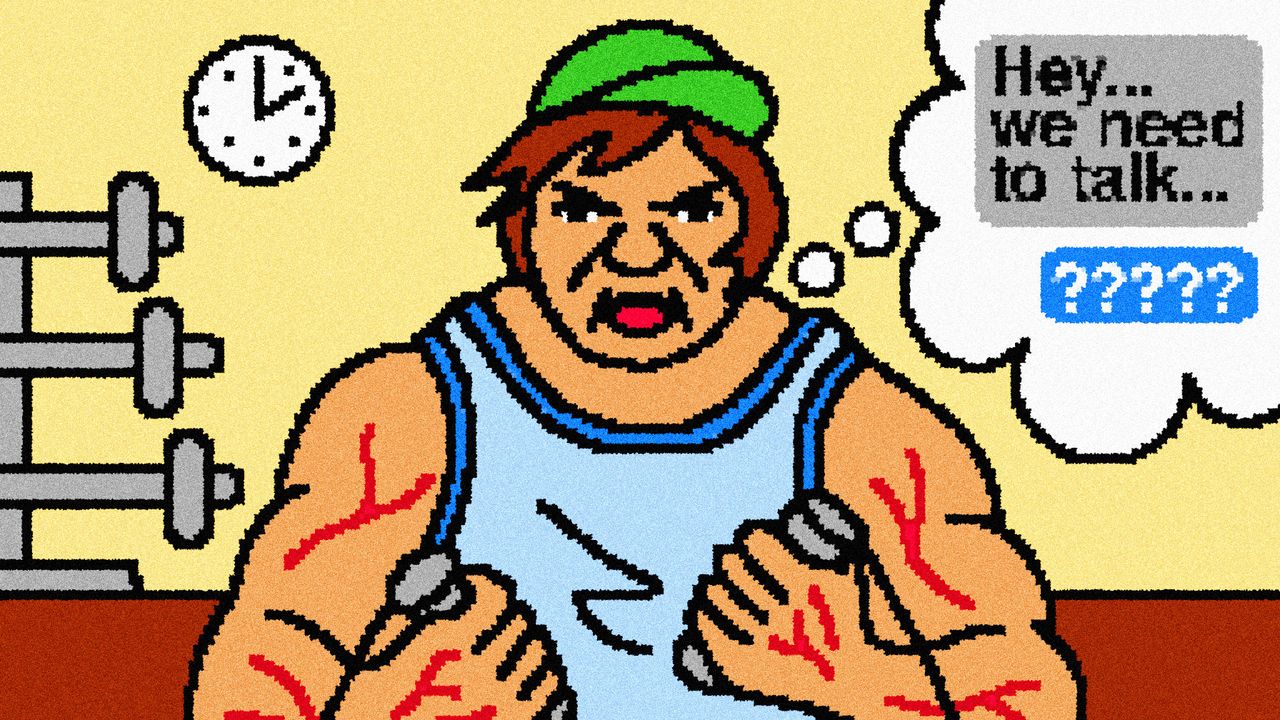
Noah’s pre-workout was screenshots. In August of last year, the 29-year-old from the Philippines says he found out his girlfriend had been cheating. After the relationship had ended, he kept the receipts on his phone, and started reading them before sets. At first, he wasn’t sure why. A month later, he had a theory: Looking at them put him in a state of rage—one that helped him lift heavier than he’d ever lifted.
“It gets your heart racing faster than any pre-workout I’ve ever tried,” Noah, who says he preferred not to give his last name to protect his privacy, says, “And the short burst of emotions does help when trying to hit a PR.”
Noah was unknowingly taking part in what a handful of sadistic gym rats have dubbed ‘the forbidden pre-workout,’ a phrase that inevitably pops up if you spend any amount of time in gym subreddits, follow fitness influencers on TikTok, or watch workout videos on YouTube. The premise is purposely humiliating: A person (typically a man, but not always) takes the jealousy or humiliation of a breakup, real or imagined, and converts it into reps. Often aforementioned imaginary scenarios paint a picture in which their partner has already moved on with someone far better. The “forbidden” descriptor is the wink—those calling their pre-workout probably know it’s not healthy in the same way that, say, Omega-3s are. That, or they simply revere such emotionally dicey territory as a potent force.
Scroll through r/GymMemes and you can see the way the phrase has infiltrated certain parts of the exercise-obsessed manosphere, repurposed in everything from Drake “Hotline Bling” memes to a skull whispering in a man’s ear telling him “this is why she left you.” So much so that savvy supplement brands have absorbed it into their ad copy, too. As an April Fool’s joke this year, the supplement company Vosus Nutrition posted an April Fool’s mockup of a tub called Forbidden Pre. Its label was a printout of a breakup text. “Zero flavors,” the caption read. “Just one savage text in every tub.”
Older than the algorithm
Though the term ‘forbidden pre-workout’ may be relatively new, the practice of conjuring romantic slights as motivation is decades older. The 1980s bodybuilder Tom Platz, nicknamed “the Quadfather” for his powerful legs, has told a version of the same tale for years. Four months before the 1981 Mr. Olympia, his story goes, his fiancée left him for his training partner. After that, he says he walked into Gold’s Gym the next day and trained harder than he ever had. “The hurt, the pain, the terrible trauma turned out to be the best thing in the world for me,” Platz says in a video that often circulates through online gym and bodybuilding communities. He placed third in that year’s Mr. Olympia, the best showing there he had in his career.
These days, similar stories are being told in the form of TikToks. Jonah Grundy, a 24-year-old creator from Florida, makes gym content that can steer into forbidden pre-workout territory. His TikTok grid is full of low-lit gym footage with captions like “she left you to sit at home alone” and “she really meant that much to you?” When I reached out he said he hadn’t heard the phrase forbidden pre-workout, but he runs across the idea of rage-inducing scenarios as fitness motivation all the time.
“A lot of people use it for fuel,” Grundy says. “When you put so much time and energy there is this void and you no longer know what to do with it.” Better the gym than the doomscroll, he figures.