
In the “The Expanse” novels and the television series adaptation, James S. A. Corey envisions a future where the asteroid belt evolves into the industrial backbone of human expansion across the solar system. The science fiction saga has long been praised for grounding its vision of space colonization in realistic astrophysics, economics, and resource logistics.
Now, a new scientific paper by researchers in Switzerland takes Corey’s vision of humanity’s expansion to Mars and beyond one step closer to reality.
In the paper, “Asteroid Mining to Sustain a Mars Colony: A Logistics Point of View,” researchers Serena Suriano, Shamil Biktimirov, Dmitry Pritykin, and Anton Ivanov model a supply chain linking Mars with metallic and carbonaceous asteroids capable of providing the raw materials needed to build and maintain a long-term human presence on the Red Planet.
Rather than framing asteroid mining as a speculative venture aimed at enriching Earth with platinum and other rare metals, the scientists from École Polytechnique Fédérale de Lausanne (EPFL) approach the concept from the perspective of building the supply chains required to support a self-sufficient extraterrestrial industrial economy.
The findings offer a glimpse into what may eventually become humanity’s first off-world mining and manufacturing network – one where colonies of asteroid belt miners (Belters) and orbital resource hubs emerge long before Martian cities.

NASA
Extraterrestrial rocks and ice will provide building materials, water, and fuel for solar system colonization.
Mining for survival
Except for helium 3 – a rare isotope that could serve as a fuel for virtually limitless fusion energy – and very high-value metals, few extraterrestrial materials can currently justify the astronomical costs of launching a space mining venture to deliver them to Earth.
However, the equation changes dramatically when the destination is Mars.
A permanent Martian settlement would require enormous quantities of metals for habitats, rovers, pipelines, industrial equipment, replacement parts, and countless other necessities of a functioning colony.
While Mars itself contains mineral resources, establishing large-scale mining and refining operations on the planet would be difficult and energy-intensive during the early settlement phases.
Many asteroids, on the other hand, are believed to contain concentrated deposits of metals and other industrial resources needed to support long-term human activity in space.
The study focuses primarily on metallic asteroids believed to contain significant quantities of iron-nickel alloys, along with platinum group metals and other industrially useful materials. These bodies are thought to be remnants of early planetary formation – possibly the exposed metallic cores of ancient protoplanets.
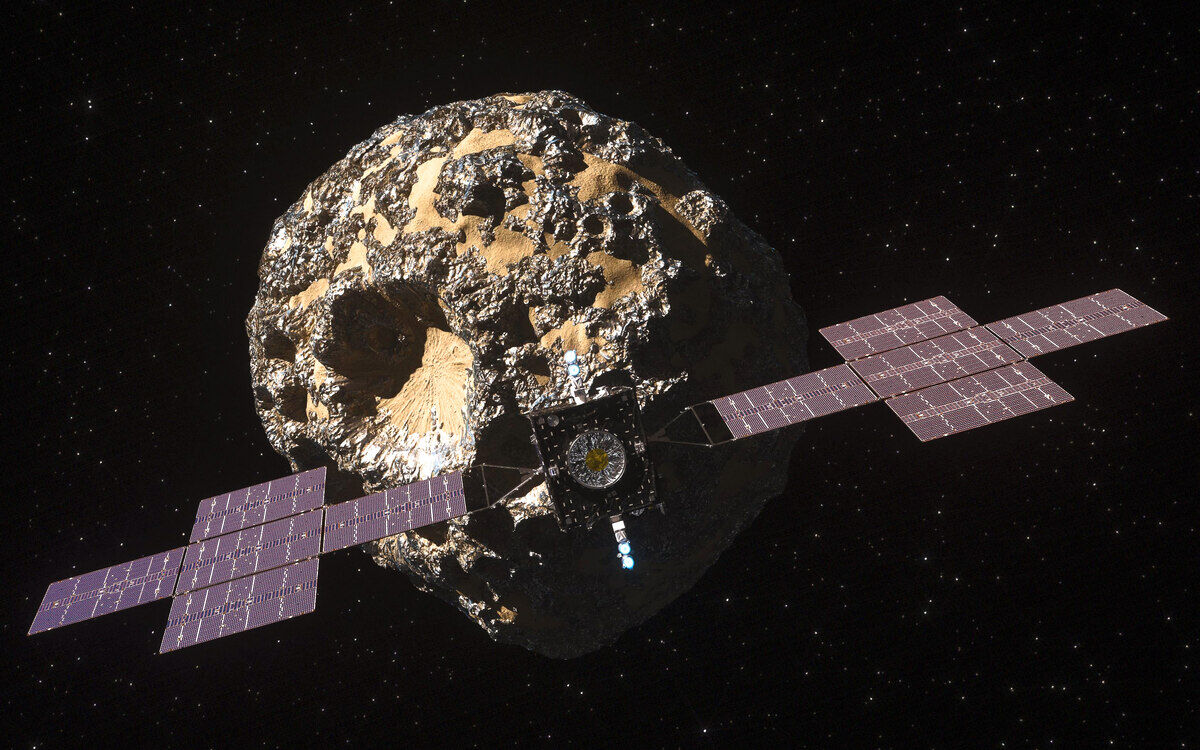
The resource potential of these metal-rich bodies captured global attention with the discovery of 16 Psyche, a roughly 140-mile-wide asteroid orbiting between Mars and Jupiter that is estimated to be more than 80% nickel, iron, and other metals.
Mining an asteroid like Psyche could provide the metals needed to build Martian infrastructure and support deeper solar system exploration and colonization.
The researchers also highlight the value of water and hydrocarbons found on carbonaceous asteroids. Beyond being a life-support necessity for future space travelers, the water extracted from these asteroids can be converted into hydrogen and oxygen rocket propellant.
In that sense, water-rich asteroids may serve as fueling stations for future deep-space transportation networks.
NASA
Metallic asteroids such as 16 Psyche could supply metals needed to build Martian infrastructure.
Asteroids-to-Mars supply chain
Bridging the gap between today’s technological reality and the mature interplanetary economy envisioned in “The Expanse,” set roughly 300 years in the future, the Swiss scientists developed an optimization to determine whether realistic asteroid mining routes could be established using current or near-term spacecraft technologies.
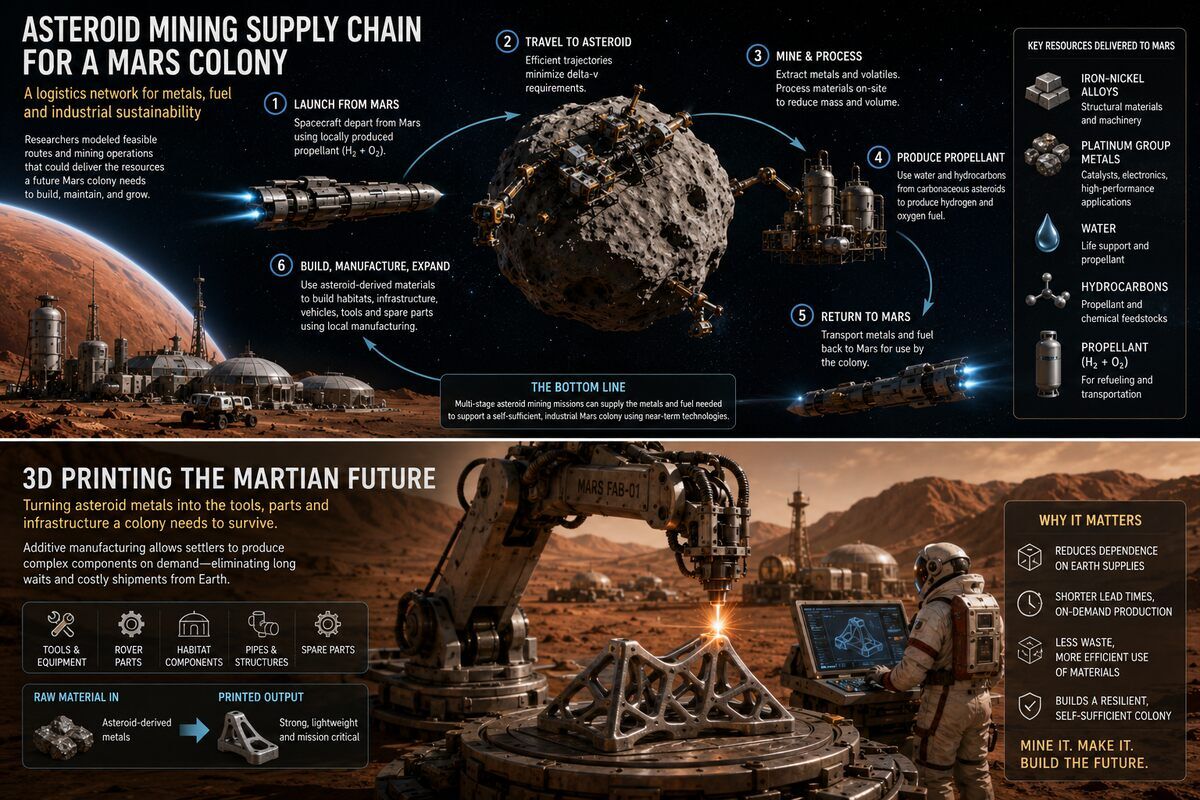
Rather than envisioning a single mining expedition, the study outlines the framework for a multi-stage logistics network that links Mars to select asteroids based on delta-v requirements – the amount of velocity change and energy needed to travel between space destinations.
The model simultaneously calculates the quantities of metal extracted, the amount of propellant that could be produced, and the overall efficiency of the transportation network.
The concept involves launching spacecraft from Mars to asteroid mining targets, extracting metals and producing fuel where possible, and returning useful materials to the Martian colony.
The researchers conclude that such a supply chain may be technically feasible using propulsion systems and mission profiles already under serious consideration within the aerospace sector.
The viability of the concept, however, depends heavily on mining productivity.
Different extraction rates were modeled to determine how much material could realistically be delivered to Mars over time. The results suggest that even relatively modest mining rates could eventually provide meaningful quantities of industrial feedstock for a growing colony.
The scientists foresee mining outposts that support the establishment of extraterrestrial supply chains may emerge decades before the Martian metropolis envisioned in “The Expanse.”
3D printing the Martian future
One of the study’s most important conclusions is that asteroid mining only becomes practical if Mars can directly use raw materials delivered from space.
Without local metallurgy and manufacturing, a Martian colony would remain heavily dependent on Earth.
Additive manufacturing – more commonly known as 3D printing – is expected to play a critical role in transforming asteroid mined metals into the habitat, equipment, rovers, tools, and parts needed for humans to survive and thrive on the Red Planet.
Considering the extraordinarily high costs of launching materials off Earth, and the months or years it would take to deliver them, the ability to manufacture colony expansion materials and replacement parts on the Martian surface will be essential to the long-term viability of a colony there.
This concept mirrors broader trends already underway in terrestrial industry and aerospace manufacturing, where additive manufacturing is increasingly being used to reduce supply chain vulnerabilities, minimize waste, and rapidly produce complex components.
For future Martians, the ability to shape asteroid-mined metals into needed supplies may be existential and the foundation of self-sufficiency.
Data Mine North via ChatGPT
From here to The Expanse
Much like Corey extrapolated the geopolitics and social classes of Earth across the solar system, today’s terrestrial critical mineral discussions may one day echo across Mars and the asteroid belt.
The critical minerals list for a Martian society, however, will likely be much broader than the current concerns here on Earth.
If Mars becomes permanently inhabited, access to reliable supplies of iron, nickel, water, and spacecraft fuel could become just as strategically important there as antimony, gallium, graphite, and rare earths are on Earth today.
In that sense, the study by the Swiss researchers shifts the asteroid mining conversation from “quintillion-dollar rocks” and toward the practical realities of extraterrestrial infrastructure, logistics, manufacturing, and industrial resilience.
The challenges of getting the concepts off paper and into space, however, are immense.
Autonomous robotic mining systems capable of operating in microgravity remain in the early stages of development, and space-based refining technologies are largely experimental. Long-duration spacecraft reliability, radiation exposure, fuel storage, and economic feasibility all remain major hurdles.
The researchers do not claim asteroid mining is imminent. Instead, their study contributes to an evolving blueprint on expanding human colonization to the Moon, Mars, and beyond.
If humanity ultimately becomes a multi-planetary species, miners, metallurgists, and manufacturing engineers will likely be among the first wave of pioneers.
And perhaps, Belters and Martians 300 years from now may look back at “The Expanse” and early scientific studies such as this one as the first serious attempts to imagine what a civilization supported by extraterrestrial mining and supply chains might look like.
Author Bio
Shane Lasley, Metal Tech News

With more than 18 years of covering mining, Shane is renowned for his insights and in-depth analysis of mining, mineral exploration, and technology metals.