
Mars has always looked quiet from a distance. Dusty plains. Empty craters. Still skies. But every mile NASA’s Perseverance rover travels adds new clues about a planet that may once have been far more active than anyone expected.
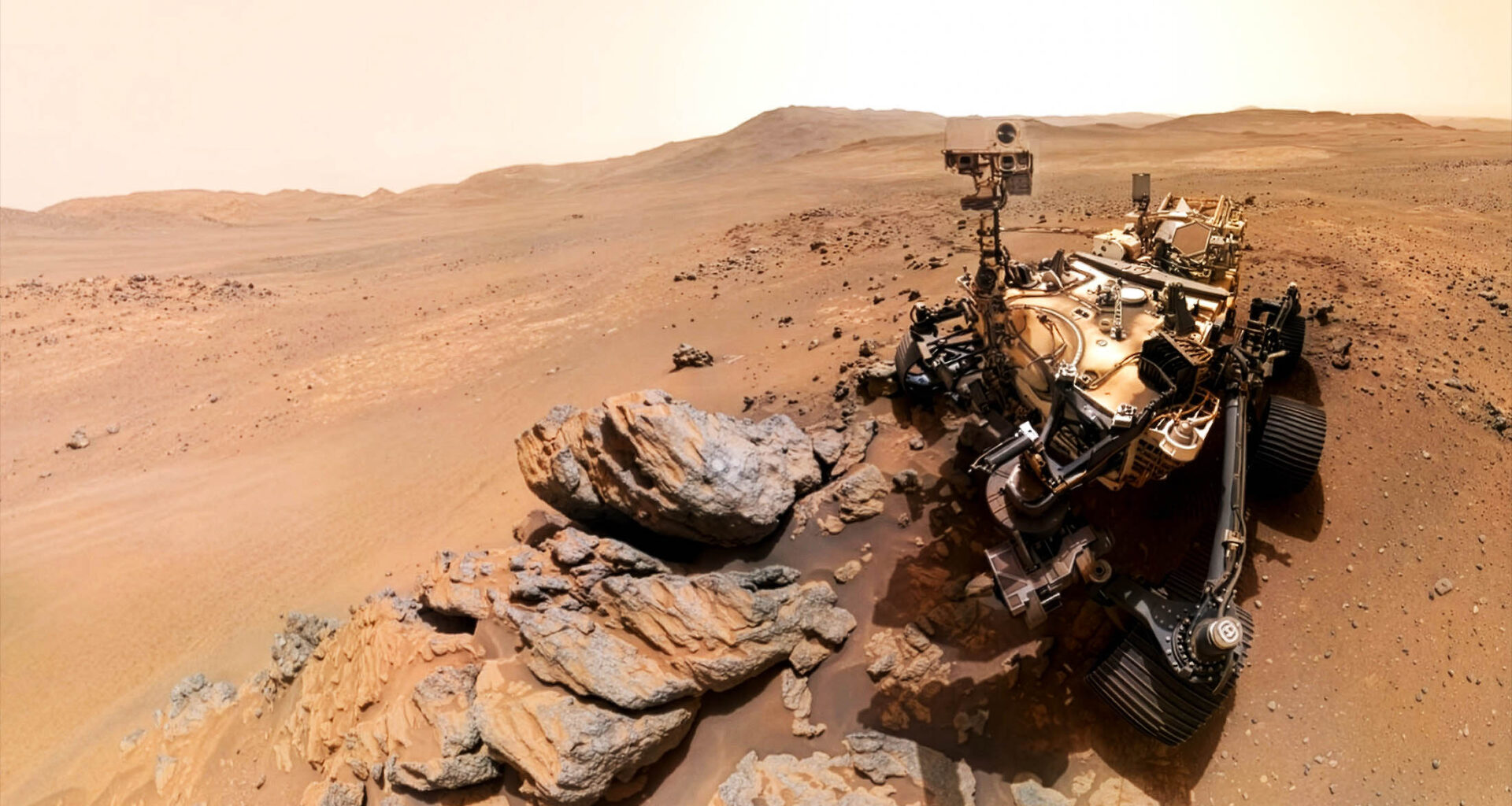
The rover recently snapped a new selfie while parked in a rugged region called Lac de Charmes, just beyond the rim of Jezero Crater.

The image is striking on its own. Perseverance sits in front of layers of rocky terrain shaped billions of years ago, with the crater rim stretching across the horizon. But the bigger story lies in what scientists found in the rocks beneath its wheels.
These rocks may be among the oldest pieces of Mars ever examined up close.
Mars rocks older than Jezero
The mission team believes the rocks here formed long before Jezero Crater existed, possibly giving researchers a rare look at Mars’ deep early crust from around 4 billion years ago.
“We took this image when the rover was in the ‘Wild West’ beyond the Jezero Crater rim – the farthest west we have been since we landed at Jezero a little over five years ago,” said Katie Stack Morgan, Perseverance’s project scientist at NASA’s Jet Propulsion Laboratory.
“We had just abraded and analyzed the ‘Arethusa’ outcrop, and the rover was sitting in a spot that provided a great view of both the Jezero rim and the local terrain outside of the crater.”
Grinding into Mars’ past
The rover did more than take pictures. Perseverance used a tool that grinds away part of a rock’s outer surface so instruments can study what lies underneath. NASA calls this process abrasion.
That fresh cut into a rocky outcrop named Arethusa revealed igneous minerals. These minerals form when molten rock cools and hardens underground.
Scientists think the rocks existed before the giant impact that created Jezero Crater itself.
That matters because ancient igneous rocks can preserve information from Mars’ earliest years, back when the planet may have had flowing water, volcanoes, and a thicker atmosphere.
Perseverance shows signs of survival
Perseverance captured the selfie using its WATSON camera, mounted on the end of its robotic arm.
The final image combined 61 photos gathered during 62 carefully controlled arm movements over roughly an hour.
NASA engineers have become surprisingly skilled at giving the rover personality through these images.
Perseverance now has six selfies since landing on Mars in 2021, and each one quietly shows how much punishment the machine has survived.
Dust covers parts of the rover, but the hardware continues to perform after years in brutal Martian conditions.
Mars’ oldest rocks exposed
Another recent image may be even more important scientifically. Using its Mastcam-Z camera system, Perseverance created a 46-image panorama of a nearby area called Arbot on April 5, 2026.
The mosaic shows rough ridgelines, scattered boulders, and layers of exposed rock shaped by ancient impacts and volcanic activity.
Some of the debris appears to be megabreccia – massive chunks of broken rock blasted across the surface by a giant meteor strike nearly 3.9 billion years ago in an area called Isidis Planitia. Some fragments may be as large as skyscrapers.
“What I see in this image is excellent exposure of likely the oldest rocks we are going to investigate during this mission,” said Ken Farley, Perseverance’s deputy project scientist at Caltech.
“There is a sharp ridgeline visible in the mosaic whose jagged, angular texture contrasts starkly with the rounded boulders in the foreground.”
Signs of ancient magma
Scientists also spotted what may be a volcanic dike – a vertical wall of hardened magma left behind after softer surrounding rock slowly eroded away over billions of years.
According to Farley, the feature stands out because of its sharp, jagged texture, which contrasts with the smoother, rounded boulders nearby.
The textures of the rocks are helping scientists separate one type from another. Some appear to be lava rock created by ancient eruptions.
Others were altered by violent asteroid impacts. Together, they could reveal how Mars evolved during its earliest chapter.
What these rocks could reveal
Scientists are especially interested because these rocks may come from deep below the Martian surface. If true, they could answer questions researchers have debated for decades.
Did Mars once have a giant ocean of magma early in its history? How quickly did the planet cool? And what conditions allowed liquid water to exist long enough for life to emerge?
“The rover’s study of these really ancient rocks is a whole new ballgame,” said Stack Morgan.
“These rocks – especially if they’re from deep in the crust – could give us insights applicable to the entire planet, including whether there was a magma ocean on Mars and what initial conditions eventually made it habitable.”
Mars today is cold and dry, with a thin atmosphere that offers little protection from radiation. But evidence gathered by orbiters and rovers continues to point toward a very different world billions of years ago.
River channels, lakebeds, minerals formed in water, and now these ancient crustal rocks all suggest Mars once had the ingredients needed for habitability.
Nearly a marathon on Mars
Perseverance is now in its fifth science campaign, called the Northern Rim Campaign. The rover recently moved northwest toward Arbot.
It will eventually head south to a region called Gardevarri, where scientists hope to study olivine-rich rocks tied to ancient volcanic activity.
After that, the rover is expected to travel toward another area known as Singing Canyon.
The mission has already exceeded many expectations. Since landing, Perseverance has abraded 62 rocks, collected 27 rock cores, sealed 25 samples for possible future return to Earth, and traveled almost 26 miles across Mars. That is just short of a full marathon.
“Having the benefit of four previous rover missions, the Perseverance team has always known our mission was a marathon and not a sprint,” said acting Perseverance project manager Steve Lee at JPL.
“We’ve almost reached marathon distance. Our selfie may show that the rover is a bit dusty, but its beauty is more than skin deep. Perseverance is in great shape as we continue our explorations and extend into ultramarathon drive distances.”
—–
Like what you read? Subscribe to our newsletter for engaging articles, exclusive content, and the latest updates.
Check us out on EarthSnap, a free app brought to you by Eric Ralls and Earth.com.
—–