
SOOKE HISTORY: Sooke caught the eye of famed Vancouver Island artist
Published 9:30 am Tuesday, May 19, 2026
What a lovely piece of news we learned from Dr. Chris Bryant last week. Many of us are familiar with the work of Vancouver Island artist E.J. Hughes. I personally have a number of prints of work he did as he travelled about Vancouver Island chronicling our scenic history in the years from the late 1940s.
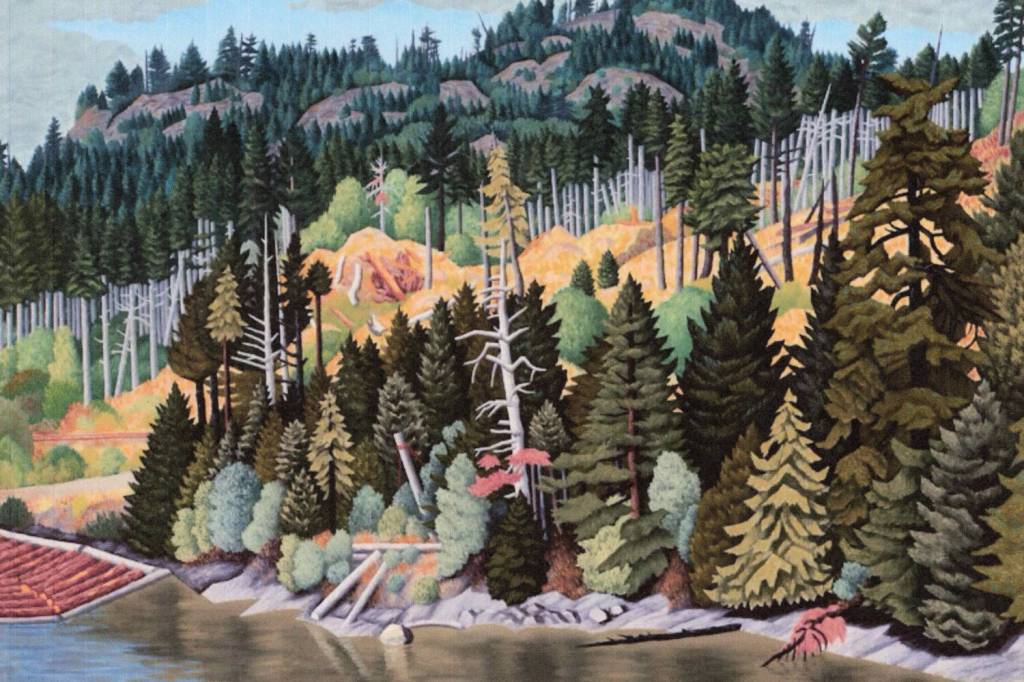
The scene that has caught our attention today is the painting Hughes did of Coopers Cove called Sooke Harbour Landscape 1951. This view is taken as he set up his easel on Goodridge Peninsula looking upwards towards Mt. Manuel Quimper (known to us as Mt. Shepherd).
At bottom left in the waters of the inlet we see a log boom, probably the work of Eric Bernard, who was taking poles out of the hillsides up Mt. Shepherd Road near Sheilds Lake and Crabapple Lake. Just to the right of the log boom we can see a log dump, where logs were trucked, originally by the Phillips Brothers and later on by Ted Shaw Logging.
It’s hard to believe the logging trucks could manoeuvre in the narrow little driveway that leads off from Highway 14 quite close to the marked route today where the Galloping Goose Trail (once the CNR line) crosses Highway 14, with a highway warning signal in place.
E.J. Hughes spent two weeks at Sooke, staying with his wife in a cottage at Sunny Shores Auto Camp in Saseenos, and walking to the sites he wished to record. As he could not afford a car, he mainly travelled by bus to painting sites. Years later, his official biographer, Robert Amos recorded several sites Hughes had depicted in our area, producing a series of fascinating books.
The news that was so interesting to learn was that nowadays, long after his passing, the work of E.J. Hughes is attracting the attention of collectors. The pictured work is currently being offered at auction in late May by Cowley Abbott, with an anticipated sale projection of $200,000 to $300,000.
It reminds one that history has shown us that often a struggling artist does not necessarily live to see their success, as it may be years later, as with Emily Carr, before the value of their work is truly realized.
Elida Peers is the historian with Sooke Region Museum.