
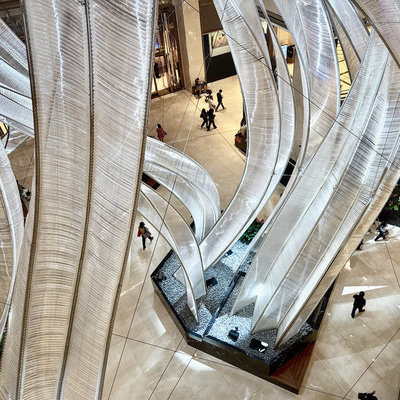
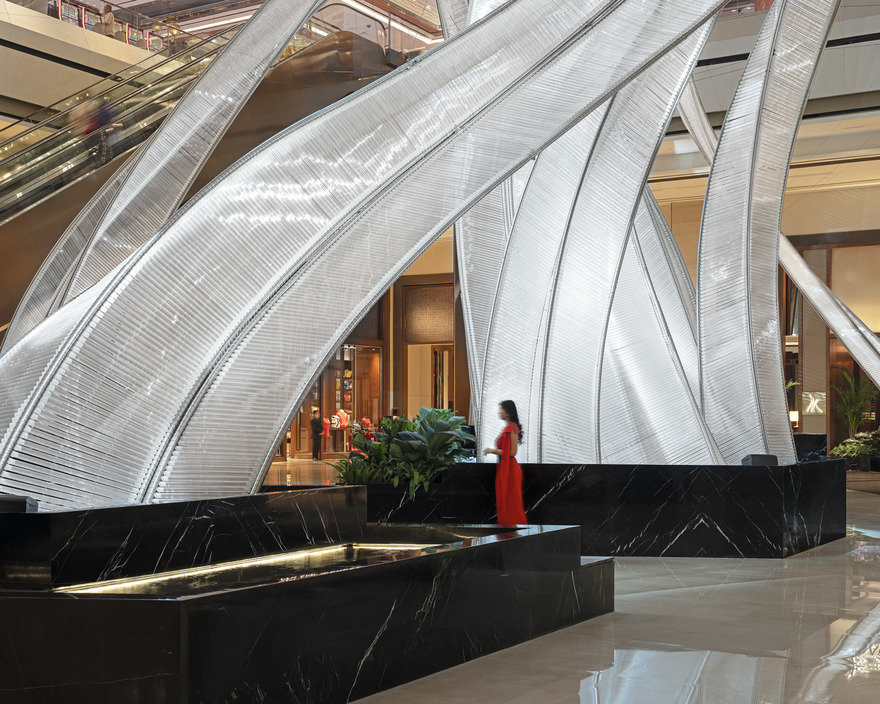
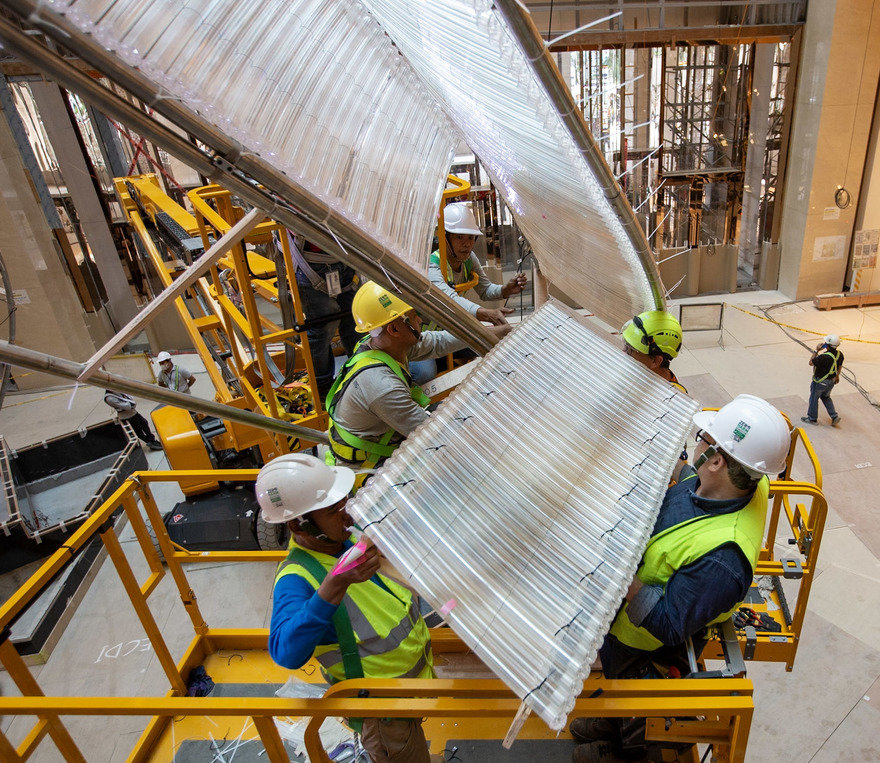
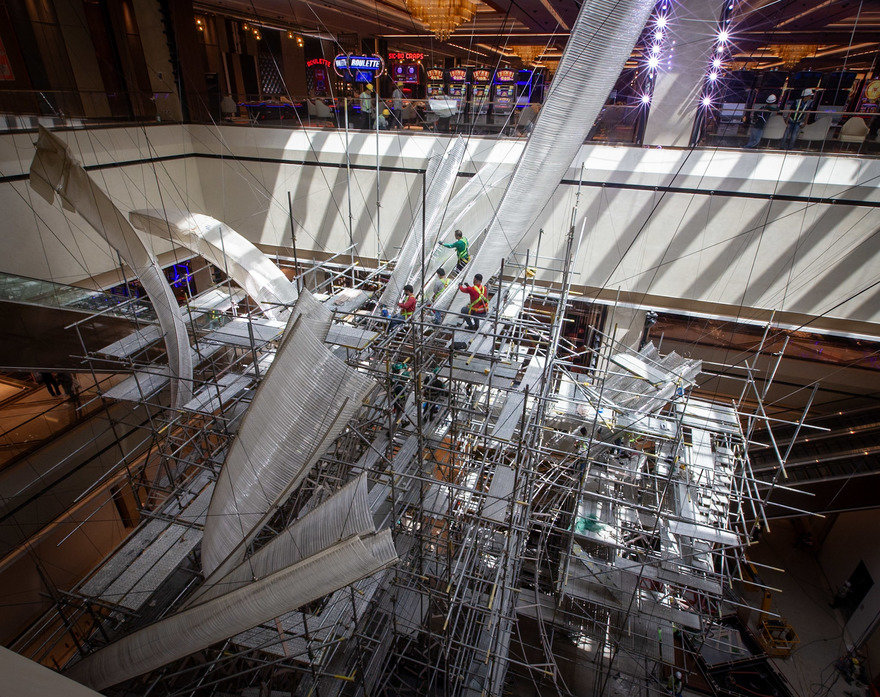
Nikolas Weinstein Studios’ sculptures are immediately recognizable. Often composed of thousands of glass tubes, they are defined by fluidity and inspired by the architectural spaces they inhabit. That vision recently earned them a Guinness Book of World Records title for Mangrove, the world’s largest glass tube installation. Soaring eight stories throughout the Solaire Resort atrium in Manila, Philippines, the sculpture weighs more than 13 metric tons and contains more than 16,000 individual glass tubes, all cut and woven by hand.
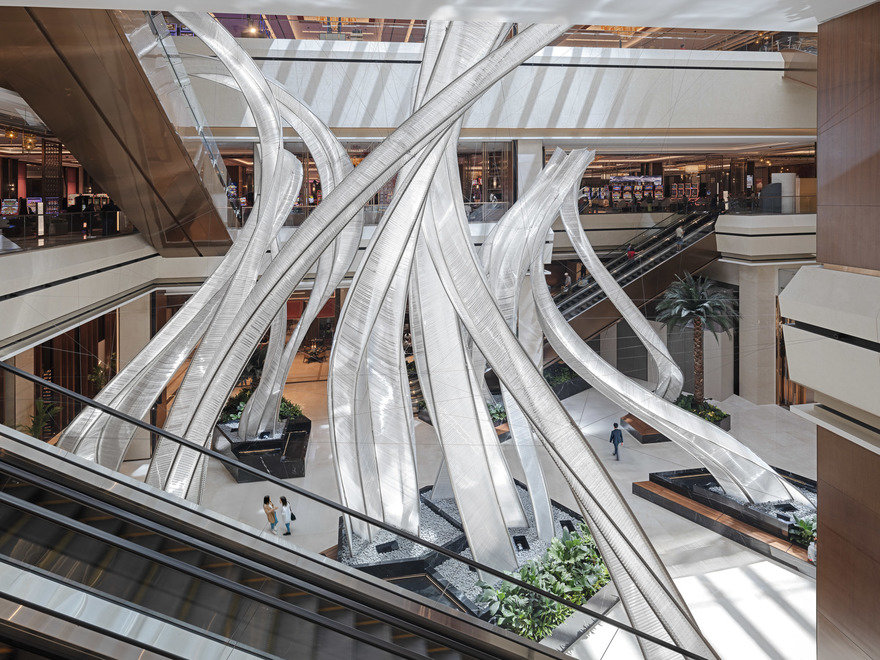 The eight-story Mangrove glass tube installation in the Solaire Resort.
Inspired by the atrium light shining down from above and the root system of the mangrove tree, Weinstein didn’t set out to break records. He simply wanted visitors to become part of the sculpture itself.
“The idea became environmental,” Weinstein says. “Instead of just looking at something in the middle of the space, like a piece on a podium, I was really interested in making something where you could move through it, above it, and around it. Even with all the modeling and preparation, the first time you see it upends expectation. It’s a beast.”
That sense of immersion and scale has defined Weinstein’s work for decades. Over the past 27 years, he has created sculptural installations for public buildings and private homes around the world. Even though the sculptures are hand-crafted, Weinstein has always been an early and enthusiastic technology adopter. Today, Autodesk Fusion plays a central role in bringing those visions to life.
Weinstein first encountered glass after college while working at a stained-glass company in Brooklyn. That rigid approach was a far cry from the fluid sculptural forms he would eventually create, but the experience sparked a fascination with glass that stayed with him.
A turning point came when renowned architect Frank Gehry encountered one of Weinstein’s sculptural pieces and invited him to collaborate. The relationship proved formative, not only because of Gehry’s stature, but because of the trust he extended to a young, relatively untested glass artist.
“I lucked out,” Weinstein says. “He gave me a tremendous amount of latitude, and it was, to say the least, both rewarding and harrowing.”
Connecting art and engineering with Fusion
Fusion now sits at the center of Nikolas Weinstein Studios’ workflow. While the organic glass forms often originate with sketches and then move into Rhino 3D, anything that must meet physical reality—dimensions, tolerances, hardware, fabrication constraints, and structural requirements—goes into Fusion.
“As soon as that organic shape needs to meet a hard reality, we move into Fusion,” says Jonah Burns, manufacturing engineer, Nikolas Weinstein Studios. “It becomes real there.”
For Weinstein and his team, Fusion acts as a hub where design, engineering, and manufacturing all come together.
“Fusion acts as a hub where we can do ‘a little of everything,’ whether it’s CAD, CAM, sheet metal design, FEA, or material calculations all in the same model,” Weinstein says. “I firmly believe that the people who are designing things should be the ones making them. With Fusion, we’re able to do that.”
That workflow became especially critical during the development of Mangrove. The studio collaborated closely with global engineering firm Arup to validate the sculpture’s structural systems and custom hardware. Fusion enabled the teams to rapidly iterate on cable tensioning components, test them, and refine them in near real time.
“We could easily work with our structural engineers at Arup, and within hours—not days or weeks—we’d redesign a component, print or machine it, physically test it, run FEA analysis, and send updated proposals back,” Burns says. “Sometimes we’d go through multiple iterations before lunch.”
Fusion also enabled seamless collaboration between the studio’s New York and San Francisco operations.
“I’d design something in New York, and someone in our San Francisco shop could immediately open it, switch to the CAM workspace, and cut it on the CNC there,” Burns says. “San Francisco has welding and metalworking capabilities we don’t have in New York, so we could instantly distribute work geographically while staying synchronized.”
For Mangrove, the team even developed a parametric welding jig generator to automate fixture creation for the sculpture’s many unique geometries.
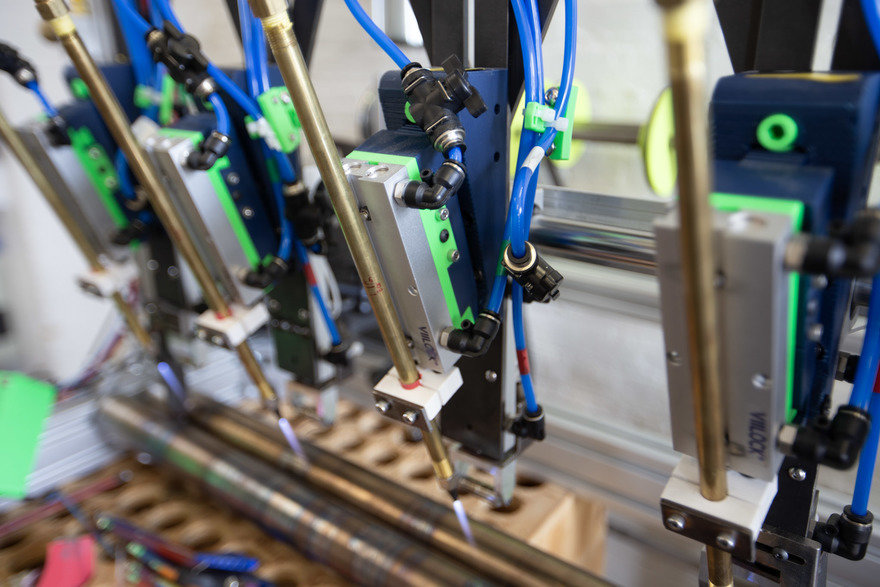
“For Mangrove, we built a parametric welding jig generator where we could take two angles (clocking and lean), and Fusion would produce a unique, labeled fixture,” Burns says. “What would have been 53 tedious custom designs boiled down to ‘tweaking a lowest common parametric denominator.'”
Designing custom tools and machines
The same mindset that drove Mangrove also pushed the studio to rethink its entire fabrication process. Over time, Fusion has evolved from a design tool into the platform the team uses to create the machines that manufacture the sculptures.
“We’re at this moment where everything is coming together,” Weinstein says. “With Fusion, we have the freedom to design and make anything we really want or need.”
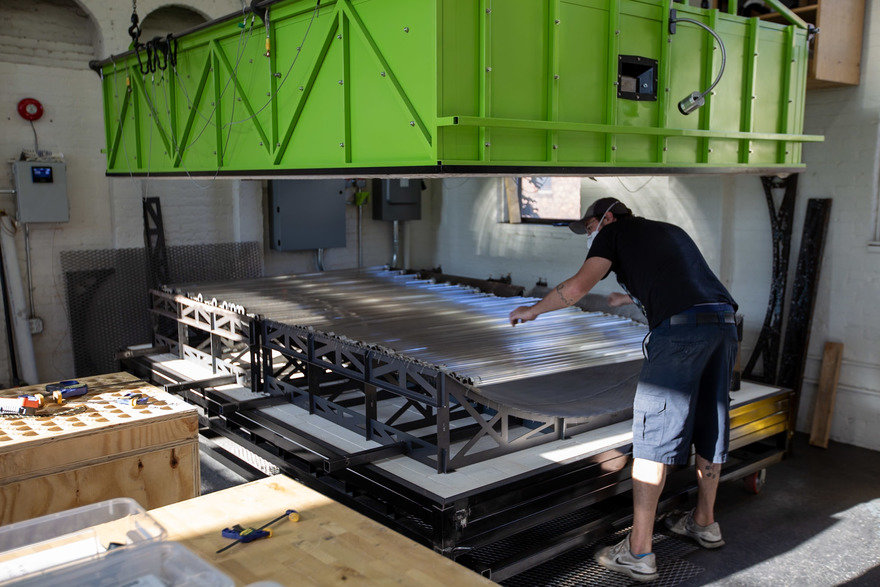
One example is a custom-built kiln that is now central to the studio’s glass shaping process. The kiln is used to heat-form or “slump” straight glass tubes into controlled curves using custom molds for Weinstein’s woven sculptures. As the glass softens over several hours, the tubes gradually bend to conform to the mold and develop the precise curvature needed for each installation.
Because the studio is located in a historic New York building, the kiln had to be designed as a sectional system that could be hoisted piece by piece to a second-floor workspace and assembled on site. Fusion enabled the team to coordinate the structure, electrical systems, and fabrication constraints within a single parametric model, ensuring every component fits both the space and the manufacturing process.
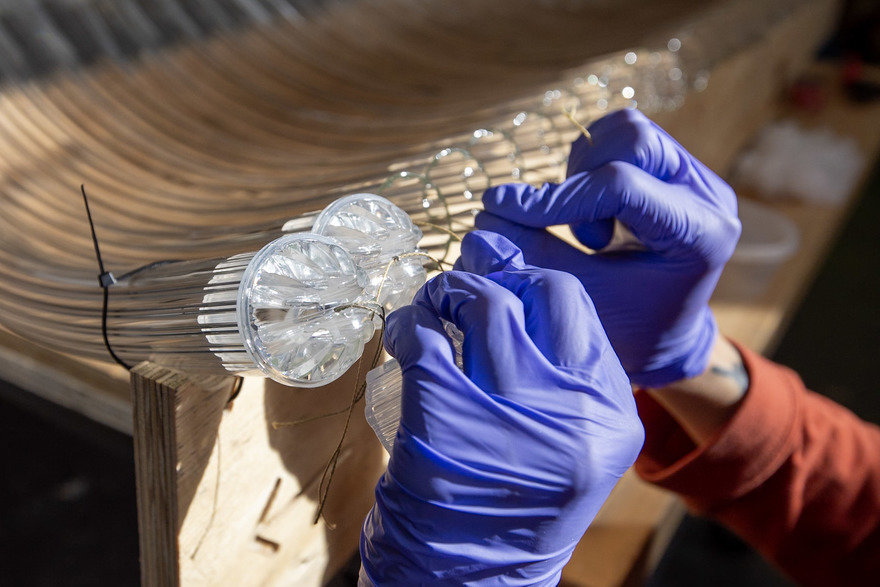
The team has also designed and built several custom fabrication machines tailored specifically to its glass weaving techniques. One of these is a glass-grooving machine that dynamically and equally spaces precise circular indentations into glass tubes. The grooves create channels for stainless-steel crossweave cables so they can’t slide during assembly.
“The entire thing was made in Fusion, and it’s now integral to our whole process,” Burns says.
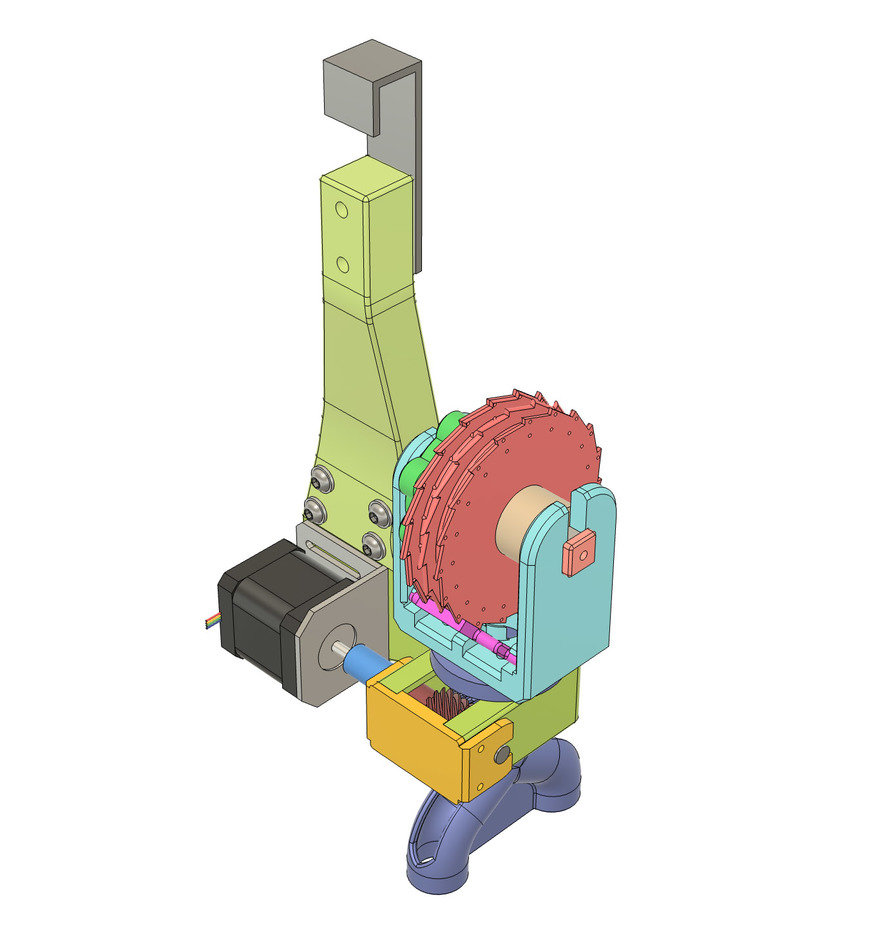
Two additional machines function almost like a loom. One automates the threading of continuous cable through hundreds of glass tubes, while another manages cross-weaving and twists cables into grooves with carefully controlled tension and spacing.
“No one else is going to want these machines or even try to make them,” Weinstein says. “They’re perfectly built for the kind of crazy things that only we would want to do. Fusion allows us this freedom to design the machines and solutions we really need.”
That ability to rapidly design, prototype, and manufacture custom systems has fundamentally changed how the studio works.
“In just the last five years, we’ve completely reinvented how we iterate,” Weinstein says. “Fusion allows us to imagine a machine that incorporates off-the-shelf parts with custom machined assemblies. Now we can make unicorn machines that do just what we want really quickly. It’s a dream that opens doors to a different way of working.”
See everything Autodesk Fusion has to offer with a free 30-day trial.