
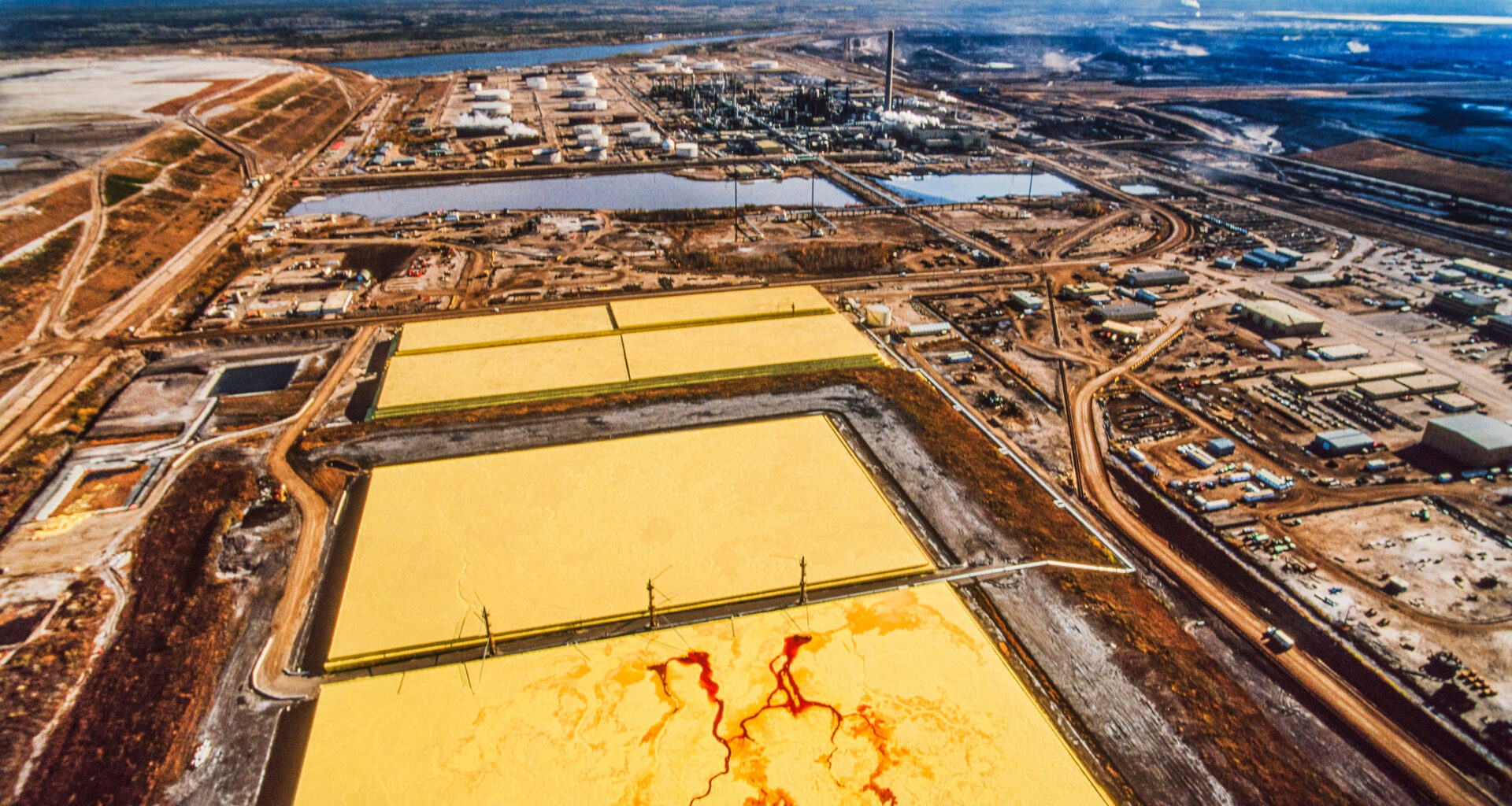
Canada’s flagship Pathways carbon capture and storage megaproject in Alberta will trap a quarter less CO2 than initially targeted by the oilsands consortium cleared to build the $20 billion-plus complex, according to last week’s energy ‘grand bargain’ agreement between Ottawa and the province.
Buried in the implementation agreement announced Friday by Prime Minister Mark Carney and Alberta Premier Danielle Smith is a clause cutting the project’s carbon capture goal to 16 million tonnes per annum (Mta) by 2035 from the original 22Mta pledged by 2030. Neither politician mentioned the revised capture target when they announced the deal in Calgary last week.
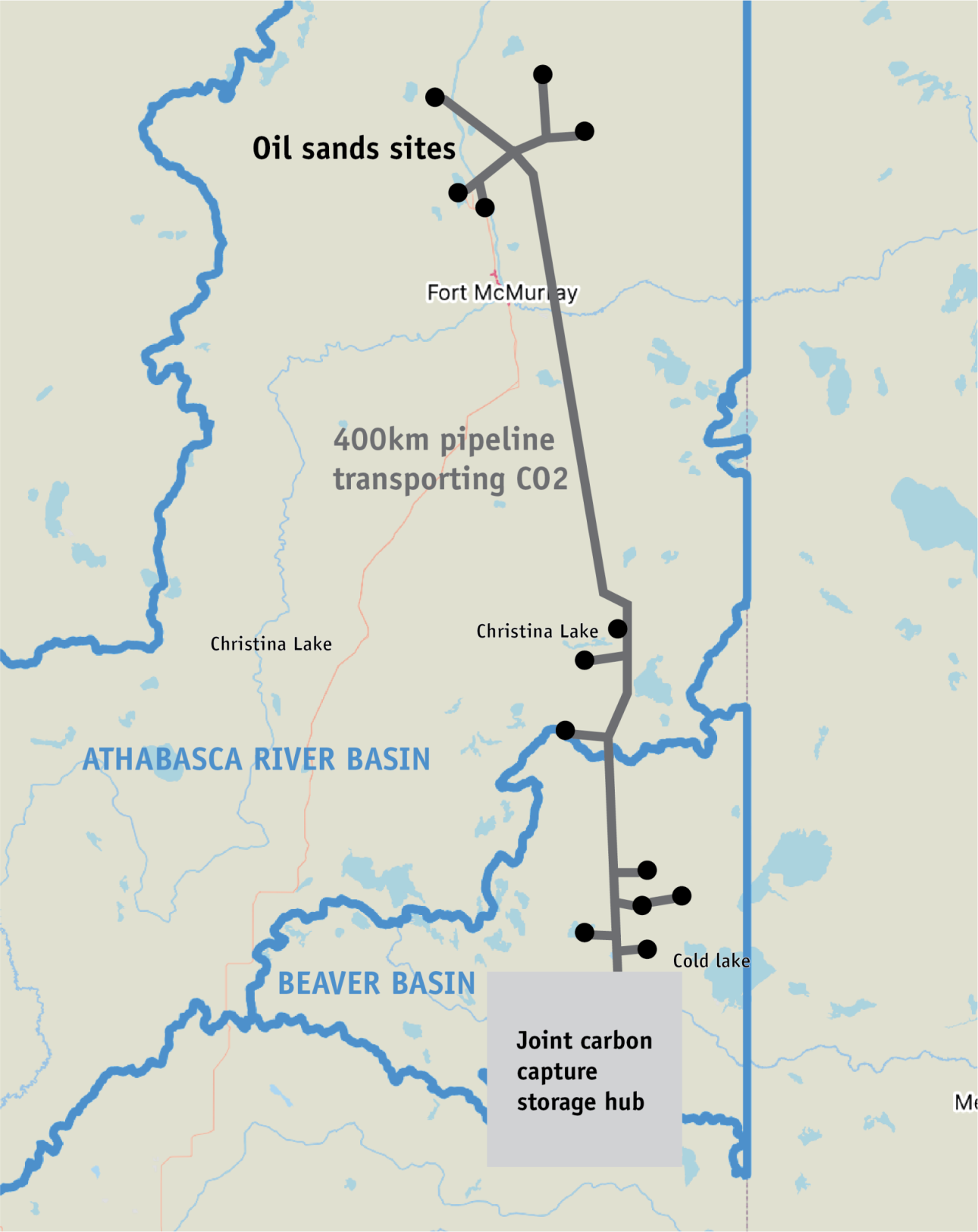 Map of Pathways CCS project infrastructure (Image: Canada’s National Observer)
The Pathways CCS project — a sprawling network of oil field CO2 capture plants north of Edmonton linked by pipelines to an underground injection hub — is being developed by the Oil Sands (formerly Pathways) Alliance, a consortium of five oil companies.
The giant CCS project, the biggest in development in the world, is a cornerstone to the oil and gas industry’s strategy for offsetting emissions from Alberta’s future expansion of production.
The scaled-back capture target comes as Pathways CCS is under scrutiny for potentially catastrophic environmental impacts that cast doubt on its ability to slow rising oil and gas sector emissions, especially with a new one million barrel per day Alberta-BC pipeline proposed in the energy agreement.
In Calgary, Carney said future production of what he has called “decarbonized barrels” of oil and gas “depends on Pathways.”
Higher oilsands emissions?
The CCS project would reduce CO2 emissions from oilsands production by the equivalent of removing 90 per cent of vehicles from Alberta’s roads, Carney said, and generate more than $16 billion in economic output while creating over 50,000 jobs in Alberta and Canada.
“Canada has been clear that we will grow the economy while reducing our emissions. The commitments made in the Canada-Alberta MoU and their resolve to work together to implement [the agreement], including with the Oil Sands Alliance on the Pathways project as a prerequisite for a potential pipeline to Canada’s west coast to serve Asian markets,” Natural Resource Canada spokesperson Charlotte Power told Canada’s National Observer.
“To create a strong future for Canada and to move forward on our climate, sovereignty, and trade diversification objectives, we need to take a collaborative approach with provinces and territories — this MoU is how we advance that work,” she said.
However, many climate and energy analyst groups are deeply skeptical. Examining various scenarios ahead of the Ottawa-Alberta MoU signing last November, the Pembina Institute said the newly finalized deal would produce the “highest absolute oilsands emissions” in its modelling — putting the sector on course to release 89 megatonnes of CO2 a year by 2035.
Canada’s emissions reduction progress slowed in 2024, due mainly to higher emissions from the fossil fuels sector, according to federal data released last month. Oil and gas production accounted for 30 per cent of the 685 megatonnes of greenhouse gases emitted that year.
There are various types of carbon capture and storage technology, but all are based around a three-step process engineered to collect CO₂ from industrial emissions, compress it, and inject it deep underground for permanent storage.
The system planned for the Pathways CCS project is a so-called post-combustion design. This concept captures flue gas during oil production and pumps it into a cooling tower to undergo a water-intensive process that uses a chemical compound called an amine.
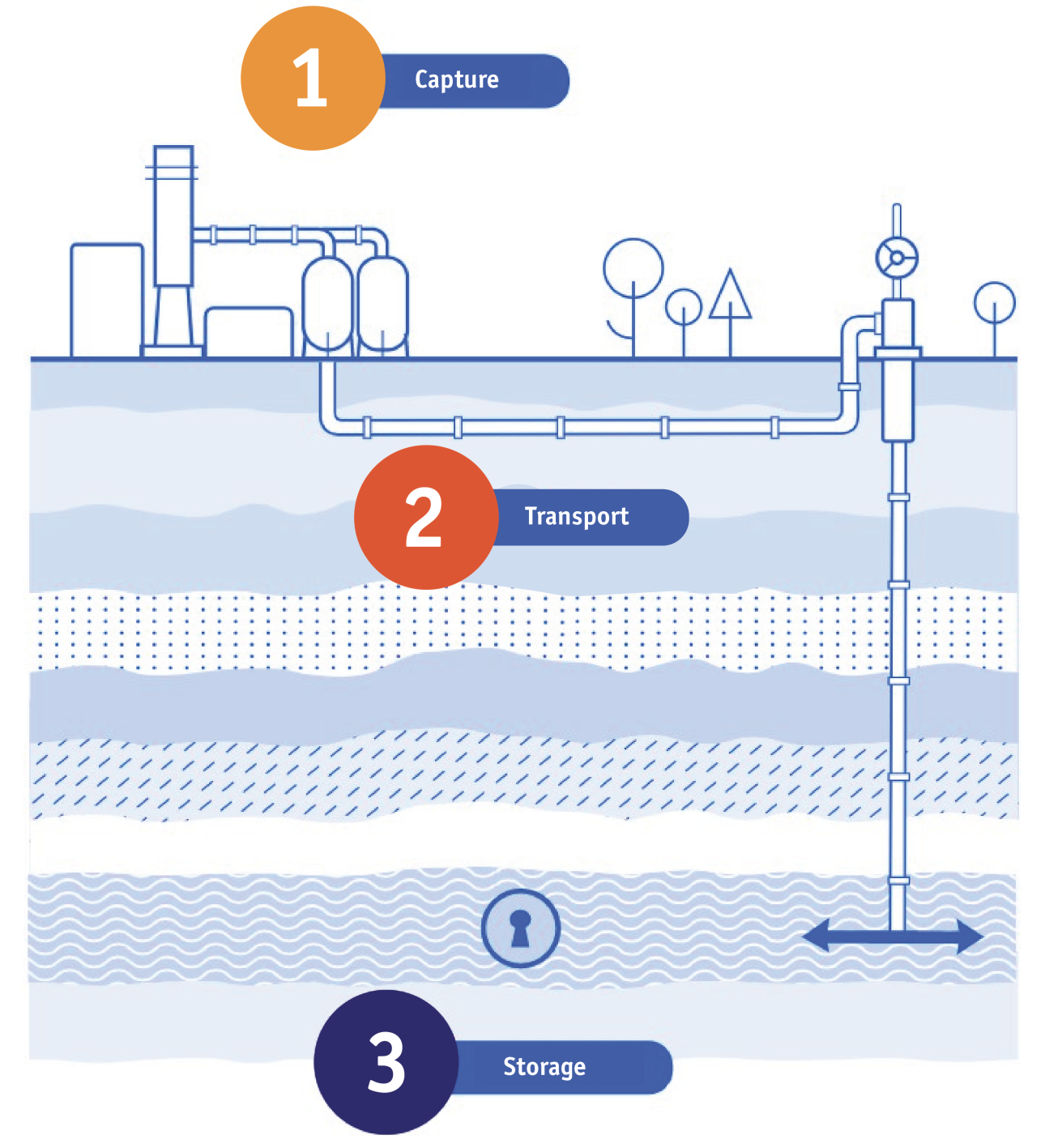 CCS systems are designed to capture (1), transport (2) and permanently store (3) emissions from industrial pollution (Image: Canada’s National Observer)
Nitrogen and water vapour are then removed and the CO₂ separated from the amine using an high-energy heating process, before it is injected “downhole.”
Storage at Pathways CCS CO₂ is planned for a site 1,000 metres below the surface of the earth, in a sandstone formation “sealed” under several layers of salt caprock. Many CCS plants to date have been used to boost hydrocarbon extraction, a strategy known as enhanced oil/gas recovery. So even if paired with CCS technology these projects would still drive a further rise in greenhouse gas released, as the vast majority of emissions come with burning the fuel.
Climate science is clear that the planet will continue to warm to dangerous levels — leading to worsening extreme weather, premature deaths, lost species and disrupted economies — until GHGs reach net-zero.
Emissions could yet be made worse by building CCS facilities as many oilsands sites will need new gas plants in order to generate enough steam to capture the carbon from existing operations.
The Pathways CCS project could bring “billions of dollars of private capital pouring into Alberta, help future proof the oilsands sector, and contribute to Canada’s climate objectives,” Janetta McKenzie, Pembina’s director of oil and gas, told CNO.
“But only if it is not twinned with a new pipeline” and its associated emissions, she added.
‘Equal to all iron and steel emissions’
Pembina calculated that developing Pathways CCS without the new pipeline, would lower oilsands emissions by 14 Mt by 2035 than in the current federal-provincial deal — removing the equivalent of “all iron and steel production emissions in Canada today.”
Alberta’s oil output is around 4.1 to 4.2 million barrels per day, exporting nearly all of it to the US. Smith has argued that demand in Asia for the province’s heavy oil justifies building a new pipeline to connect her province to BC tidewater.
But once in production, a new oil pipeline would add some 22Mta of CO2 to Canada’s emissions, according to estimates by the Canadian Climate Institute.
Ottawa’s support for a pipeline reflected its “light touch on policy” toward the oil and gas sector, CCI’s principal economist Dave Sawyer told CNO.
“The oil companies are going to benefit significantly from a big new pipeline, of course,” he said, “while the country is locked into a high rate of oilsands emissions for a very long time.”
CCI projects that current policy trajectories would “reverse progress already embedded” in legislation and push Canada’s national emissions more than 40 Mt above federal targets by 2050.
CCI has said the country’s climate progress is off track, including the 2030 Paris Agreement commitment, and the long-term goal of reaching net-zero emissions by 2050.
Carbon price peril looms
Pathways CCS is being funded through 75 million tonnes of carbon contracts for difference – long-term government deals with developers that guarantee a fixed, stable carbon price for industrial decarbonization projects.
Carbon capture and storage (CCS) is far from a new technology, with first projects dating back to the early-1970s. Today, according to the Global CCS Institute, a trade body, there are 50 CCS facilities operating worldwide, with 44 projects under construction.
The International Energy Agency forecasts CCS would need to account for around 15 per cent of the global greenhouse gas reductions needed by 2050 to limit the global temperature rise to below 2°C. To achieve this, the IEA projected the volume of CO₂ captured globally would need to increase from 43 million tonnes in 2024 to 5.6 billion tonnes in 2050.
Canada has a long history developing the technology, going back to Saskatchewan’s Boundary Dam and Weyburn CCS projects in Saskatchewan in the mid-2010s, which captures emissions for use in pressure-driven ‘enhanced’ production from existing oil and gas fields.
Among the highest-profile CCS projects since it came online in 2015 is Shell Quest, located near Edmonton, Alberta. A year into operation, the oil company reported the $1.3 billion facility had successfully captured and stored some 2 million tonnes of CO₂ – twice its target.
But efficiencies at the plant, which is connected to the Scotford refinery, have been falling, and costs had more than doubled between 2016 and 2022 from $35/tonne to over $75/tonne, according to latest calculations the Institute for Energy Economics and Financial Analysis, a thinktank.
Pathways CCS – being developed by the Pathways Alliance, a group made up of oil giants Canadian Natural, Cenovus, ConocoPhillips, Imperial and Suncor, is the project to eclipse all others. The $16.5 billion development, a key piece in the recently-signed energy deal between Ottawa and Calgary, aims to link 20 different oilfield CCS facilities via CO₂ pipeline to a central injection hub near Cold Lake.
Carney said the MoU’s carbon pricing model would “help put Canada on the path to net-zero” by 2050.
But the MoU with Alberta set a carbon price of $130/tonne — far below the ambitious $170/tonne set by the previous Liberal government. With the estimated capital cost already climbing from $16.5 billion to more than $20 billion, that lower price floor could raise financing risk for the project.
“With an industrial carbon price that will barely move against inflation for the next 15 years, it is highly unlikely we will see investment in the Pathways project or other meaningful action to reduce emissions in Canada’s oil sands,” McKenzie said.
The MoU with Alberta “just adds more uncertainty” to the future of PathwaysCCS, Sawyer said, noting that at the project’s launch four years ago it was expected to be operational by 2030.
Carney and Smith did not give a new project timeline at the press event last week, but the implementation document set a “6 Mta minimum as CCS in-service by 2035.”
McKenzie said the best way forward was a “strengthened” industrial carbon pricing system. “This, along with the federal and provincial subsidies already on offer for carbon capture projects, would create the necessary investment certainty to move the Pathways project to FID [final investment decision],” she said.
Signals from the industry have added to the project “uncertainty.” The Oil Sands Alliance — comprising producers Canadian Natural, Cenovus Energy, ConocoPhillips, Imperial and Suncor — has recently been backpedaling on its commitment to Pathways CCS and to carbon capture in the group’s decarbonization plans.
Lisa Baiton, CEO of the Canadian Association of Petroleum Producers, an industry body, made no mention of Pathways CCS in her statement welcoming the conclusion of the Ottawa-Alberta energy deal.