
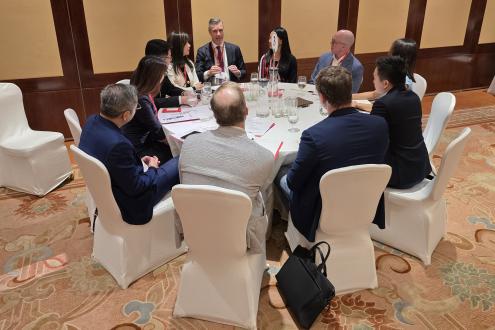
Hong Kong wealth management is no longer in a period of simple recovery – it is entering a phase of recalibration and strong growth. The city has come through a turbulent half-decade marked by political disruption, pandemic dislocation, outbound migration, and shifting China dynamics, alongside persistent questions about its long-term relevance as an international private wealth hub. Yet recent data point to a meaningful resurgence in activity. Assets under management have climbed back above HK$35 trillion, reflecting renewed growth, while net fund inflows have rebounded sharply, signalling a return of investor engagement. At the same time, the family office segment continues to expand, with more than 3,300 single-family offices now established in Hong Kong, supported by ongoing government initiatives to reinforce the city’s position as a leading regional wealth centre.
Key Takeaways
Hong Kong’s Wealth Market Is Rebuilding from a Position of Strength: Hong Kong is no longer defined by recovery alone. With AUM back above HK$35 trillion, net fund inflows rebounding, and more than 3,300 single-family offices established in the city, the market is entering a new phase of growth. The core message from WealthTHINK Hong Kong 2026 was clear: Hong Kong remains highly relevant, but its relevance now depends on continued adaptation, stronger execution, and clearer differentiation.
Clients Are Cautious in Sentiment, But Still Seeking Growth: Private clients remain concerned about valuations, geopolitics, technology concentration, and macro fragility, yet many are still positioning for upside. Survey findings pointed to stronger appetite for capital appreciation, more moderately adventurous allocations, and reduced defensiveness. For wealth managers, the challenge is to advise clients who are anxious but still unwilling to miss market opportunities.
Advice Must Move Beyond Product Access: The industry is shifting away from product-led distribution towards more aligned, transparent and defensible advice. Clients are increasingly questioning portfolio construction, fees, manager selection, conflicts of interest and implementation quality. Advisers will need to prove their value through judgement, interpretation and contextual thinking, rather than basic information delivery or access alone.
Wealth Advice Is Expanding into Structuring, Mobility and Jurisdictional Resilience: Families are no longer focused only on investment diversification. They are also seeking resilience across tax residence, succession, legal exposure, education pathways, citizenship, mobility and geopolitical risk. For Hong Kong advisers, this means greater fluency is required across trust structuring, insurance wrappers, CRS, cross-border planning and the evolving needs of Greater China families.
AI and Technology Need to Deliver Operating Leverage, Not Theatre: Technology was framed less as disruption for its own sake and more as a practical route to better economics, workflow efficiency, compliance support and adviser productivity. AI will not replace the adviser, but it will raise the standard of advisory work by automating lower-value tasks and allowing human judgement to be applied where it matters most. Firms that use technology to improve service quality and scalability will be better positioned in Hong Kong’s next phase.
View the photos HERE.
That backdrop matters, because the discussions at WealthTHINK Hong Kong 2026 were not framed by decline or defensiveness. Quite the opposite. The tone across the day was that Hong Kong remains highly relevant, but that relevance can no longer be taken for granted. The market is more competitive, clients are more discerning, and the operating model of private wealth management is being stress-tested from multiple directions at once. The old assumptions still carry weight, but fewer of them now go unquestioned. Themes running through the opening panel and the interactive discussions included rising risk appetite amid persistent anxiety, the shift from product-led distribution to more aligned advice, the growing maturity of the family office ecosystem, the mainstreaming of jurisdictional planning, and the push to use AI and digital infrastructure not as theatre, but as real operating leverage.
One of the clearest conclusions from the day was that client behaviour has become more contradictory, not less. Investors remain concerned about valuations, geopolitical risk, concentration in technology, and the fragility of the global macro backdrop. Yet many continue to position for growth. The opening survey findings, discussed welcome address, suggested a marked rise in moderately adventurous positioning and a decline in defensive allocations, while capital appreciation regained ground over capital preservation as the primary portfolio objective. That matters commercially. It suggests that despite the noise, private clients are still seeking upside, still allocating to equities, and still drawn to innovation-led themes, even when their rhetoric remains cautious. For wealth managers, the implication is straightforward: this is not an environment in which fear has paralysed decision-making. It is an environment in which clients are worried, but unwilling to be left behind.
That creates a more difficult advisory landscape. Clients are not merely asking for access anymore. They are interrogating portfolio construction, fee structures, manager choice, implementation quality, and increasingly the rationale behind advice itself. Several discussions made clear that private wealth clients in Hong Kong are becoming harder to serve with lazy intermediation. That is partly because information is more widely available, partly because clients are more global in their frame of reference, and partly because AI is beginning to change the way they prepare for meetings and challenge recommendations. The Unique AI and Avaloq sessions both pointed to a future in which advisers are less valued for basic information transfer and more valued for judgement, interpretation, and contextual thinking. In other words, the adviser’s role is not disappearing, but it is moving up the chain.
This is particularly relevant for Hong Kong, where the industry has long depended on relationship strength, execution capability, and access to opportunity. Those pillars still matter, but the basis of competitive differentiation is shifting. Product shelf alone is no longer enough. Across the Janus Henderson and opening panel discussions, there was a repeated emphasis on alignment, transparency, and trust. Clients may still tolerate embedded economics in some cases, but they are much more alert to conflicts of interest and much more willing to question whether a recommendation primarily serves them or the institution. That makes fee transparency and business model clarity more important than many firms have historically assumed. It also helps explain the continuing rise of family office, MFO, EAM, and hybrid advisory structures that position themselves as more open-architecture, less transaction-driven alternatives to the traditional private bank model.
That said, the day did not endorse a simplistic anti-bank narrative. Large institutions retain formidable advantages in custody, execution, research, lending, balance sheet, and global connectivity. What is changing is the ecosystem around them. Hong Kong increasingly looks less like a market dominated by a single private banking archetype and more like a layered advisory architecture, in which banks, family offices, independent advisers, trustees, fiduciary specialists, technology platforms, and structuring experts all play more differentiated roles. This is probably a healthy evolution for the market. It reflects the fact that wealthy families are themselves becoming more complex: more international, more multi-jurisdictional, more exposed to private assets, and often more divided generationally in how they think about risk, governance, and purpose.
That generational shift was another important thread. The opening panel discussion made the point that next-generation wealth owners in Hong Kong are not simply a younger version of their parents. They often have different expectations around impact, delegation, digital assets, and the use of time. They are typically less interested in frequent trading for its own sake and more interested in finding structures, advisers, or managers they can trust. That matters because it points towards a more discretionary, more outsourced, and potentially more scalable future for parts of the industry. Several discussions also noted the growing commercial importance of recurring revenue models, including discretionary portfolio management, model-based advisory frameworks, and platform-enabled delivery. For firms looking ahead, the message was clear: client preferences are changing in ways that may favour less episodic, less transaction-heavy relationships.
At the same time, the industry is being forced to widen its definition of what wealth advice actually includes. One of the most valuable insights from the 1291 Group and Henley & Partners discussion was that jurisdictional planning is moving from the edge of the conversation to the centre. In a more fragmented world, wealthy families are no longer asking only how to diversify portfolios. They are asking how to diversify legal exposure, tax residence, succession risk, educational pathways, and geopolitical optionality. For Hong Kong-based advisers, this is especially relevant. Hong Kong remains attractive precisely because it sits at the intersection of Mainland connectivity and international capital access. Cross-boundary Wealth Management Connect continues to expand, and the city’s policy framework is increasingly geared towards reinforcing its role as a cross-border wealth hub. But that same positioning means advisers must be more fluent in mobility, citizenship, CRS, trust structuring, insurance wrappers, and evolving tax interpretations, particularly for Greater China families.
Family offices sit at the centre of this shift. Hong Kong’s official push into the sector has clearly gained traction, supported by tax concessions for eligible family-owned investment holding vehicles and by broader ecosystem building around the segment. But one of the more honest conclusions from the Eton Solutions discussion was that many family offices still remain under-institutionalised relative to the complexity they now carry. Manual reporting, fragmented data, and weak infrastructure remain common. That is a crucial point for the industry. The family office opportunity is real, but so is the execution challenge. Firms that want to serve or become institutional-grade family offices will need stronger operating models, better governance, and more integrated technology. Branding alone will not get them there.
Technology, in fact, was discussed throughout the day in a more mature way than is often the case at industry events. AI was not treated as a novelty or as a wholesale replacement for advisers. Instead, the conversation was more commercially grounded: where can AI reduce friction, improve workflow, support compliance, enhance research, or help advisers prepare better? The Unique AI and Avaloq sessions both landed in roughly the same place. The real opportunity is not in pretending wealth management has become a pure technology business. It is in redesigning workflows so that human judgement is applied where it matters most, while repetitive and lower-value tasks are increasingly automated or augmented. That distinction is important for Hong Kong firms facing margin pressure, rising client expectations, and growing competition from more agile models. Technology must improve economics, service quality, or both. It cannot simply become another expensive layer in an already costly business.
So where does this leave the Hong Kong private wealth industry?
The broad answer from WealthTHINK Hong Kong 2026 is that Hong Kong remains one of the world’s most consequential wealth centres, but its next phase will be defined less by legacy prestige and more by its ability to adapt. The city still has formidable structural strengths: deep capital markets, international legal and financial infrastructure, close access to Mainland wealth creation, improving policy support for family offices, and a growing role in cross-border allocation. More than 54% of Hong Kong’s AUM originates from outside Hong Kong and the Mainland, reinforcing its position as an international rather than purely domestic hub. But the firms best positioned to thrive will be those that respond to the market as it is now, not as it used to be.
That means several things in practice.
First, firms need to sharpen their value proposition around aligned advice, not just access. Second, they need to build more scalable operating models, whether through discretionary frameworks, better platforms, or more disciplined use of AI. Third, they need to broaden their advisory remit beyond investments into structuring, mobility, and jurisdictional resilience. Fourth, they need to be much more deliberate about how they serve next-generation clients whose expectations are materially different from the old private banking archetype. And finally, they need to recognise that in Hong Kong’s next chapter, credibility will come from substance: clearer economics, better execution, stronger governance, and a more honest articulation of where they genuinely add value.
That, ultimately, was the most useful conclusion from the day. Hong Kong is not trying to recreate the private wealth market of ten years ago. It is building the next version of it. And for firms prepared to adapt, the opportunity remains substantial.