
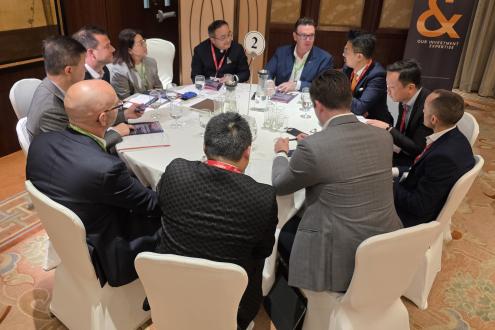
At WealthTHINK Hong Kong 2026, one of the day’s most timely and strategically rich discussions came in the form of an interactive session led by Yannick Haeni, CEO Asia at 1291 Group, and Dominic Volek, Group Head of Private Clients and Member of the Executive Committee at Henley & Partners. The conversation explored how wealth managers are responding to a world shaped by geopolitical tension, tax uncertainty, regulatory change and the growing importance of cross-border optionality.
What emerged was a clear shift in emphasis. For many years, mobility, residence planning and cross-border structuring sat at the margins of private banking conversations in Asia. Today, they are moving much closer to the centre. For ultra-high-net-worth (UHNW) families in Greater China, the question is no longer simply how to allocate capital, but how to diversify jurisdictions, preserve flexibility and structure wealth in ways that remain resilient as rules change. From residence and citizenship planning to Common Reporting Standard scrutiny, Chinese tax developments, offshore trusts and Private Placement Life Insurance (PPLI), the discussion made clear that structural resilience is becoming as important as investment performance.
Key Takeaways
Mobility planning is moving into the advisory mainstream: Residence and citizenship are increasingly being discussed as part of broader wealth preservation and optionality planning.
Clients are diversifying jurisdictions, not just portfolios: Families are thinking more carefully about where they can live, study, hold assets and manage succession.
Tax still matters, but it is no longer enough on its own: Location decisions now depend on a wider mix of lifestyle, safety, education and geopolitical considerations.
CRS enforcement is pushing clients towards real substance: A passport alone is not a solution. Long-term planning requires genuine tax residence and real facts on the ground.
Chinese tax assumptions may be shifting: Recent legal and tax developments suggest that old thinking around citizenship, household registration and reporting may no longer hold.
Trusts and insurance structures remain relevant, but must be used properly: Substance over form is becoming more important, especially for offshore trusts and Private Placement Life Insurance.
Citizenship programmes are becoming more selective: Wealth alone is less sufficient than before, and clients increasingly need to show connection, contribution and long-term intent.
View the photos HERE.
Setting the Scene: What is WealthTHINK?
WealthTHINK is an exclusive, invitation-only forum designed for CEOs and senior management at leading private wealth management firms. It provides a platform for senior practitioners to engage in peer-to-peer networking and collaborative discussion, without product pitches or formal presentations. The format is designed to encourage candid, table-level exchanges on the issues most relevant to the future of wealth management.
At its best, WealthTHINK allows participants to move beyond conventional talking points and focus on the strategic questions shaping client advice. This session did exactly that, bringing together bankers, wealth planners, tax specialists, insurance advisers and residence and citizenship experts to examine how families are navigating a more fragmented world.
Optionality Is Becoming a Core Wealth Objective
A major theme running through the discussion was that residence and citizenship planning are now less about relocation in the traditional sense and more about optionality.
Participants noted that many Asian clients who seek second residences or passports are not planning immediate moves. Rather, they want flexibility. They want more jurisdictions available to them if circumstances change, whether because of education, succession, politics, personal safety or a deterioration in the policy environment where they currently live.
As one participant observed, the motivation in Asia is often less lifestyle-driven than it once was in markets such as the United Kingdom. Instead, it is about having the ability to move if necessary. Another participant described this as a form of diversification, not unlike asset allocation itself.
That framing felt especially relevant in the current environment. Families are no longer just asking where they should invest. They are also asking where they can live, where their children can study, and which sovereign systems they want greater exposure to. In that sense, mobility planning is increasingly being treated as part of a broader wealth preservation strategy.
Tax Matters, But It Is Not the Whole Story
Although tax remains part of the discussion, participants were careful to stress that it is rarely sufficient on its own.
One participant noted that clients do not generally leave places such as Hong Kong or Singapore purely for tax reasons, because the practical benefits of living in those cities are difficult to replace. Another added that relocating solely for tax seldom produces a durable outcome. If the location does not suit the family culturally or practically, the move is unlikely to last.
That said, tax rules still shape decisions. The group discussed the reversal of flows involving the United Kingdom, where recent tax and residency changes triggered frustration among many wealthy international residents. Participants also pointed to changing interest in jurisdictions such as Portugal, and to the growing appeal of alternatives such as the United Arab Emirates, Singapore, Switzerland, Italy, Monaco and, for some families, New Zealand.
The central point was that location decisions are now multi-factor. Tax may be relevant, but so are education, safety, weather, culture, quality of life and geopolitical distance from conflict. Wealth managers therefore need to understand client priorities in a much more holistic way.
CRS, Tax Residence and the End of Easy Assumptions
Another major thread in the discussion was the tightening enforcement environment around the Common Reporting Standard and tax residency.
Participants said clients are becoming more aware that superficial solutions no longer work. Simply obtaining a second passport does not solve a tax residency issue. Nor does holding residence rights in another jurisdiction while continuing to live primarily somewhere else. If a family wants a genuine long-term solution, it increasingly has to establish real substance, real presence and, in many cases, genuine tax residence.
This was particularly relevant for Chinese clients. Participants stressed that many still come to advisers with misunderstandings, especially around the idea that a Caribbean passport or nominal overseas residence can somehow solve Common Reporting Standard (CRS)-related concerns. In reality, the discussion made clear that the issue is far more complex and depends on where a person is actually tax resident, how much time they spend there, and how their wider facts and circumstances are assessed.
There was also a broader sense that CRS 2.0 and related scrutiny are forcing families to take a more disciplined approach. In the past, some may have sought residence rights as a form of optional backup. Now, more are asking what it really takes to establish long-term compliance across multiple jurisdictions.
Chinese Clients Face a More Fluid Tax Landscape
One of the most detailed and sensitive parts of the discussion centred on evolving interpretations of Chinese tax and citizenship rules.
Participants referred to recent legal and tax developments that may challenge long-standing assumptions about how Chinese nationality, household registration and dual status are treated in practice. In particular, the conversation highlighted a recent Shenzhen court case involving a person who had obtained Singapore citizenship but continued to rely on Chinese documentation and status in mainland China. The case appeared to suggest that authorities may be willing, in some circumstances, to treat the Chinese nationality as effectively void once another citizenship has been taken up.
Participants also referenced a recent Beijing tax bureau decision that indicated tie-breaker analysis may be applied in some situations involving Chinese nationals with Hong Kong permanent residence. That, too, was described as a meaningful departure from traditional assumptions.
Taken together, these examples suggested that wealth planners and private banks may need to rethink how they approach Chinese clients who believed their status was straightforward or permanent. One implication discussed at the table was that these developments could shape not only reporting and tax analysis, but also how clients think about asset deployment, family ties and long-term structuring outside China.
The tone of the discussion was cautious, but the message was clear: old assumptions may no longer be reliable, and advisers need to pay much closer attention to legal developments that could materially affect clients’ status.
Structures Still Matter, But Substance Matters More
The group also examined the role of trusts and Private Placement Life Insurance in this changing landscape.
Participants noted that offshore trusts remain widely discussed by Chinese entrepreneurs and controlling shareholders, especially around succession planning and pre-listing structures. But there was also recognition that clients often misunderstand what these tools can actually achieve. A trust may help with estate planning, governance and asset protection, but it is not a simple shield against tax reporting or regulatory scrutiny.
One participant was explicit that using a trust as a way to avoid reporting obligations would be unacceptable. Others noted that regulatory authorities are becoming more sensitive to how such structures are used, particularly where pre-initial public offering shares or offshore holding structures are involved.
The discussion around Private Placement Life Insurance was equally nuanced. Participants said these structures can work well, including for listed or unlisted assets, but only when implemented properly. The key principle repeated several times was substance over form. If a client transfers assets into a policy but continues to control them as before, the structure risks being challenged. If the client genuinely gives up a degree of control and the arrangement functions as a real insurance solution, then the structure can still deliver planning benefits.
Taiwan was cited as one jurisdiction where authorities have made this distinction more explicit. That was seen not as a rejection of the structure itself, but as a reminder that these solutions must be used for the right reasons and with the right discipline.
Citizenship by Merit and a More Selective Future
The discussion closed with reflections on how the residence and citizenship market itself is evolving.
Malta, which had previously been a prominent route for citizenship, was cited as an example of a programme that has shifted away from a more formulaic process and towards a citizenship-by-merit framework. Participants explained that the new model requires more than wealth alone. Applicants need to demonstrate who they are, what they will contribute to a specific approved project, and how they will maintain ties with the country over time.
This was significant because it pointed to a broader trend. Citizenship planning is becoming more selective, more bespoke and less transactional. Clients cannot simply buy access in the way they may once have imagined. They increasingly need to show a credible connection and a meaningful contribution.
For wealth managers, this means the advice process is becoming more strategic. It is no longer only about identifying the quickest or cheapest route. It is about helping families choose jurisdictions that fit their long-term goals and can be defended in substance as well as form.
From Portfolio Diversification to Jurisdiction Diversification
This session highlighted how the remit of wealth management in Greater China is broadening.
Clients still need investment advice, but increasingly they also need guidance on where they are exposed, how they are structured, and which legal and tax systems they may need to rely on in future. Residence, citizenship, tax residence, trusts and insurance wrappers are no longer niche topics. They are becoming part of the mainstream advisory toolkit for globally mobile families.
The firms best placed to serve these clients will be those that can connect structural planning with practical reality. In a world of greater volatility and scrutiny, the goal is not simply to optimise. It is to remain flexible, compliant and durable across jurisdictions.
At WealthTHINK Hong Kong 2026, this discussion made clear that global volatility is changing the nature of private wealth advice. The future will belong to firms that can help families build not only stronger portfolios, but stronger jurisdictional resilience.