
For three billion years, if you’d looked at life on Earth, you’d have seen nothing.
Not nothing in the sense of empty space – the oceans were full – but nothing visible, nothing that moved, nothing with a body. Just microbes, everywhere, doing their invisible microbial things.

Then, in a period that feels sudden even by geological standards, animals appeared that were capable of moving around, of eating, and eventually of reproducing sexually.
How that transition happened – where, when, under what conditions – is one of the deepest unsolved questions in the history of life.
Fossils found in Canada
A new fossil discovery in a remote mountain range in Canada’s Northwest Territories has just brought us closer to an answer.
The study was led by researchers at the American Museum of Natural History and Dartmouth College.
The site sits in the Mackenzie Mountains on the traditional lands of the Sahtú Dene and Métis, who gave the research team permission to access it and provided guidance throughout.
It contains more than 100 fossils – including six groups of organisms never before found in North America – and some of them are older than anything of their kind previously discovered anywhere.
The strangest animals that ever lived
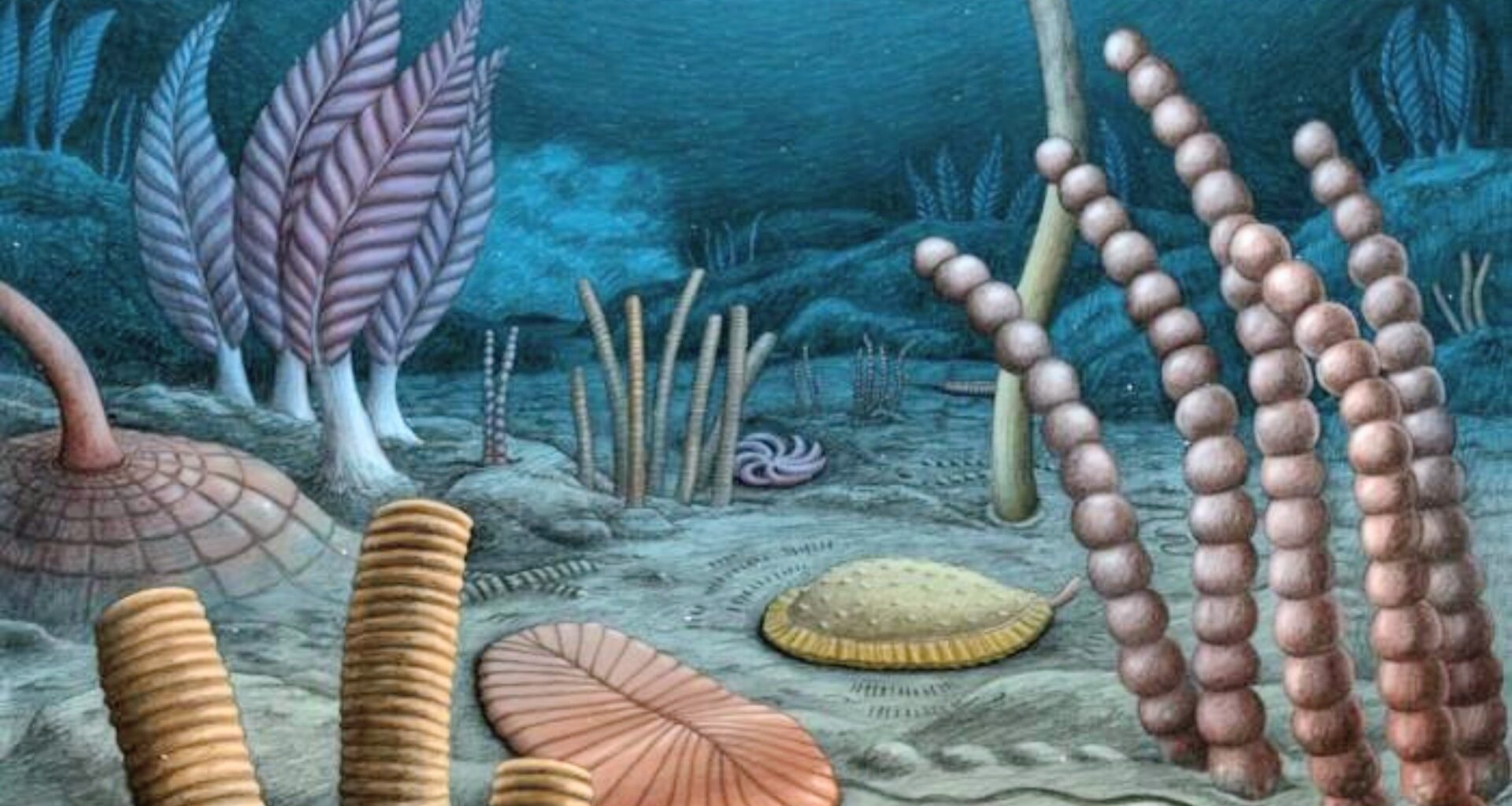
The organisms preserved here belong to what scientists call the Ediacaran biota. These are soft-bodied creatures that lived on the seafloor more than 500 million years ago.
They’re an extraordinary collection of things: flat discs, leafy fronds, ribbed ovals, tubular clusters.
Some bear a distant resemblance to animals alive today, while others look like nothing that has existed before or since.
Because these animals lived before most organisms evolved hard parts like shells or bones, they could only be preserved under exceptional conditions – the right sediment, the right chemistry, the right burial.
A rare fossil site
Ediacaran fossil sites are rare. Sites with more than ten distinct species are rarer still.
This one may turn out to be among the most important ever found, and the researchers have barely scratched the surface.
The rock layers containing the fossils are overlain by hundreds of feet of potentially fossil-rich rock that no one has yet examined.
Study lead author Scott Evans is an assistant curator of invertebrate paleontology at the American Museum of Natural History.
“For 3 billion years, life on Earth was dominated by microbes. Then, all the sudden, we get these strange-looking marine animals big enough to see and capable of behaviors we would find familiar today,” said Evans.
Organisms identified at the site
Among the organisms identified for the first time in North America, a few stand out.
Dickinsonia is one of the most recognizable Ediacaran animals – flat, oval, divided by internal ridges, capable of moving across the seafloor.
Kimberella had a muscular foot and fed by scraping the seafloor, and is widely considered a distant relative of mollusks. More significantly, it may be the oldest known fossil bilaterian.
This means it belonged to the group of animals with a distinct front and back, top and bottom, and left-right symmetry. That group today accounts for more than 99% of all known animal species, including us.
Evidence of sexual reproduction
Funisia is a tubular organism that lived in clusters, and it holds a particular distinction: the oldest evidence of sexual reproduction in the fossil record.
The clusters are thought to have formed through coordinated spawning – organisms releasing sperm and eggs into the water simultaneously, much the way corals do today.
Life was already figuring out sex more than 560 million years ago.
And then there’s Eoandromeda – a possible comb jelly with eight spiral arms, looking for all the world like something a child might draw if asked to imagine an alien.
What really surprised everyone
The fossils themselves are remarkable. But the timing is what has surprised palaeontologists.
Scientists divide Ediacaran fossils into three groups based on their age. The White Sea assemblage – the middle group, which includes animals like Dickinsonia and Kimberella – has previously been dated to between 559 and 550 million years ago.
Moreover, specimens had only been found in Europe, Asia, and Australia – never in North America.
The Canadian fossils belong to the White Sea group. But they appear to be around 567 million years old – 5 to 10 million years older than any White Sea specimens found anywhere on Earth.
Pushing back the timeline
What that means in practice is that the oldest evidence for animal movement (Dickinsonia moving across the seafloor) and the oldest evidence for sexual reproduction (Funisia spawning in coordinated clusters) just got 5 to 10 million years older.
Study co-author Justin Strauss is an associate professor of Earth and Planetary Sciences at Dartmouth, who has been exploring this region for about 15 years.
“Not only is this new site highly diverse, but also it is from a part of the rock succession where we have previously lacked fossil remains,” said Strauss.
“This is really exciting. Given our understanding of the regional geology in northwestern Canada, there is great potential here to revisit our understanding of Ediacaran Earth history.”
Where complex life began
There’s one more twist. The fossils were found in deeper-water environments than previously associated with White Sea assemblage animals.
That detail matters because it adds to a growing body of evidence for a hypothesis that, if true, would turn a long-standing assumption about animal evolution on its head.
The conventional picture has complex animal life beginning in shallow coastal waters – warm, sunlit, nutrient-rich – and spreading outward from there.
But these fossils, and others like them, suggest that the first experiments in complex animal life may have happened in the deep ocean, in cold, stable, dark conditions, before gradually expanding into shallower waters over millions of years.
“These results suggest a pattern where evolutionary innovation begins in deeper environments and later spreads toward the coast,” Evans said.
“We think of the deep ocean as a dark, inhospitable place, but it is also relatively stable, with few fluctuations in things like temperature and oxygen essential to most animal life. This stability may have provided key opportunities to support early animal life.”
The fossils will eventually be permanently housed at the Prince of Wales Northern Heritage Centre in Yellowknife.
The study is published in the journal Science Advances.
Image Credit: Alex Boersma
—–
Like what you read? Subscribe to our newsletter for engaging articles, exclusive content, and the latest updates.
Check us out on EarthSnap, a free app brought to you by Eric Ralls and Earth.com.
—–