
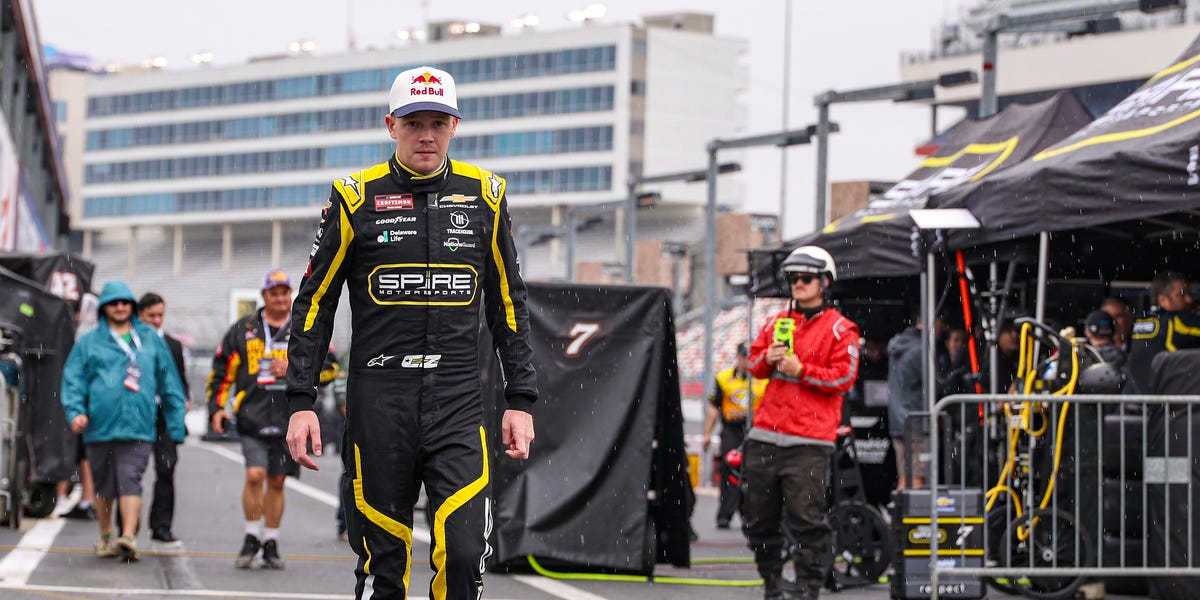
It’s hard to fathom that an entire generation has passed since the death of a NASCAR driver hit the sport with the same force as the loss of Dale Earnhardt Sr.
But it has. And the untimely passing of Kyle Busch a few days ago is a brutal reminder of that fact. It has been a little more than 25 years since that awful February afternoon when Earnhardt, a seven-time champion and arguably the greatest driver of his generation, lost his life on the final lap of the Daytona 500. What should have been a celebration became something else entirely. The sort of sporting moment where time stops dead in its tracks, the noise disappears, and even people who claimed they hated the man suddenly realized the sport would never quite sound the same again.
Related Story
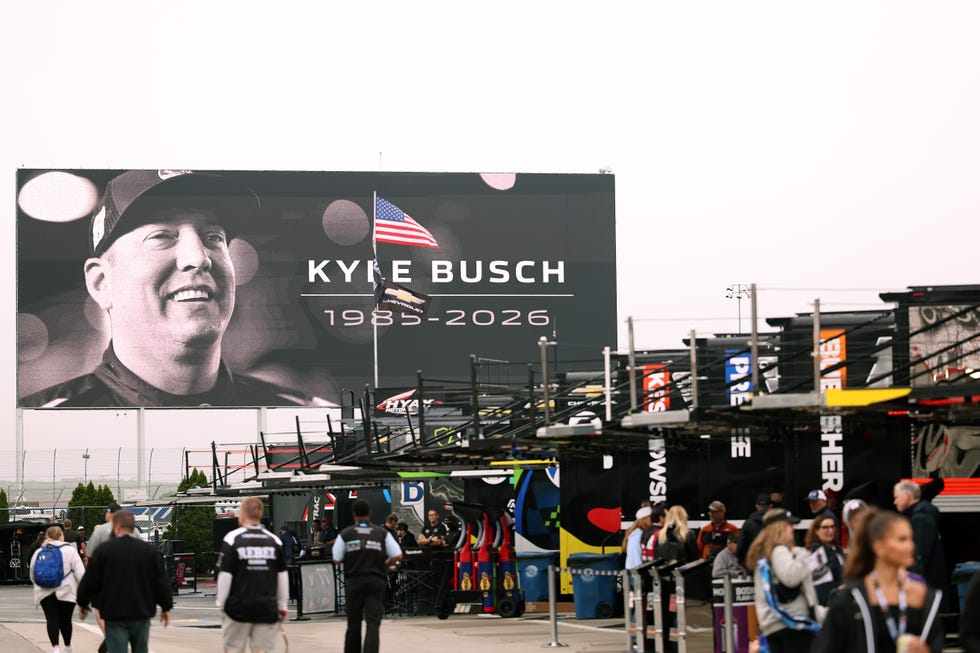
Now NASCAR has lost Kyle Busch.
Not in a race car. Not on the final lap of a race with sparks flying and engines screaming. Which raises an uncomfortable but unavoidable question: can Kyle Busch be compared to Dale Earnhardt?
For many younger drivers, Busch may ultimately become the first truly larger-than-life NASCAR personality they experienced in real time. Drivers like Connor Zilisch. Born in 2006, Zilisch, and in fact his entire generation, never saw Earnhardt race live. He grew up instead during the Kyle Busch era, which meant growing up around a driver who was impossible to ignore even if you desperately wanted to.
James Gilbert//Getty Images
And the memories Zilisch carries are both meaningful and very, very Kyle Busch.
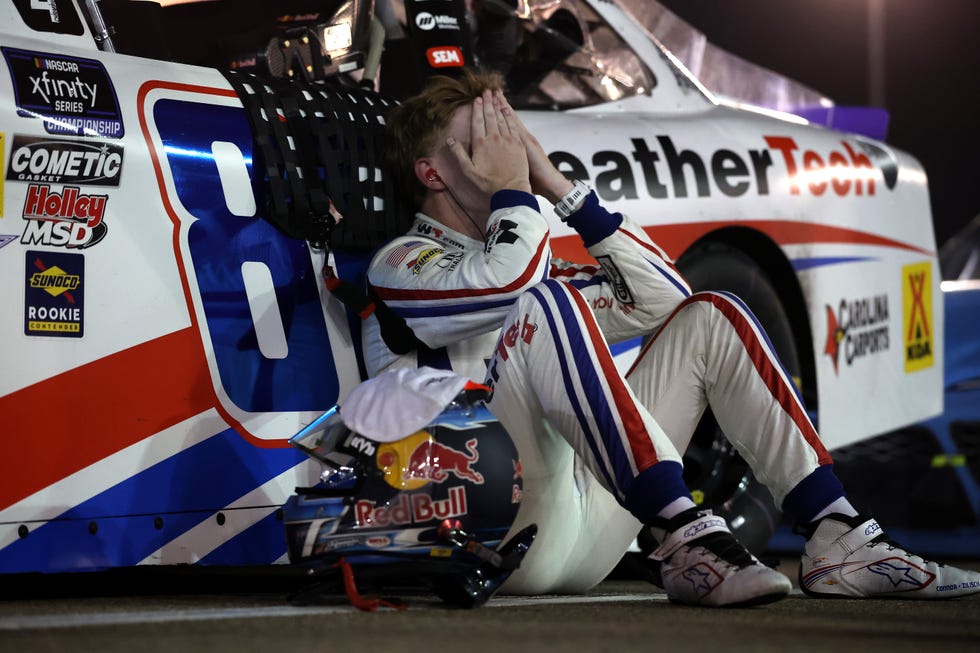
“He texted me after I lost the championship last year and just told me how proud he was of me and just how far I’d come,” Zilisch said Saturday at Charlotte Motor Speedway. “That meant a lot. You know, he didn’t have to reach out and do that. He wrote a few paragraphs and just kind of gave me some confidence after what was a really tough day for me, so that one meant a lot.”
And then there was this story, which sounds exactly like the sort of thing Busch would say because subtlety was never really his department.
“He texted me after I lost the championship last year and just told me how proud he was of me and just how far I’d come.”
“We were at the Daytona 500 this year and we do a driver meeting before the race,” Zilisch said. “I was in the driver’s meeting. It was my first one as a Cup driver. I asked if we were the last OEM group to pit, what should the plan be… are we going to try and like block the track and try and keep track position after the pit cycle? I asked that question. It was the end of the meeting and everybody kind of went silent. Nobody was answering me. And Kyle speaks up and he goes, ‘No, just get the fuck out of the way’. It’s my first time in one of these meetings. I’m a rookie, and I’m just like, ‘Oh okay… yeah, sorry.’ I was so embarrassed (laughs).”
Having never raced against Earnhardt, Zilisch admits it’s difficult to describe exactly what made “The Intimidator” so feared. But he absolutely can describe Busch.
Related Story
“He was just a fierce competitor that didn’t hold back,” Zilisch said. “…He did things the right way until he felt like he had to do something in retaliation maybe, get somebody back or racing against somebody that had raced him the wrong way previously.”
“You know, he taught me a lot from the few times that we got to race against each other,” he added. “He never put himself in the wrong spot. I felt like he was a wizard at this stuff. Growing up watching him, you wanted to be like him, even if you didn’t like him. You know, some days I didn’t like watching him because he was so good that I didn’t like watching him and that was just the way it was.”
 Jared C. Tilton//Getty Images
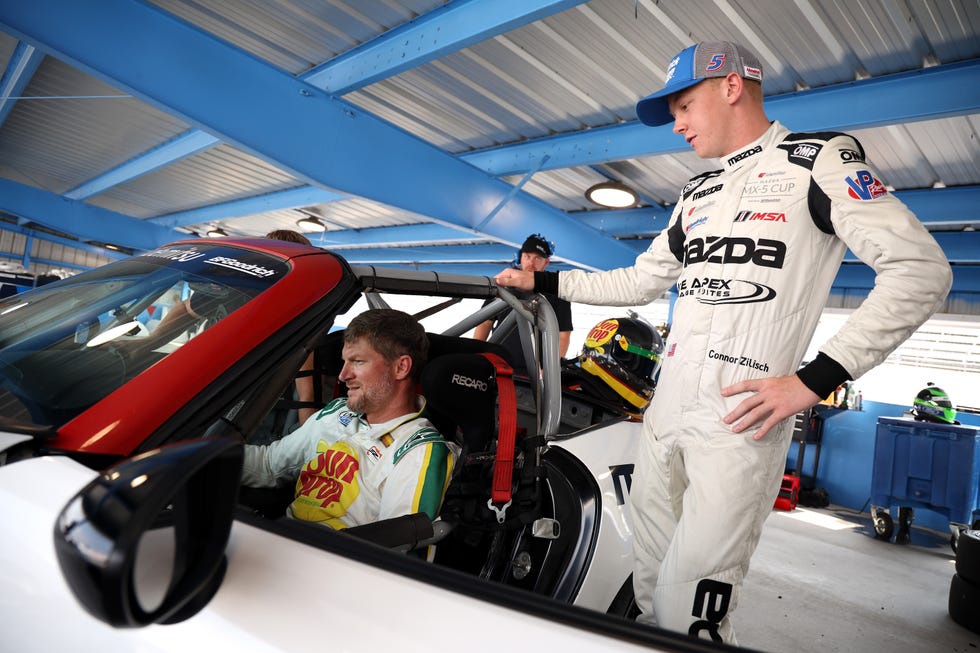
Dale Earnhardt Jr. speaks with a 17-year-old Connor Zilisch prior to driving a Mazda MX-5 Cup race car during the Mazda MX-5 Cup Test at Martinsville Speedway in 2003.
Born five years after Earnhardt’s death, Zilisch knows the legend mostly through stories, grainy highlights, and the mythology NASCAR carefully preserves around the black No. 3 Chevrolet.
“He was kind of like the guy back in the day, right?” Zilisch said.
But he knows exactly what Kyle Busch represented.
“Kyle Busch, when I was growing up, he was the villain, but he’s what made people watch the race,” he said. “People loved to watch Kyle Busch either because they loved him or because they hated him and they loved hating him. You know, it wasn’t really much in between there.”
Related Story
And perhaps most importantly, Zilisch understands something modern sports sometimes forget: Indifference is infinitely worse than dislike.
“I feel like 5-10 years ago, everybody would be cheering. Some would be booing, but everybody was making noise,” Zilisch said. “And I feel like that’s kind of just the way people viewed Kyle and who he was. I think that’s what this sport needs. You heard Steve O’Donnell say yesterday that you have to connect with the fans, and he connected with the fans.”
What young Connor Zilisch may not fully realize is that many of those same descriptions once applied almost perfectly to Earnhardt himself. Both men were generational talents. Both were unapologetically aggressive. Both could turn a grandstand into a thunderstorm of cheers and boos with a single move. And both understood something that many athletes never do: Fans don’t necessarily need to love you. They just need to feel something when you walk into the room.
David Jensen//Getty Images
“Yeah, that was just who Kyle was,” Zilisch said. “He was unapologetically himself. Some people didn’t like him. Some people liked him. But everybody respected him. That’s the Kyle that we’ll remember.”
And that’s just the way the older generation remembers Dale Earnhardt. Brad Keselowski was 17 when Earnhardt died. He wasn’t yet in NASCAR but witnessed it all from a fan perspective. He admits he hates comparisons of different eras, but even he has to make at least one.
“It is a significant moment in the sport,” Keselowski said. “Much like when Dale died, this sport won’t be the same without Kyle. How that is, I’m not entirely sure. I’ll understand it a lot more in the next three to five years and you will, too, but it is a certainty that it will be different—much like when Dale passed, it was different.”

I have been around and written about the sport of NASCAR for over three decades and previously worked fulltime for the Sporting News and Scripps-Howard News Service. I am also a contributor to two Chicken Soup for the Soul books including the NASCAR edition, published in 2010 and the author of “The Nuts and Bolts of NASCAR: The Definitive Viewers’ Guide to Big-Time Stock Car Auto Racing.” I am a multiple National Motorsports Press Association award winner. Early in life I spent 23 years combined active and active reserve military service, much of that in and around the Special Operations community serving in support of Operation Just Cause, Desert Shield/Storm and ended my military career in support of Operation Enduring Freedom.