
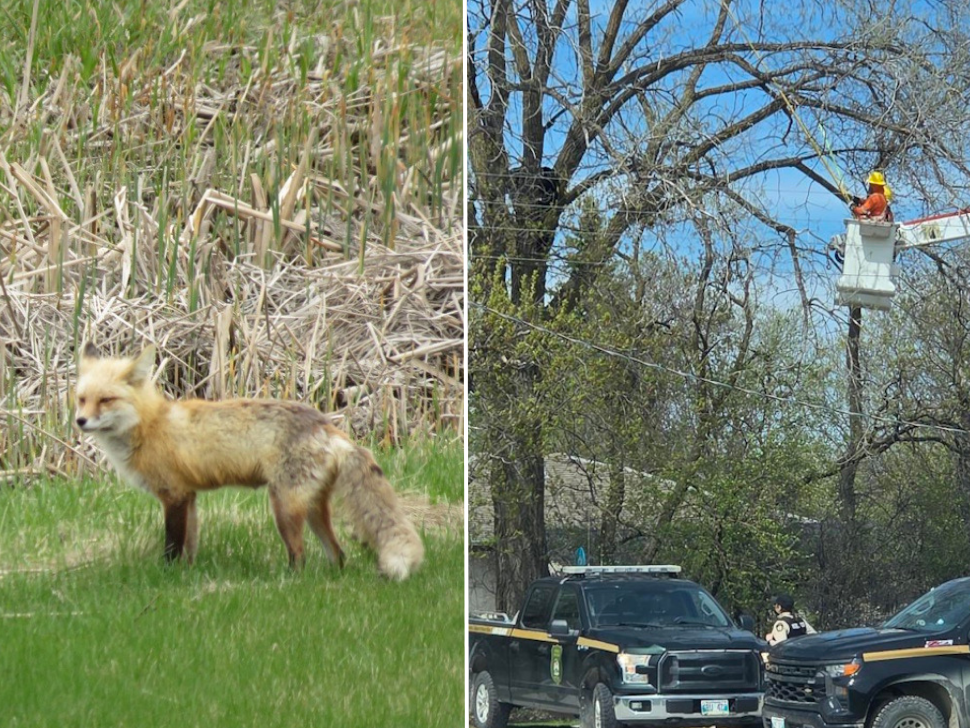
Recent wildlife sightings across the Southeast are serving as a reminder that animals are becoming more visible in urban and residential areas as they search for food, shelter, and safe travel routes.
Bears relocated from Ste. Anne
On Friday, May 22, the Manitoba Conservation Officer Service (COS) responded after reports of a mother black bear and two yearling cubs climbing several trees in Ste. Anne.
“After numerous attempts to push the bears out of the community, with assistance from a Manitoba Hydro truck, the COS was eventually able to safely immobilize the bears and relocate them to another area,” a spokesperson said.
On Friday, May 22, the Manitoba Conservation Officer Service responded after reports of a mother black bear and two yearling cubs climbing several trees in Ste. Anne. “After numerous attempts to push the bears out of the community, with assistance from a Manitoba Hydro truck, the COS was eventually able to safely immobilize the bears and relocate them to another area,” a spokesperson said.
♬ original sound – SteinbachOnline
According to the Manitoba government’s Wildlife Smart program, residents are encouraged to learn how to safely co-exist with black bears and take steps to minimize encounters.
The province advises Manitobans to:
If someone encounters a bear, the province recommends stopping, remaining calm, and assessing the situation. Residents are urged not to run or make direct eye contact. If the bear has not noticed you, slowly and quietly leave the area when it is safe to do so.
Fox sightings reported in Mitchell and Steinbach
Foxes have also been spotted recently in several communities. A family of foxes was seen in Mitchell, while residents have also reported sightings near the Steinbach Soccer Park and along the Bush Farm Trail. The trail system and nearby green spaces are known wildlife corridors on the edge of the city.
According to Manitoba Natural Resources and Indigenous Futures, red foxes are common throughout the province and are increasingly adapting to life near people. Provincial information on co-existing with red foxes says the animals are generally shy and avoid human contact whenever possible.
“Foxes are intelligent and adaptable,” the province notes.
The province says foxes are commonly drawn into residential areas by unsecured garbage, outdoor pet food, compost piles, and small prey animals such as rodents.
Trees, brush, and open green spaces can also provide ideal habitat for foxes raising pups during the spring and early summer months.
While sightings may concern some residents, provincial officials say fox encounters are usually harmless if people keep their distance and avoid feeding the animals.
Tips for co-existing with foxes
The province encourages residents to:
Officials also note that foxes play an important role in controlling rodent populations.
The province adds that seeing a fox during the daytime is not necessarily a sign the animal is sick, as foxes are often active during the day while hunting or caring for their young.
Reporting problem wildlife
Residents are encouraged to report wildlife that appears aggressive, sick, injured, or orphaned by contacting local conservation officers at 204-346-6110 or the TIP line at 1-800-782-0076.
More information on preventing conflicts with wildlife can be found through Manitoba’s human-wildlife conflict resources.
With files from Shannon Dueck