
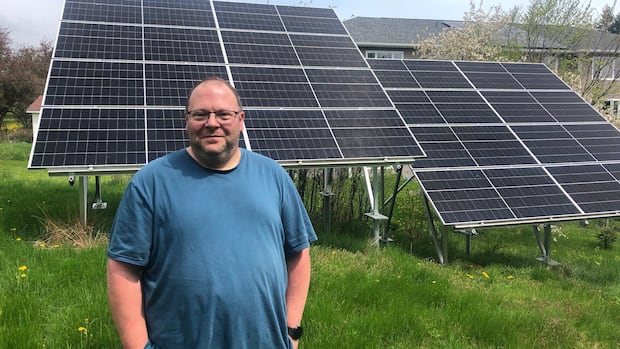
The number of residential solar systems in New Brunswick has more than quadrupled in the past three years, but that rapid growth could slow down if two proposed changes from N.B. Power go ahead.
The utility announced an end to financial incentives of up to $3,000 toward residential solar systems and has asked the Energy and Utilities Board to approve a new charge that will make it more costly to sell excess power back to the grid.
The two changes combined could make investing in solar panels less attractive in New Brunswick.
“It’s going to have serious negative implications,” said Chris Meechan, spokesperson for Solar NB Solaire, an industry group representing installers, manufacturers and solar customers in the province.
“Making technology uneconomical, I’m sorry, it’s backwards thinking, right?”
According to N.B. Power data, the number of customers with solar systems connected to the utility grew from 465 in spring 2023 to 2,138 three years later.
Feeding extra power to grid
Josh Goguen was part of that growth.
The Sackville resident installed his first system in his backyard in the fall of 2023 and expanded to his rooftop in May 2025.
He uses the power he produces during the day, and whatever is not used on site goes to the N.B. Power grid. When he’s not producing power, he pulls it from the grid.
As part of N.B. Power’s net metering program, he gets charged for each kilowatt hour he pulls off the grid and credited for each kilowatt hour he feeds in, all at the same rate.
WATCH | ‘It’s backwards thinking’:
N.B. Power proposal has solar industry seeing dark clouds ahead
N.B. Power wants to change how home solar users are compensated and that could mean greater costs for people in the utility’s net metering program. [Correction: A previous version of this video contained a graphic which reversed the rate changes proposed by N.B. Power. In fact, the proposed rates are 9.22 cents per kWh for power charges and 6.77 cents per kWh for power credits.]
During the summer months, there can be a lot of extra power. Over the course of the year, Goguen produces enough to cover “running what I need in the house, plus charging my electric car.”
He uses the money he saves on power bills to pay down loans for the two systems, with an expected payback period of about 13 years. With the systems expected to last about 30 years, that leaves about 17 years of very little in energy costs — under the current program.
But that may change, if N.B. Power gets approval for what it calls a plan to modernize how it handles net metering.
Changes to rates, new demand charge
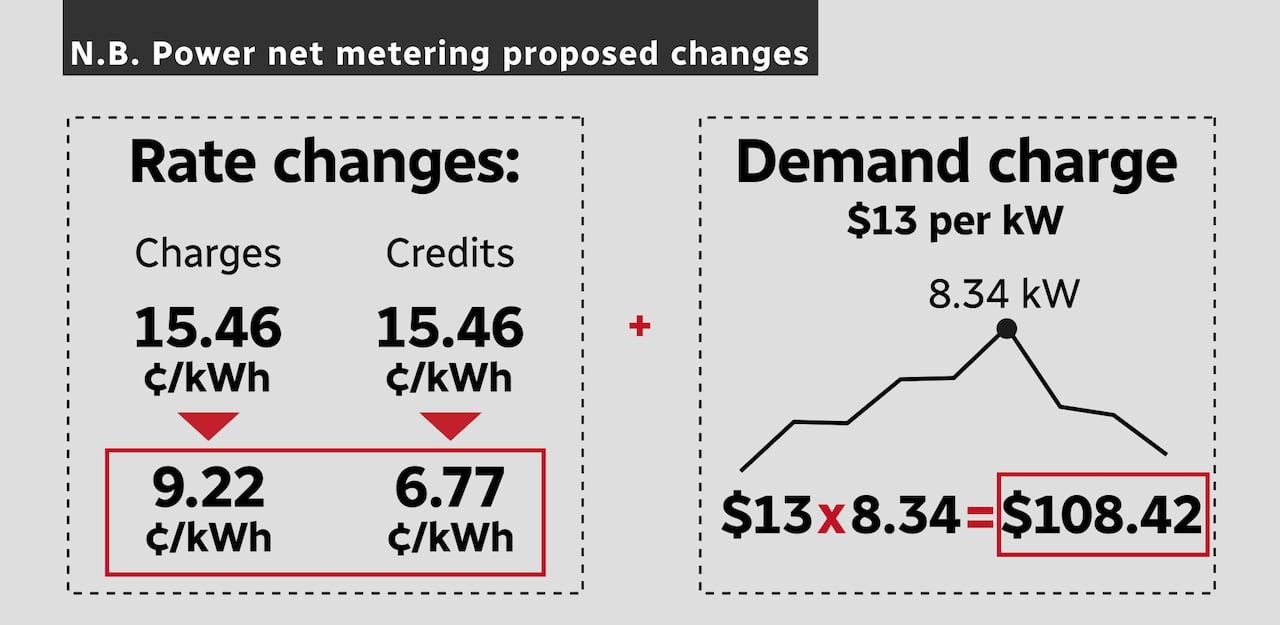
Currently, producers are both credited and charged for power at the retail power rate, now 15.39 cents per kWh and predicted to go to 15.46 cents per kWh in N.B. Power’s proposal.
But N.B. Power is also proposing to charge solar customers less for the power they use, just 9.22 cents per kWh, while also paying them even less for power they feed to the grid, just 6.77 cents per kWh.
 (CBC)
On its own, the rate change could result in lower bills for some solar producers. But the big impact, said Goguen, comes from another big change: a new demand charge.
The proposed demand charge is a new fee that charges customers for their peak demand — the highest rate of power usage they hit between 7 a.m. and 10 p.m. on weekdays — in any given month.
Goguen said his peak demand hit nearly 18 kilowatts this past March. With N.B. Power’s proposed new $13 per kilowatt demand charge, that would translate to over $230. According to his calculations, that would leave Goguen with a bill about $240 higher than under the current pricing system.
Goguen said his peak demand is usually lower, around 12 kilowatts. The example N.B. Power presents in its case to the Energy and Utilities Board estimates a peak demand of 8.4 kilowatts, resulting in a demand charge of just under $110 and a total bill that’s $90 higher than the current net metering program allows for.
 Chris Meechan is a member of Solar NB Solaire and national solar director for Greenfoot Energy Solutions, based in Moncton. (CBC)
Meechan said the new demand charge is “unpredictable” for users, and, according to Solar NB Solaire, is not something used by any other Canadian utility.
N.B. Power said demand charges are used elsewhere, particularly for commercial, industrial and higher-usage customers.
Current system not sustainable, says N.B. Power
“There’s no intent to dry up the solar industry in New Brunswick, whatsoever,” said N.B. Power chief commercial officer Brad Coady. “The vision would be for all homes in New Brunswick to eventually have [solar generation] as a solution.”
But that will not be possible under the current framework for net metering, said Coady, because it was designed to help nurture residential solar growth and not be sustainable in the long term.
“The market has now moved beyond an entry or a nascent market,” said Coady, “and now it’s starting to hit more mainstream. So, the time to make it sustainable is today.”
 Brad Coady, N.B. Power’s chief commercial officer, said the utility’s current net metering program is not sustainable. (CBC)
Meechan rejected the idea that incentives for New Brunswickers to adopt solar are costing other ratepayers. N.B. Power is “looking at it from a one-sided perspective,” said Meechan.
“Even, in their documentation, they talk about how they haven’t weighed in the positive economic benefits of these private capital investments that support the grid,” he said.
Meechan said the changes risk leaving New Brunswick “in a chasm situation where the adoption is not happening fast enough” to meet growing electricity demand.
Encouraging battery storage
Coady said new demand charges will encourage residential solar producers to invest in battery systems, so they can use their solar power outside of daytime hours and reduce their peak demand.
“If I were to do it again, I would need to invest in a battery,” said Goguen.
But that comes at a cost, which Goguen estimated would be about $10,000 for his home system.
As an existing net metering customer, Goguen will have some time to consider whether he makes the investment.
N.B. Power’s proposal includes a 10-year grandfather period for those already registered in the net metering system or who have applied by Nov. 1.
The new demand charge and rate changes for net metering are now before the Energy and Utilities Board with a hearing expected in late summer or fall.
N.B. Power has already announced an end to financial incentives for new solar systems, taking effect on May 27.
Solar NB Solaire is asking for a pause on the changes to allow time for consultation with the public and industry stakeholders.
“If this goes through the way that it is currently being devised,” said Meechan, “nobody’s having a say here, and it’s not fair.”