
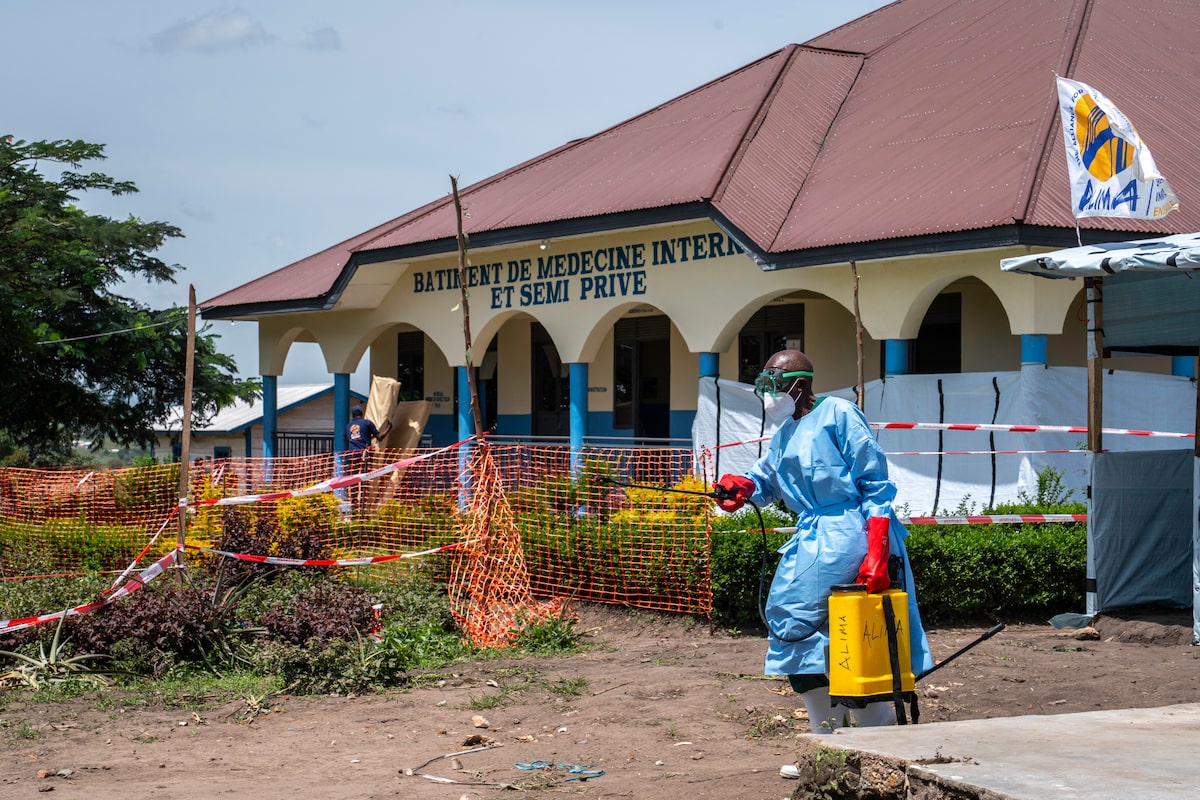
Dieudonné Sezabo, a health worker, carries a disinfecting device as he walks through the Rwampara Hospital in Ituri, in the eastern Democratic Republic of the Congo, on Tuesday.GLODY MURHABAZI/AFP/Getty Images
The federal government is temporarily suspending all visitor applications from residents of the Democratic Republic of Congo, Uganda and South Sudan, including permanent and temporary resident visas, because of the concern about the spread of Ebola.
The new measures, which take effect Wednesday, were announced on Tuesday after a meeting by Prime Minister Mark Carney’s cabinet.
The government is also imposing new screening measures, as of Sunday, for Canadian citizens, permanent residents and foreign nationals under the Quarantine Act who have been in the Democratic Republic of Congo and Uganda in the past 21 days.
Opinion: The hantavirus outbreak should be Canada’s wake-up call
The new rules will require travellers to undergo a health assessment upon arriving in Canada and that they comply with public-health measures. Travellers with symptoms will be transferred to a hospital for further assessment and all others will be required to provide a plan for self-isolation for 21 days.
The measures are being announced at a time when there is mounting concern about the spread of Ebola in the Democratic Republic of Congo and Uganda, caused by the Bundibugyo strain.
Congo has reported more than 1,000 suspected or confirmed cases of Ebola in the latest outbreak, and more than 230 suspected or confirmed deaths. Uganda has also reported seven cases.
No cases have been reported in South Sudan, but it shares a border with the Congolese region, where the outbreak’s epicentre is located and is considered at high risk of Ebola cases.
There are no approved treatments or vaccines for Bundibugyo, the less common Ebola species that has sparked the latest outbreak. Experts are deeply worried about the outbreak because the virus may have been spreading for up to two months before it was detected. The epicentre is an impoverished region where armed conflict has been raging for years, with an estimated one million people displaced from their homes, often living in crowded makeshift camps.