
Each year, overage players — or re-entry players — account for roughly one round’s worth of picks at the NHL Draft.
Here, I’ve ranked my top 20 overagers in getting a second or third crack at the draft in 2026. The list is made up of 2007- and 2006-born players. The first five names made my final 2026 NHL Draft ranking, which will be released next week. A few others were close and are worthy of strong consideration for the draft. And the rest are development camp invite types, or are players I’d at least keep a peripheral eye on.
This list of overagers combines with my 30 honorable mentions (posting tomorrow) and my final top 100 to form my 2026 NHL Draft package for a total of 150 player reports this year.
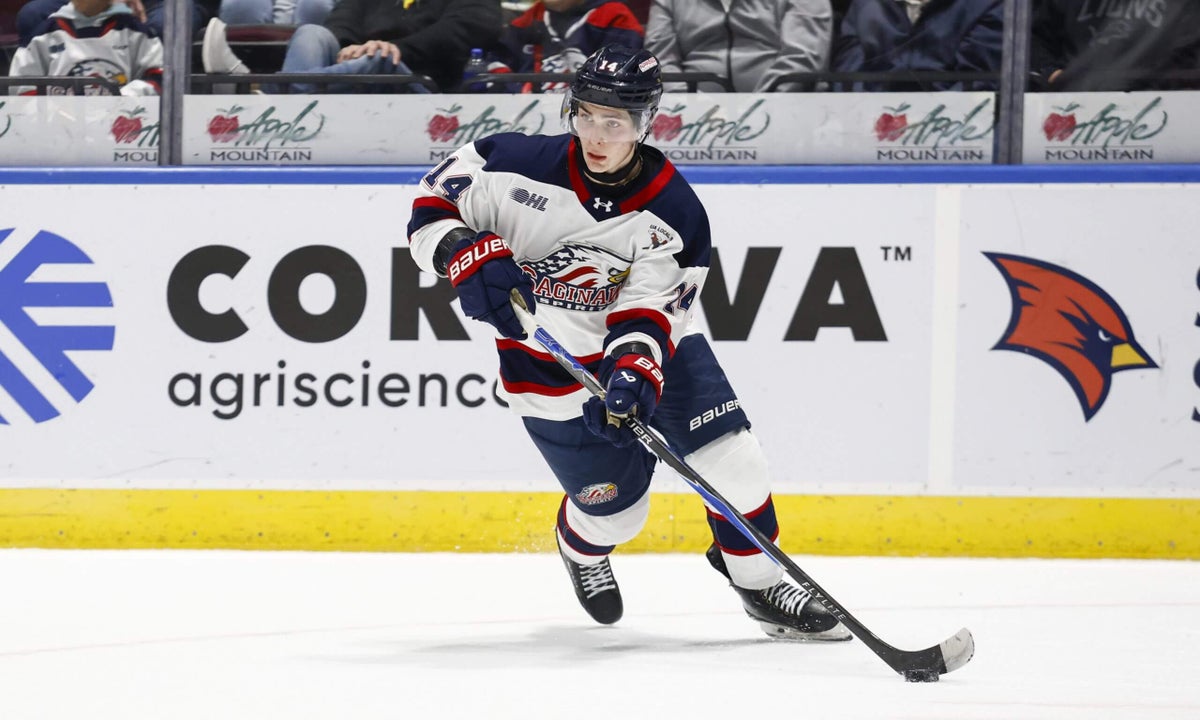
1. Egor Barabanov, C, 6-foot (Saginaw Spirit)
Barabanov finished fourth in the OHL in scoring this year, registering 28 goals, 63 assists and 91 points in 68 games as the Spirit’s first-line center, often playing between Nikita Klepov (2026) and Dima Zhilkin (2027). He’s a heady, skilled and competitive player who was named the Western Conference’s second-smartest player and its No. 1 playmaker in the OHL Coaches Poll this year.
A former Penn State commit who is now considering his options, Barabanov sees the ice at an advanced level, finding his way around the offensive zone in possession and then making plays from the outside in. He looks a bit awkward skating, and presents a little lanky, but he’s stronger than he looks and still gets around the ice quite well. And while I wouldn’t say competitiveness defines his game in the way it does Zhilkin’s, he’s willing to compete. His game is primarily about his good skill, his offensive know-how (in terms of spacing, timing, reads, anticipation) and his ability to break down coverage.
2. Ethan MacKenzie, LHD, 6-foot-0.75 (Edmonton Oil Kings)
Every year or two, there’s an undrafted player or two who plays their way into the mix for Canada at the World Juniors and then the draft. In Gothenburg, it was Owen Allard and starting goalie Mathis Rousseau. The year before that, it was Thomas Milic. Before them, there was famously Joe Hicketts. This year, MacKenzie’s excellent first half in the WHL (which included 10 goals, 31 points and a plus-22 rating in 30 games) played his way onto the team — his first Hockey Canada experience. He had injury troubles in his first two years in the WHL that held him back from showing what he could do, but he felt he had a good enough year last season to get drafted (32 points in 54 games). This year, his 58 points in 59 games put the question to bed. He told me he had a couple of talks with NHL teams last season, but said they never felt serious. This year has been different. And not only did he make Team Canada, but he rose from No. 7 to the top six, even playing some PP2 for them at times.
A North Dakota commit for next year, his skating is high-end and will carry him. He can break up plays with his stick, seems to see the ice well, moves and carries pucks effectively and has a good shot and a strong build. He has a chance to be a two-way depth skating defenseman.
3. Tomas Galvas, LHD, 5-foot-10 (Bili Tygri Liberec)
Galvas, despite being a small and slight D, was one of the only players on my board all the way back in his first year of eligibility in 2024 who didn’t get picked. He skates effortlessly and played the last three seasons at Czechia’s pro level to positive two-way results and steady growth in production. He has excelled internationally at U18s and three World Juniors, playing big minutes (he also just played at men’s worlds). He was absolutely tremendous at this year’s tournament and had a very good year professionally in his third and final crack at getting picked.
At his best, he can be everywhere with his skating and is often deep in the offensive zone, but rarely caught out of position back the other way because he swings back to the point so quickly. He can control play. He thinks it. He competes for his size. And the mobility is elite. He’s a natural handler who blends good touch with his four-way mobility to rotate around coverage, shape play crossing over and maneuvering across the blue line, or carry pucks past the first layer of pressure. I like the way he jumps in and out of coverage while still recognizing where his responsibilities are and when he needs to hop back out to the blue line. I like the way he jumps on pucks and gets them out of danger so that he can spend less time defending. He makes little plays under pressure to seamlessly outlet pucks from his own zone, uses his feet to annoy opposing carriers as much as a player his size can, and thinks the game at an advanced level all over the ice to limit some of his physical deficiencies. He works to help compensate for his size (alongside his superb mobility). He has good posture and looks taller on the ice than he is. He’ll try to push and involve himself when he can. He handles the puck smartly and excels in particular at skating backwards, which gives hope that he’ll continue to be able to defend up levels. There aren’t many defensemen his size in the NHL, so there’s always inherent risk there, but he has defended well at the pro level already and with some more strength and reps, there could be something there. He should be a good AHLer at minimum, and I’d strongly consider a mid-to-late-rounder on him again.
4. Niko Tournas, RW, 6-foot-2 (Moncton Wildcats)
Tournas, 20, is a late-blooming double overager who led the NAHL in scoring last year and then made the jump to the Q this year. He was one of Moncton’s best forwards for much of the year, too, and finished his rookie season with 49 goals and 92 points in 85 combined regular-season and playoff games, leading the Wildcats in goals. Despite his age, he’s still raw. By all accounts, he’s dedicated to getting better and has the tools, including a hard NHL shot and good size. He didn’t penalty kill for the Wildcats this year, but he played nearly four minutes per game on the power play and scored goals in a lot of different ways (off the flank, rebounds, dekes, catch-and-release, bad angles, backdoor, tips, jam plays, drives). He’s moving on to the University of New Hampshire next season and is expected to get drafted. He has to improve his pace and reads/decision-making, but there’s an interesting skill-shot-size combination there, and he clearly still has runway despite his age.
5. Michal Orsulak, G, 6-foot-4.25 (Prince Albert Raiders)
Orsulak is an overager in this class, but only by three weeks. He’s a big, heavy goalie who made the jump from Czechia’s junior level to the WHL this year and won the starting job for a Prince Albert Raiders team that he backstopped to the WHL final. He has also been a consistent member of Czechia’s 2007 age group internationally; he started at last year’s World Juniors and is eligible to return for the tournament in Edmonton this December.
I watched him play some games, particularly early in the year, where he stole wins for the Raiders and was the best player on the ice. He has some real power to his pushes and can make difficult stretch saves. He seals his posts and the bottom third of the net effectively. He plays a confident, challenging style. But I’ve also seen him falter or give up soft goals and look smaller than he should in the net. His highs and his size/tools have made him NHL Central Scouting’s No. 2-ranked North American goalie after he started the year with a “C” rating for them (which “indicates a 4th/5th round candidate”).
6. Liam Lefebvre, C, 6-foot-2.75 (Chicoutimi Saguenéens)
A member of the QMJHL champs and a Vermont commit, Lefebvre made the jump from the U.S. prep circuit to the Q this year as an 18-year-old (he turned 19 on May 15) and registered 37 goals and 71 points in 79 combined regular-season and playoff games. He also finished strong at the Memorial Cup, including the overtime winner in a two-goal performance to beat the Rockets. He’s a big, heavyset center (though he split time between the middle and the wing this year) who can shoot it and finish around the net. He has some one-on-one skill and a varied NHL shot (one-timer, catch-and-release, natural wrister). Despite being an overager, his game is still quite raw and has some development to do in terms of reads, pace and playmaking. He also still has some work to do on his fitness level. He’s relevant, though, and I considered ranking him in my top 100.
7. Alex Kostov, RW, 6-foot-3.5 (Flint Firebirds)
Kostov, who has Bulgarian and Slovakian heritage but was born in Canada, is a big, rangy winger who attended Maple Leafs development camp last summer and Predators main camp. He wore an “A” for the Firebirds this year and registered 64 points in 55 combined regular-season and playoff games, missing time in the winter with an upper-body injury. And while NHL Central Scouting list him as a winger, he played more center this year (he has work to do in the dot and won just 47 percent of them, but his 577 faceoffs were second-most on the Firebirds). He was a crucial part of Flint’s team this year, averaging 20 minutes per game and featuring on both the PP and PK. He’s a fluid north-south skater (I think he skates better than people give him credit) who can attack in straight lines or on angles. He plays and works hard. He plays direct and likes to challenge with his wrister. He’s athletic. I liked watching him play this year and think he’s at least got a chance to become a bottom-sixer someday. He was one of the final cuts for my board.
8. Ben Hrebik, G, 6-foot-2.25 (Barrie Colts)
Hrebik, a Providence commit, posted back-to-back .920 save percentage seasons in the OHL the last two years and was the biggest reason the Colts beat the Brantford Bulldogs to advance to the OHL final this year. He’s a very hardworking, competitive goalie who battles for every puck and uses active feet to fight to stay in plays and move to spots early. He gets up and down into and out of his butterfly quickly, making a lot of recovery saves and shutting down the bottom of the net. He’ll occasionally get scrambly and pull himself off his lines, but he anticipates and moves well in the net and has great hands when he needs to recover. He plays with a bit of a hunch and wants to be on his toes, but has good size and is athletic.
9. Matias Vanhanen, LW, 5-foot-10.75 (Everett Silvertips)
Vanhanan is technically an overager, but he was born less than a week away from being eligible as a first-timer for this class. He has also grown more than two inches since he passed through the draft at 5-foot-8.25 last year. He made the jump from Finland to the WHL this season and registered 111 points in 80 combined regular-season and playoff games with the WHL champs, leading Everett in regular-season scoring and finishing second on the team in playoff scoring. He also played well at the World Juniors, where he registered six assists in seven games for the Finns (who he can play for again next year). He lacks physicality for his size and can play a little too deferentially or on the perimeter at times, but he’s a very, very intelligent player on and off the puck, his skating has improved, he sees the ice at an advanced level, and he can play on both the power play because of his feel and vision and the penalty kill because of his anticipation. There’s definitely a chance he tops out as a second-line playmaking winger in Europe or the AHL, but scouts and those around the WHL have some time for him, and he’d make a perfectly worthwhile late-round pick.
10. Liam Danielson, RW, 6-foot (Orebro HK)
Danielson is a very likable player who, despite an ordinary profile in terms of tools, always finds a way to be effective. He registered 21 points in 28 total HockeyAllsvenskan games this year as a 19-year-old and was a really serviceable up-and-down-the-lineup player for Sweden’s gold-medal winning team at the World Juniors, where he registered five points in seven games. He also finished the year with 16 points in eight J20 playoff games (his only J20 games of the season). He’s a hardworking, well-rounded, committed and consistent winger who has been productive against his age group over the last couple of years. He gets to good spots, has good habits, skates well, has some skill and can be trusted to make the right plays. He can play with anybody. There’s a lot to like. If he were a little more dynamic in any one area, he’d be a legit NHL prospect. Even without that, though, I think he has earned a late-round selection.
11. Oliver Sjostrom, LHD, 5-foot-11 (Lulea HF)
Sjostrom wasn’t ranked by NHL Central Scouting at all a year ago, but he had been a top-four D for the ’07 Swedish age group internationally and was productive at the J20 level for his age across two seasons, and I listed him as an honorable mention for last year’s top 100. He then spent his post-draft season this year on loan with Bjorkloven in HockeyAllsvenskan and appeared in the SHL playoffs with his club team Lulea. In HockeyAllsvenskan, he played an offensive role, averaged 14-15 minutes per game, and led all under-19 players in scoring with 26 points and a plus-12 rating in 48 games. In the SHL playoffs, he played 10 minutes per game.
His challenge is that he’s undersized, and while he has smooth offense, skating and puck-moving ability, it’s not dynamic, take-over-a-game talent. I do like him defensively as well, though. He has been a go-to penalty killer on his teams at times over the years, even if he didn’t do it professionally this year, and he has a good stick. He has a balanced skating posture going backward and gaps up well (though I do think there are times when he could close earlier, and he waits for carriers to come to him head-on). His profile makes him a bit of a long shot for the NHL, but he’s already well on his way to becoming an offensive D in the SHL at minimum, and that’s more than can be said for some players who are going to get picked this year.
12. Alexander Sapozhnikov, LHD, 6-foot-6 (HK Sochi)
Sapozhnikov is a giant who made the jump from the NMHL to the MHL this year, registered 15 points in his first 19 MHL games and quickly earned his first five KHL looks in the fall. His boots are heavy from a standstill, and his feet can look a little clunky, but he moves well enough (he’ll occasionally open up for the one-timer or walk the line) to be interesting and then has the raw strength to overpower opponents physically and hammer a puck from the point. After playing big minutes with Stupino to start the year, he did play a reduced role after a move to SKA, though. And while his results were generally positive defensively, he’s still very much learning the game and playing catch-up with some of the finer details. A team using a late-round flier on him would be treating him as a long-term project, even though he’s an overager.
13. Matthew Minchak, G, 6-foot-5 (Kingston Frontenacs)
Minchak got off to an excellent start to this season and outplayed first-year eligible Gavin Betts early on. While he wasn’t able to take and hold the starting job, they basically split starts, and he finished the year with the better numbers of the two (.910 to .905). A Colgate commit, Minchak (NHL Central Scouting’s No. 15-ranked North American goaltender) was playing 18U AAA a year ago and adjusted quickly to the big jump, playing his way into the OHL Top Prospects Game (which he started for Team East). He has size and room to get stronger while already being decently athletic (I wouldn’t call it a standout trait, but he’s not slow or uncoordinated either). He plays with composure. He tracks the play well and does a good job holding his lines and controlling his rebounds for his size.
14. Timofei Runtso, RHD, 6-foot-2.25 (Victoria Royals)
Runtso, a Miami University commit, made the jump from the NAHL to the WHL this season and led all Royals D in scoring with 44 points in 68 games. He averaged nearly 25 minutes per game and played in all situations from the jump, playing more than two minutes per game on both the PP and PK. A Belarusian-American, Runtso has a pro look to him, with an athletic build and a direct disposition on and off the puck. He makes a good first pass but will also drop a shoulder and drive past the first layer of pressure in the offensive zone into puck protection or a hard wrister from the high slot. He plays with a certainty to his game and decision-making. His feet aren’t quick, but his stride is strong, and he’s sturdy over his feet. He has some pop off his blade and keeps his shots on target. He’s not super physical, but he plays firm defensively. There are some pro attributes and habits there.
15. Yaroslav Bryzgalov, LW, 6-foot-3.25 (Medicine Hat Tigers)
Bryzgalov, a Merrimack commit, is a big, heavy winger who can play the power game and check but also has some secondary playmaking feel and vision that you typically don’t find in a forward his size (he’s listed at 216 pounds) at that age. He registered 69 points in 79 games as a first-year WHLer with Medicine Hat this year and did it while averaging only about 15 minutes per game on a deep team and primarily on PP2. He cooled off in the middle third of the season but started and finished strong, producing in the playoffs. He didn’t PK, and he had some learning to do off the puck, but he’s willing to track and came up with his fair share of takeaways. He also quickly identifies his options when he gets the puck and does a good job pre-scanning so that he can get pucks to his teammates in space early and surprise opposing D with a heady pass. He also does a good job attacking inside ice and using the attention his big frame gets when he does to hit the backdoor option. And while I’d like him to shoot more, he has a quick release. He needs to develop his skating and play with more tempo more consistently, but he protects the puck well and can slow it down. He has some proponents.
16. Dakoda Rhéaume-Mullen, LHD, 6-foot-0.5 (University of Michigan)
The son of legendary goaltender Manon Rhéaume, Rhéaume-Mullen is a late-2006 who, after two years at the NTDP, played college hockey with the Wolverines in his draft year and then had a really solid season on their blue line as a sophomore this year to play his way onto the World Junior team and help Michigan to the Frozen Four. His minutes per game rose from 14:13 as a freshman to 18:12 as a sophomore (fourth among Michigan’s D), and he finished with a respectable 18 points in 40 games. He impressed in particular at last summer’s World Junior Summer Showcase, where he played his way into the mix for the U20 team and made some things happen.
He’s a good skater with projectable four-way mobility. He handles pressure well and has some poise. His head and eyes stay up, and his reads seem to be in a good place. But whenever I watched him over the years, I felt he had more smarts and offense and that an opportunity to show it just didn’t come pre-draft due to both roles at the NTDP and Michigan. He played behind Cole Hutson and Logan Hensler for offensive opportunities at the program, and that carried over into Michigan, where his role and game got caught in no-man’s land. This year, after PPQB Henry Mews went down with a season-ending injury, he got some PP reps. I could see him take another step as a junior or senior and become an involved, puck-possession two-way D. He may well end up as an AHLer/ECHLer in the end, but he now looks like he’s going to play pro hockey.
17. Ben Wilmott, C, 6-foot-1.25 (Barrie Colts)
Wilmott, an Ohio State commit, made the jump from the USHL to the OHL this year and was immediately a really solid player for the London Knights in advance of a trade to Barrie. Between those two spots and then a run to the OHL final in the playoffs, he registered 38 goals and 88 points in 86 games, averaging 20 minutes per game and winning the strong majority of his draws (58 percent in the regular season and 53 percent in the playoffs, though Utah first-round Cole Beaudoin took the toughest ones). He played the net-front/goal line well on the power play. He does a good job staying on his toes and winning races for loose pucks. He does a really good job slipping off coverage to get open and then has a good catch-and-release shot he can strike with around the home plate area. He has decent hands. The playmaking and skating/pace are just average, though.
18. Felix Carell, LHD, 6-foot-1 (Malmo Redhawks)
Carell is a pro-built, thick-bodied defenseman who played 20 minutes per game for Sweden at World Juniors to positive results, establishing himself as a stable option for a gold medal-winning team. He also spent almost this entire season in the SHL as a teenager, and while he didn’t pick up his first points until the playoffs, he held his own. His game is vanilla, but he competes, he gaps up well, he has a good stick and he’s willing to play physical and battle. He’s a sound, reliable player. That’s normally not enough to be more than SHL/AHL depth, but that he’s already that at a young age and has been a trustworthy stopper against his peers isn’t nothing, either. He’s a decent skater, too, so there’s a base there.
19. Kade Stengrim, LW, 6-foot-4 (Medicine Hat Tigers)
Stengrim, a University of St. Thomas commit, made the jump from the USHL to WHL this year and registered 32 goals and 55 points in 81 combined regular-season and playoff games with Medicine Hat, where he found ways to contribute in a bottom-six role on a deep team and was a factor on PP2. He’s a big, strong forward who can use his size to protect pucks along the wall and take them to the net and then when he gets there, he has an NHL shot and can score around the slot (and occasionally even from the high slot when he has time to really lean into one). There’s not a lot else to his game, but you’d be betting on the athletic build and bottom-six traits.
20. Daniil Ustinkov, LHD, 6-foot-1 (Zurich SC)
Ustinkov, who represents Switzerland but also has Russian citizenship, impressed scouts years ago with his play at U18 worlds and the Hlinka Gretzky Cup but has struggled to take that next development leap since then and has bounced between the NL and second-rung SL in Switzerland (he was also a solid player for them at his second World Juniors this year but never became their No. 1 D, either).
He’s a late-August birthday who has always played a mature game for his age. He makes the right choices with the puck and reads without it, consistently on both fronts and in all three zones. He has some poise, simplicity and efficiency to his game. I’ve seen him command the puck and try to make something happen against his peers inside the offensive zone and extend himself (though I’m not sure he has the jump to have that be much of an element in his game up levels). His head is always on a swivel, and he’s an intelligent player who takes what’s given to him and advances and steers the play. I’ve also seen him force things defensively, mistime step-ups trying to break up plays early instead of gapping up. Generally, he moves pucks quickly, he’s got a good first pass, he manages the puck well, he’ll make the odd play through or around coverage, and he has proven he can be active and involved against his peers on both sides. He needs to get a little quicker getting back to pucks, but he’s helped by knowing where to be, good enough edges, competitiveness and a desire to make a difference.
His challenge is that all of the tools are about average, and that’s going to make it hard for him to define himself up levels and likely limits him as a depth NL/AHL D.