

Listen to this article
Estimated 4 minutes
The audio version of this article is generated by AI-based technology. Mispronunciations can occur. We are working with our partners to continually review and improve the results.
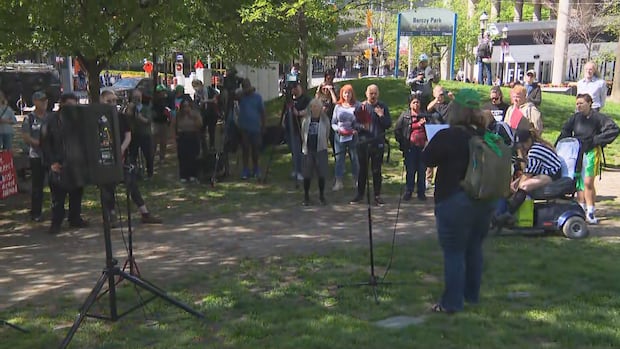
Advocates rallied in a downtown Toronto park on Tuesday to demand that the city take action to stop what they say is harassment of unhoused people at Union Station.
Members of a group known as the Toronto Underhoused and Homeless Union (TUHU) gathered in Berczy Park to protest alleged violence against marginalized people in the station by special constables, private security agents and Toronto police ahead of the FIFA World Cup.
In a news release, the group says it interviewed 45 unhoused people at Union Station in the last six weeks, asking if they had noticed an escalation in security. It says roughly 90 per cent of respondents reported either witnessing or experiencing “security violence” first hand.
Instances of alleged violence include physical and verbal assaults by security and police, and forced removals of people from public spaces and washrooms, the group says.
One respondent says they were kicked out of the station in the rain and taunted. Another says they were dragged out of a station bathroom with their pants down, sustaining injuries that make it painful to walk.
The group says the survey revealed a trend of people feeling increasingly targeted by enforcement for being visibly poor or homeless.
There’s this mentality right now of cleaning up the streets, right? It’s FIFA and we want to look a certain way- Rev. Angie Hocking, TUHU
Rev. Angie Hocking, a member of the TUHU, said the violence is “out of control,” putting unhoused people at risk, and the group wants to draw attention to displacement, intimidation and violence directed towards Toronto’s most vulnerable residents.
Hocking said people are being targeted for the way they look and assumptions are being made. She said people have nowhere to go.
“There’s this mentality right now of cleaning up the streets, right? It’s FIFA and we want to look a certain way,” Hocking said. “It’s all in the name of safety. But whose safety matters right now? Because clearly it’s actually causing harm to certain people for the sake of safety.”
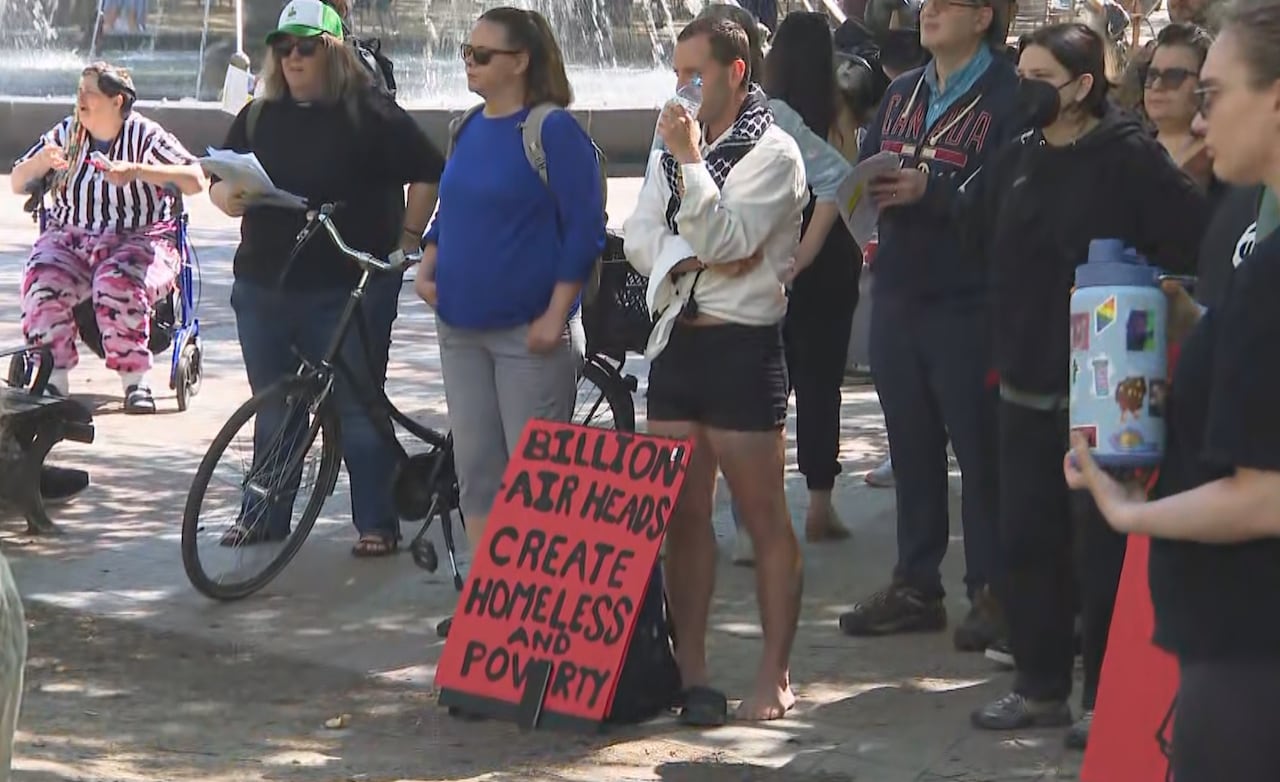 In a news release, the group says it interviewed 45 unhoused people at Union Station in the last six weeks. Roughly 90 per cent of respondents reported either witnessing or experiencing ‘security violence’ first hand. (Martin Trainor/CBC)City says it launched pilot at Union Station in April
In a statement Tuesday, Russell Baker, spokesperson for the city, said Toronto supports people experiencing homelessness through a “people-first, human rights-based” approach focused on outreach, relationship-building and voluntary access to services.
Baker said a pilot launched at Union Station in April with Metrolinx, TTC, Toronto police and other partners to strengthen co-ordination amongst existing outreach, health, housing and crisis-response teams.
“The pilot helps connect vulnerable individuals to shelter, housing, healthcare, food, clothing, mental health and harm-reduction supports, while emphasizing care, de-escalation and voluntary service access,” Baker said.
“Co-ordination between outreach, maintenance and security has also been enhanced to help keep the station safe and welcoming for all.”
Baker said residents and visitors can submit concerns or complaints regarding security personnel through the City’s Corporate Security complaints process for review and investigation.
At a unrelated news conference on Tuesday, Toronto Mayor Olivia Chow referenced the April pilot, saying the different partners are “working as a team to help those that are at Union Station if they are in need of support.”
“We are trying to consolidate and make sure they work together as a team so that the services available to those that need help will be seamless.”
Metrolinx provided a statement saying the agency is working with social service providers to connect vulnerable people with appropriate supports while maintaining a safe transit environment. Metrolinx has also added more special constables and other frontline staff to support greater ridership.
Advocates are calling on the city to:
Provide immediate 24/7 respite spaces during World Cup preparations and during the ongoing World Cup events.Cancel security contracts and replace them with peer-support, harm reduction workers and outreach teams who embody a trauma-informed approach.Indefinitely postpone shelter and supervised consumption site closures.
Vancouver, the only other Canadian host city for the World Cup, released a human rights action plan this week, but advocates there are also worried about how the city will treat its homeless population as the world visits.