
As part of our buildup to the 2026 FIFA men’s World Cup in the United States, Canada and Mexico, we are publishing excerpted chapters from The Soccer 100, The Athletic’s definitive book on the 100 greatest players of all time, courtesy of HarperCollins Publishers.
The 10 players we will feature are the highest-ranked World Cup winners of our 100. Today, it is the Brazilian who came in 14th in our 100, having decorated the national team’s performances for 11 years.
Before the hard sell comes a pause. He stands there, briefly upright. It’s as if he is rifling through his mental hard-drive, looking for the right words for a lover or a child or a jury — although, given what we know about him, it’s more than possible he’s just looking at distant clouds.
It’s a split second, over in the flap of a bird’s wing, but it seems longer. It feels like just this side of forever.
Then he launches into it: story time, the beats of the plot lovingly sketched out by his eyes and his wonky legs. We are heading to his right, the defender’s left. His shoulders start to lean, and soon his entire body is going along for the ride, a roller-coaster rounding the corner into a death plunge.
The defender follows, more out of duty than desire. It is a hopeless pursuit. But here’s the funny thing: It’s hopeless in a way he is not even aware of yet.
Look at the ball. The bodies are tumbling offstage, but the ball hasn’t moved. It’s been there this whole time, waiting patiently. It has seen all this before.
The defender is committed; momentum and gravity are now his enemies. He digs deep, ignores his complaining muscles, and hauls himself back to centre. There’s only one problem: His tormentor is already there, already departing. And this time he is taking the ball with him.
He could be going either way for all the difference it would make to the defender. Zoom out a little and it would probably make more sense to dart left, infield, since a handful of other opponents also bought the initial routine. But no, he’s going right, going where he pretended to go before, where the defender has just returned from, back to the scene of the crime.
Why? That’s the easy part. It’s funnier this way.
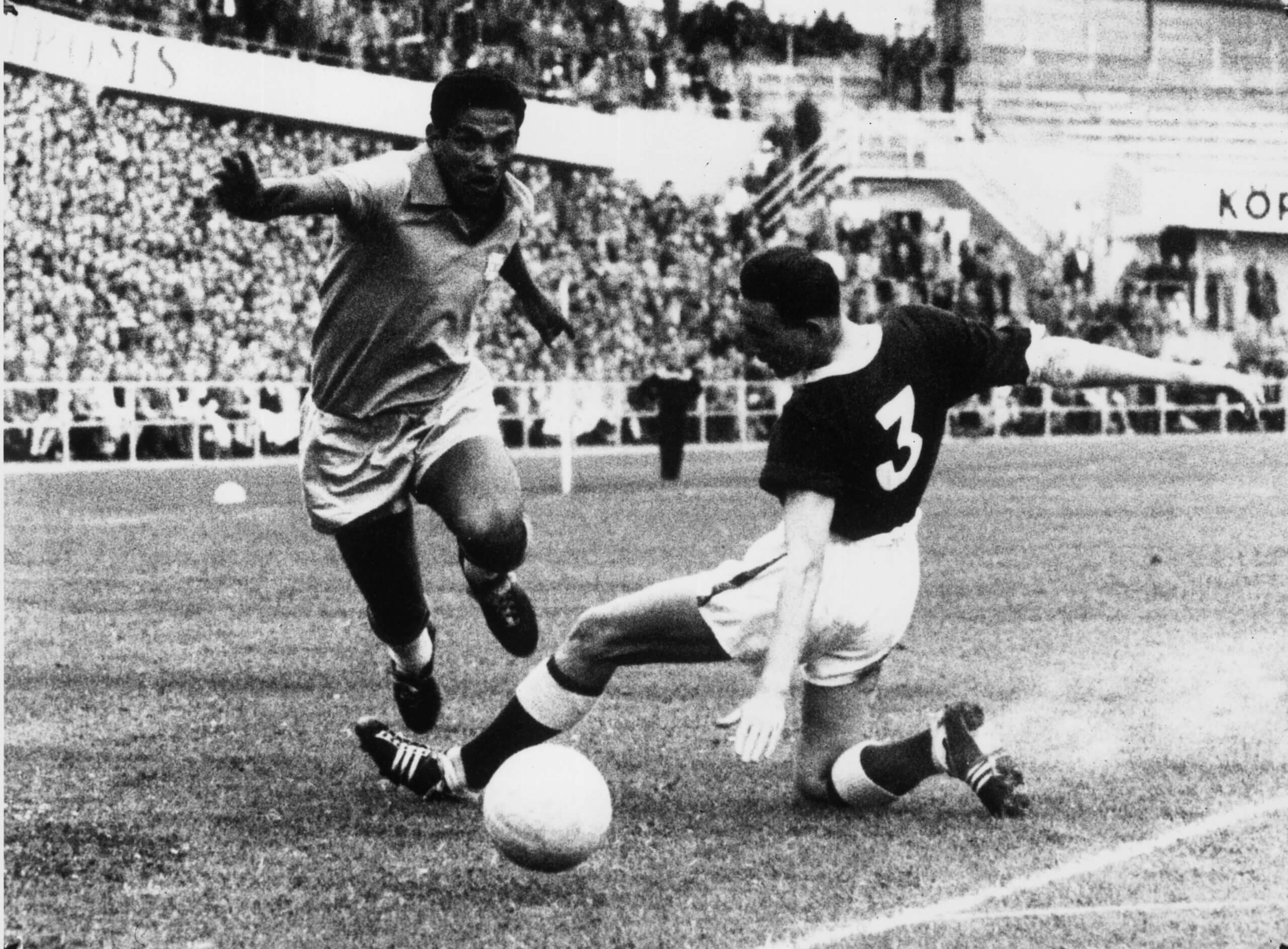
Garrincha in full flight against Wales at the 1958 World Cup (Central Press/Getty Images)
One of the best things about football is the sheer variety of responses — rational, emotional, physical — it is capable of eliciting in the observer. Some of them are common and recurring. Those people in shorts running around in front of us or on our television screens make us swoon, make us tremble with nervous energy, make us tear our hair out.
One reaction, though, is rarer than it should be, at least when you reach the professional game. Football can be awfully po-faced; it hardly ever makes you laugh.
At which point enters Garrincha, the Little Wren, not quite the greatest Brazilian footballer of all time, but definitely, definitely the most hilarious.
We’ll circle back to the tragic irony of that fact later and lament the tears of the clown, but when it comes to Garrincha, it really is worth just establishing a baseline appreciation of his oeuvre in all its wriggly, flippant glory.
The dribble described above — that full-bodied, Drunken Master feint — has always been my favourite. But Garrincha, not inappropriately, adhered to a version of the old Groucho Marx line: “This is my signature trick, and if you don’t like it… well, I have others.”
Watch the videos.
Through the fuzz and the bad camera angles emerges an extraordinary catalogue of dummies, flicks, and feints, a hodge-podge of silly tricks. There are fast dribbles and there are slow dribbles, when he seems to want to take in the view. There are slalom runs, all acute angles and twisted ankles, and there are direct bursts. There are hundreds of little forays into forests of legs, an eager little dog pursuing a rabbit, not even sure if he wants to catch it, just enjoying the sheer exhilaration of the chase.
There he goes, inside and out, outside and in, twisting, jerking, leaping, skipping. He nutmegs defenders. More often, he just lures them in, makes them think the ball is there to be won, then flicks it away with a nonchalance that manages to be both cruel and cheerful. Occasionally, he just seems to teleport through them.
And so you laugh. You laugh because it’s funny seeing football played like this. Funny to see the strategy and the superstructure stripped away for a moment, leaving only pure play. You laugh because you could easily be watching Charlie Chaplin or Stan Laurel, those other masters of slapstick. You laugh because sometimes you see something your brain doesn’t quite know what to do with, something that is at once recognisably wonderful and not recognisable at all.
He was born into poverty in a town whose name translates as Big Stick, and he had crooked legs. The left one was about two inches shorter than the right and turned outward. The right one turned in. When Garrincha reported for military service as a teenager, the local army chief took one glance at him and told him he wouldn’t be needed. The notion that he would become a footballer was deeply illogical.
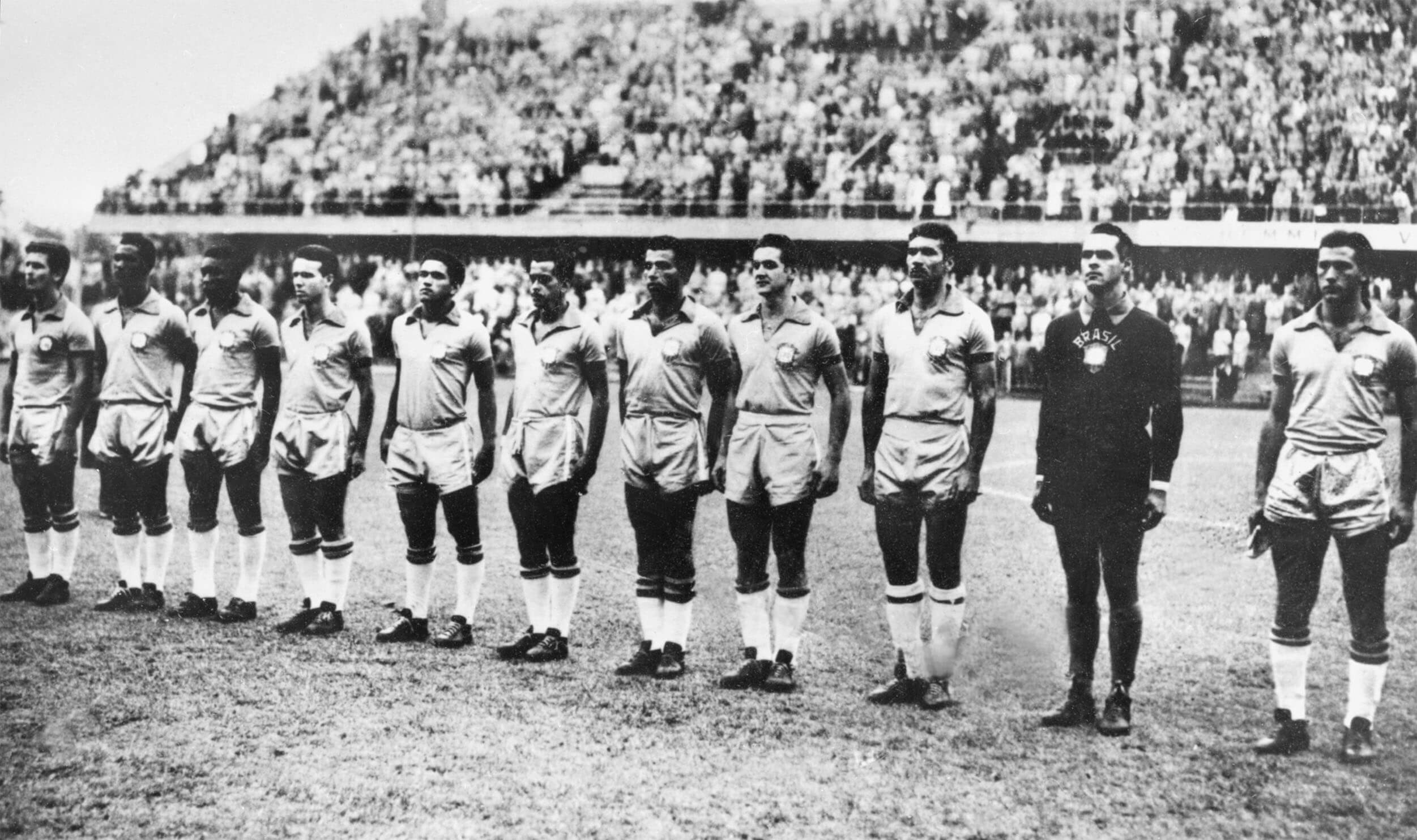
Brazil line up against the Soviet Union at the 1958 World Cup, with Garrincha fifth from the left (AFP via Getty Images)
Garrincha — Mané to his friends — dribbled past logic. After doing well for the local factory team, he went for a trial at Botafogo, one of the big clubs in Rio de Janeiro. He was 19. He yanked Brazil full-back Nílton Santos into so many strange shapes during his first practice session that Botafogo fast-tracked him into their team. Within months, the young winger was the talk of the city.
It is not hard to imagine a world in which Garrincha remained a darling of the provinces. His talent spoke for itself, but his outlook was blinkered: he liked to return to his hometown between games, knocking about with old friends. It wasn’t immediately obvious that his matador skill set would translate beyond the local leagues. His unprofessionalism — to say that Garrincha liked to drink and womanise is akin to saying fish are partial to water — also appeared to make him a poor fit for genuine stardom.
He made Brazil’s squad for the 1958 World Cup, but it looked like it was going to be a washout. Garrincha was characterised as childish and moronic in psychological tests commissioned by the Brazilian federation before that tournament in Sweden and was then left out of their first two games.
His appearance in the starting line-up for the third, against the Soviet Union, owed much to his popularity among his fellow players, who had lobbied coach Vicente Feola for his inclusion. Garrincha repaid the favour with a display of almost ludicrous menace and never left the side as Brazil claimed their first World Cup title.
He was doubly influential as Brazil retained their crown in Chile four years later. Garrincha was the best player at that World Cup, scoring four times and leading the attack after an injury sustained in the group phase ended Pelé’s involvement. The image of Brazil’s No 7 running rings around opposition defences — often literally — will forever be embedded in the nation’s collective memory.
The wider football community, too, was now awake to his otherworldly charms. “Garrincha,” ran one headline in Chilean newspaper El Mercurio, “what planet are you from?”
The spontaneity and devil-may-care looseness of Garrincha’s play did not only endear him to fans. He was also a gift to Brazil’s writers, who were beguiled and fascinated by him.
“The joy of Garrincha’s football is that he plays on pure inspiration, on magic, without reservations, without plans,” wrote newspaper columnist Paulo Mendes Campos.
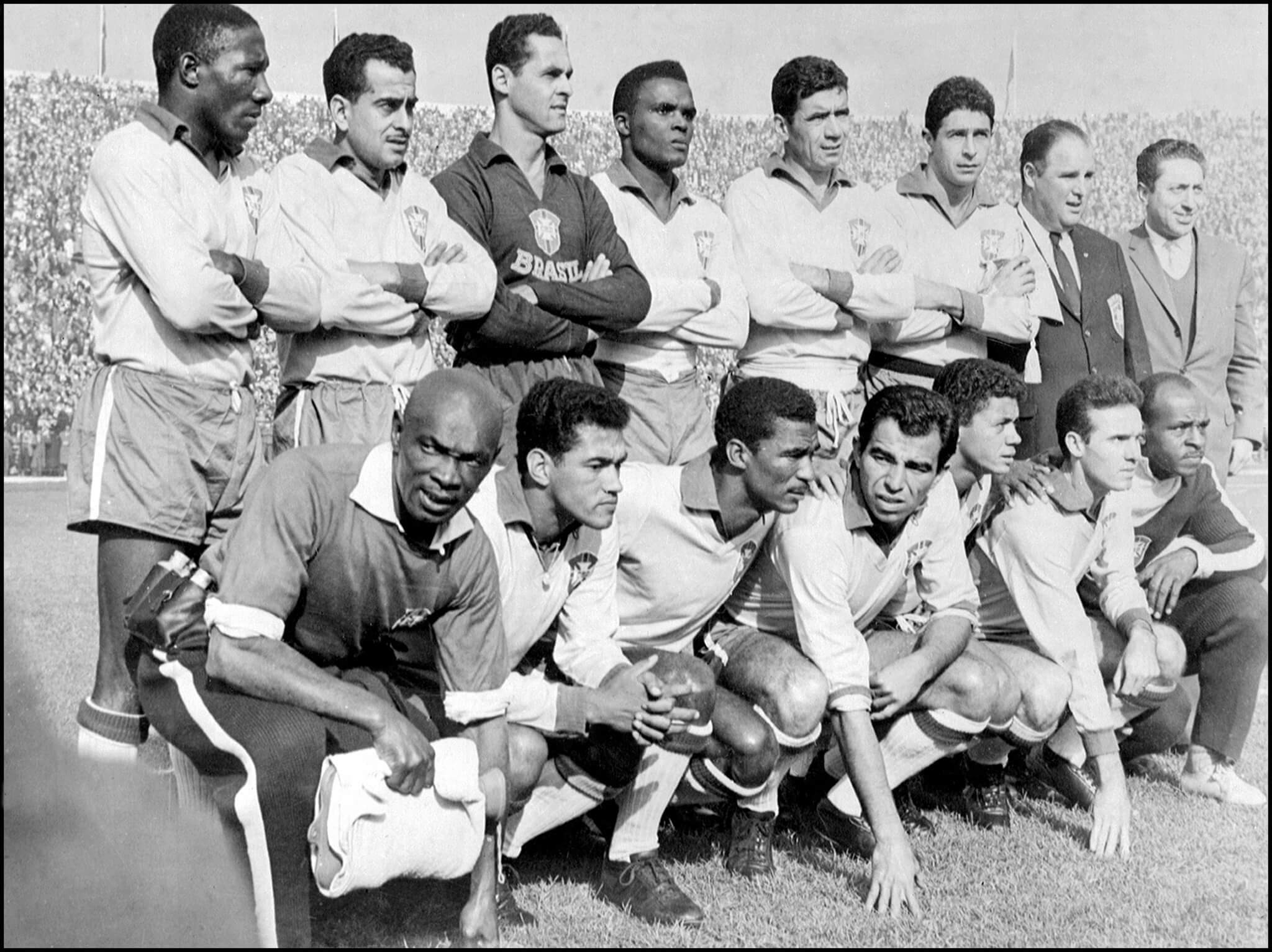
The Brazil team pose ahead of the 1962 World Cup final against Czechoslovakia in Santiago, Chile. Garrincha is crouching second from the left (AFP via Getty Images)
Playwright Nelson Rodrigues, one of Brazil’s most celebrated cultural figures, was even more lyrical.
“Garrincha doesn’t think,” he wrote in 1958. “He doesn’t need to. Rationality is foolish, a horse-drawn cart up against the vertiginous agility of instinct. He teaches us that nothing is more beautiful than speed. Up against him, we are all slowcoaches, cattle, hippopotamuses. He doesn’t kick the ball like others do. He cultivates it, like it was a rare orchid. Even God must admire him from above.”
Garrincha’s appeal transcended the bounds of the pitch. Brazilians also identified with the man, imperfect of body and of mind, a mortal — so crushingly mortal — among the idols. The unavoidable comparison here is with Pelé, sporting excellence personified but also inscrutable, even a little remote. Garrincha was one of the gang, and people loved him for it.
That only became more true as his flaws consumed him. Garrincha also played at the 1966 World Cup, but his drinking had reached catastrophic levels by then. He was at the wheel — and likely inebriated — in a car crash that killed his mother-in-law in 1969. By that stage, his club career had fizzled out into a series of failed restarts. Already, his story had begun to take on the grim pallor of tragedy.
The years after his retirement confirmed it. Garrincha, feeling increasingly abandoned and alone, bounced between the bar and the hospital, often on the same day. Alcohol’s grip grew tighter, ever tighter, until it was impossible for even the great escape artist to squirm free.
“I ask myself if there was some deep reason that made him drink,” wrote Nílton Santos, Garrincha’s former Botafogo and Brazil team-mate. “Maybe it was something so personal, so intimate, that he didn’t want to tell anyone.
“I got tired of telling him, ‘Mané, that’s a slow death’. But I don’t think I understood that his true, unconfessed desire was to die. He lived trying to destroy himself.”
In his final years, Garrincha cut a ghostly figure. One of his last public appearances, on a parade float during the 1980 Rio Carnival, was so distressing that it moved those who observed it — Pelé included — to the brink of tears. “He was sitting there, with no apparent notion of what was going on around him,” wrote Pelé. “His face looked worn out, like there was no life left. It was one of the saddest things I ever saw.”
Garrincha died in January 1983. He was 49.
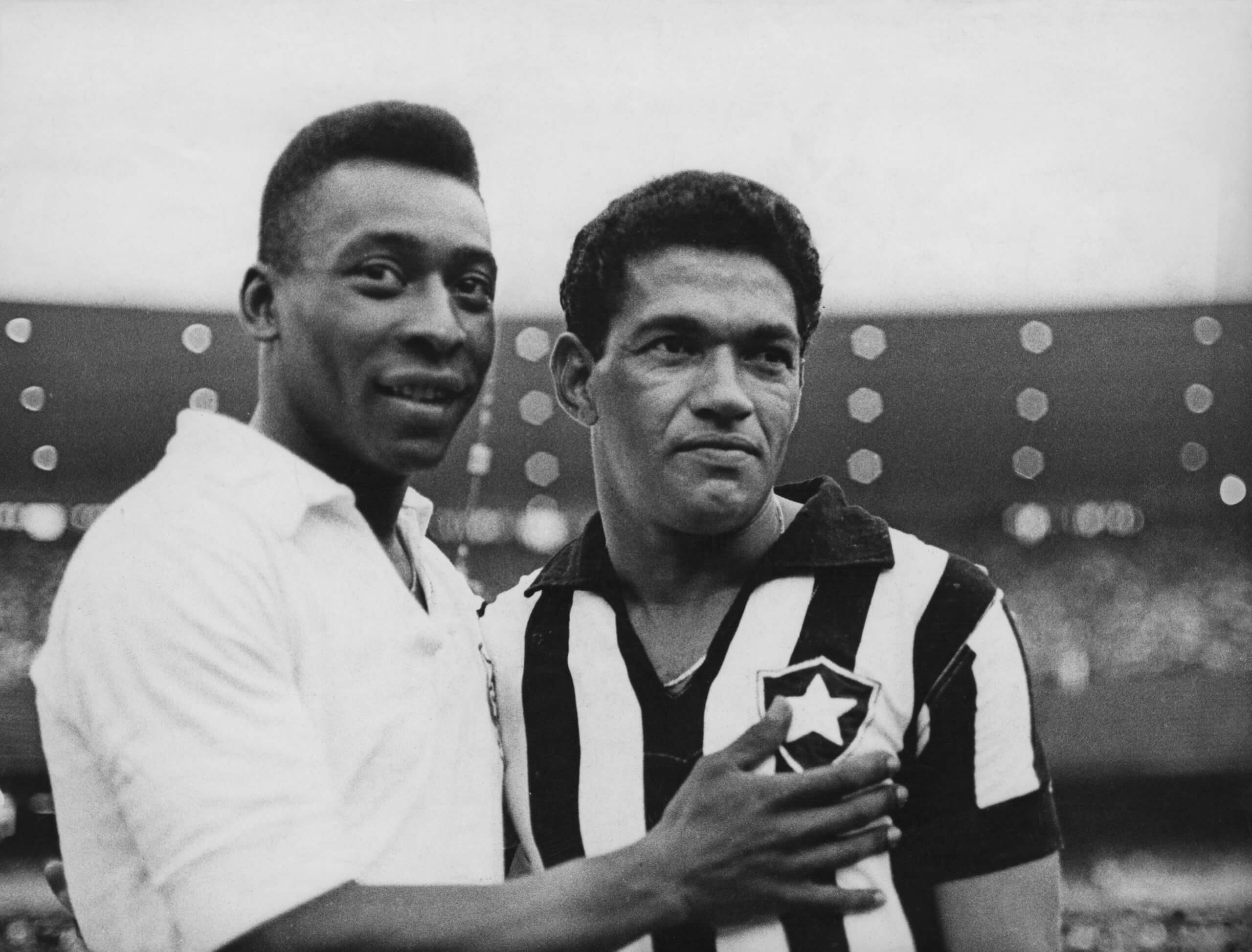
Pelé and Garrincha in February 1968 (Pictorial Parade/Archive Photos/Getty Images)
Grief enveloped Brazil. It was tempered only by a parallel movement to celebrate Garrincha’s life and to restate, one last time and for future generations, the reasons for his status as a national emblem.
That task was best tackled by the great Brazilian poet Carlos Drummond de Andrade, whose tribute, published in the Jornal do Brasil, captured the nuances of the collective mood. He painted a picture of Garrincha as an antidote to — or, like Carnival, a distraction from — Brazilian ennui. A figure who, during those electric colt years, made an entire country lift its chin. “Joy of the People,” they called him, and that was no empty sentiment.
“Fun, spontaneous, inconsequential, with an innocence that did not stop him from being street-smart . . . there could be no better model to seduce a public that, looking around, did not find serious heroes, the miraculous saints they needed in their day-to-day lives,” Drummond de Andrade wrote.
“Garrincha asked nothing of his admirers; he didn’t demand sacrifices or mental effort to follow him. He carried the weight on his shoulders with joy, giving us permission to do the same. He was a poor mortal who helped an entire country to sublimate its miseries. The sad thing is that the miseries return, but there is no other Garrincha available. We need a new one to feed our dreams.”
Four decades have passed since Drummond de Andrade wrote those words. You can add on a couple more to get back to Garrincha’s peak. It can be hard to appreciate the depth of feeling at such a remove. Emotion slowly bleeds out of history; there is no tourniquet.
We must be thankful, at least, for those blurry old videos. They are a poor substitute for what it must have felt like being there, but they tell just enough of the story and evoke warm echoes of the sentiments.
There he is, the king of the playground, thrillingly unbound. There he is, giggling as he outruns his own shadow. There he is, legs askew, a living, breathing repudiation of common sense, dodging, ducking, throwing punch lines.
Go ahead, laugh. It’s what Garrincha would have wanted.
Excerpted from The Soccer 100 by Oliver Kay & James Horncastle with The Athletic Soccer Staff, published by William Morrow. Copyright © 2025 by The Athletic Media Company. Reprinted courtesy of HarperCollins Publishers.