
The English stays — and you won’t have to prove you are allowed to read it.
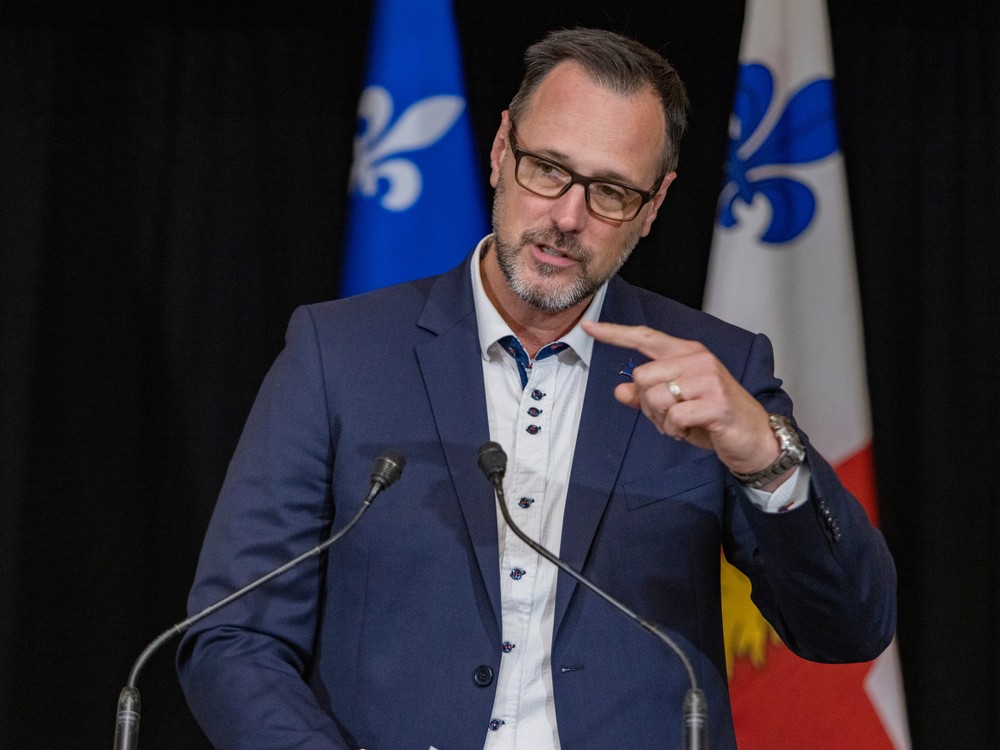
French Language Minister Jean-François Roberge has dismissed a recommendation that he remove most English from government websites, leaving a limited amount for people who can prove they are eligible.
“I’ll tell you right away that we have no intention of having some kind of password or identification mechanism,” Roberge told reporters in Quebec City on Thursday.
“We’ll keep what I would call the good-faith mechanism that we currently use.”
He made the comment a day after Quebec’s French language commissioner complained that English remains too freely available on Quebec government websites and should be sharply reduced, with checks on who is allowed to read it.
The recommendation was in a report that the commissioner published on the linguistic choices Quebec makes when communicating with the public.
The commissioner’s office evaluated content on the websites of seven major government bodies, including Hydro-Québec, Revenu Québec, Services Québec, Retraite Québec and the workplace safety, auto insurance and health insurance boards.
In a statement to The Gazette, the commissioner’s office said the sites “are essentially bilingual (French and English), with a button allowing the user to switch from one language to the other.”
“The government’s message appears contradictory: on the one hand, the Charter of the French Language establishes that French, as the official language, must be used exclusively; on the other, the administration operates essentially bilingual websites,” the office said.
It said English should be scaled back: “Except in the exceptional situations provided for by the charter, the websites of the organizations evaluated must be in French only.”
Extensive English content could still be provided, the commissioner said, but only in “secure areas of websites” — and only if the government body “can demonstrate that an exception applies.”
Since 2023, government websites have displayed banners stating that access to English content is intended only for eligible Quebecers, along with links explaining eligibility placed at the bottom of English-language pages.
The Coalition Avenir Québec passed reforms in 2022 that strengthened the Charter of the French Language, commonly known as Bill 101, and imposed an “exemplary” duty on the state to prioritize French.
Under Bill 96, which amended the Charter of the French Language, certain groups are entitled to access English services in Quebec.
Among them are people eligible for English-language schooling, members of Indigenous nations and the Inuit, new arrivals in Quebec for less than six months and people outside Quebec.
Under the commissioner’s recommendation, websites of the government organizations studied would be in French only, “except when they relate exclusively to a situation provided for by an exception and are not otherwise relevant.”
As examples, it said English information could be freely available if it is related to health or public safety requirements; residents eligible for English-language education in Quebec; Indigenous Peoples; immigration; and tourism.
Roberge’s stance is in line with what he said in 2023 — that anglophones would simply have to assert that they have existing language rights to receive government services in English.
“It will be self-identification,” he told The Gazette at the time. “We aren’t going into any kind of witch hunt. We are sticking with good faith.”
Trying to ‘remove English from the public space’: TALQ
The commissioner’s recommendation alarmed the anglophone rights group TALQ, which called it “another attempt to diminish and minimize the English-speaking community and remove English from the public space.”
On Thursday, the coalition of anglophone groups said it was relieved the English content will remain in place.
“Common sense has prevailed, and we thank Minister Roberge for keeping his word,” said TALQ president Eva Ludvig.
She said the commissioner should have considered the impact on the English-speaking community.
“You almost feel as if they’re always searching, looking for different ways — almost at a loss as to what to do next” with regards to the anglophone community, Ludvig said.
“I think we all have to focus on things like the economy and housing, and just let English-speaking Quebecers go on with their lives in peace.”
The commissioner also studied other ways Quebec could be more “exemplary” in its use of French.
The report found government departments are not ensuring they stop providing services in English to new immigrants after they have been in Quebec for six months — one of the limits imposed in 2023.
It also looked at whether Quebec government departments are following rules requiring that Quebec music be played when callers are placed on hold. After finding that many play instrumental music, the commissioner recommended that hold music must be vocal, so French can be heard.
In addition, the commissioner studied the language of government advertising on digital platforms, finding that some run English-language ads — one, for example, on platforms including The Gazette and the Globe and Mail. It recommended a French-only rule, except “where the content concerns a situation for which a permitted exception already exists” under the charter.
The CAQ government appointed Benoît Dubreuil as Quebec’s first French language commissioner in 2023. His role is separate from that of the Office québécois de la langue française.
Dubreuil’s mandate is advisory and observational, while the OQLF handles day-to-day application of language laws.
Editor’s Picks

A Montreal native, Andy Riga has reported for The Gazette since 1991, covering technology, transport, business, and now politics, language and other Quebec issues.
Montréalais d’origine, Andy Riga est journaliste à la Gazette depuis 1991. Après avoir couvert la technologie, le transport et les affaires, il traite aujourd’hui de la politique, des enjeux linguistiques et d’autres sujets d’actualité au Québec.
ariga@postmedia.com