
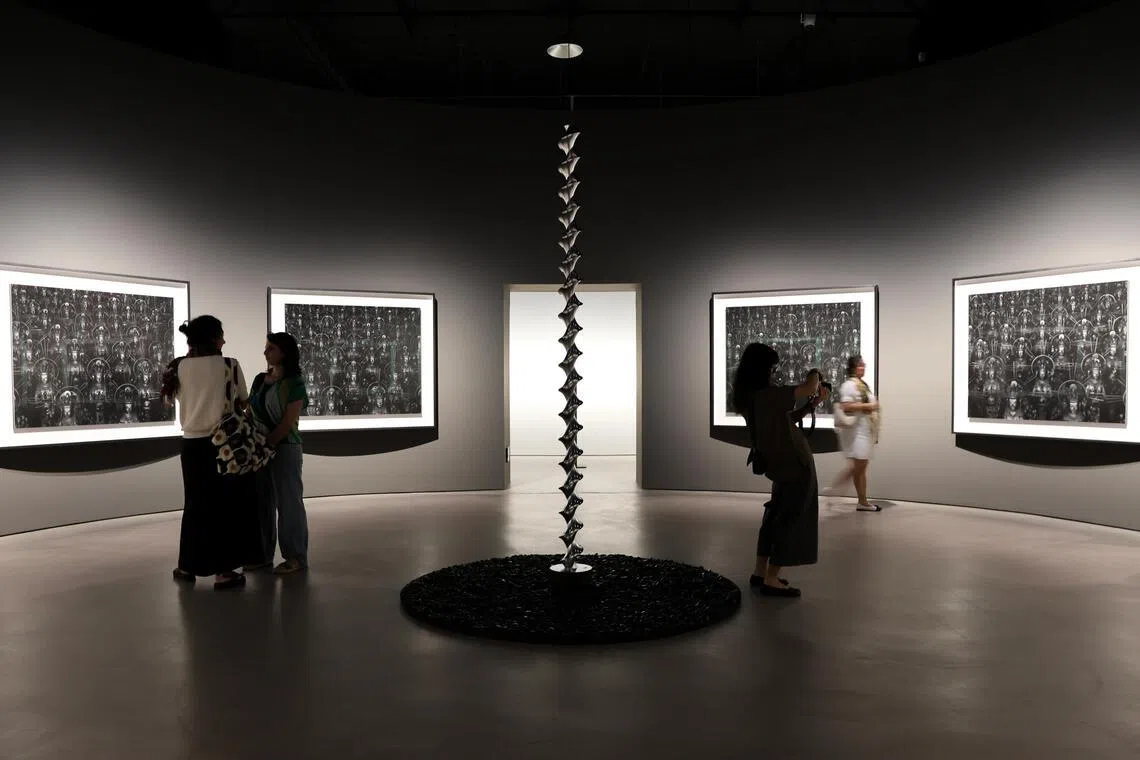
SINGAPORE – The Singapore Art Museum (SAM) is presenting South-east Asia’s first major survey of acclaimed Japanese artist Hiroshi Sugimoto, best known for his philosophical photographic experiments.
The 78-year-old’s show, on till Oct 4, is a dark space structured in the form of a mandala and titled after the Buddhist mantra Form Is Emptiness. Here are five works that still the mind, and query: Does contemporary art always have to to be disruptive and loud?
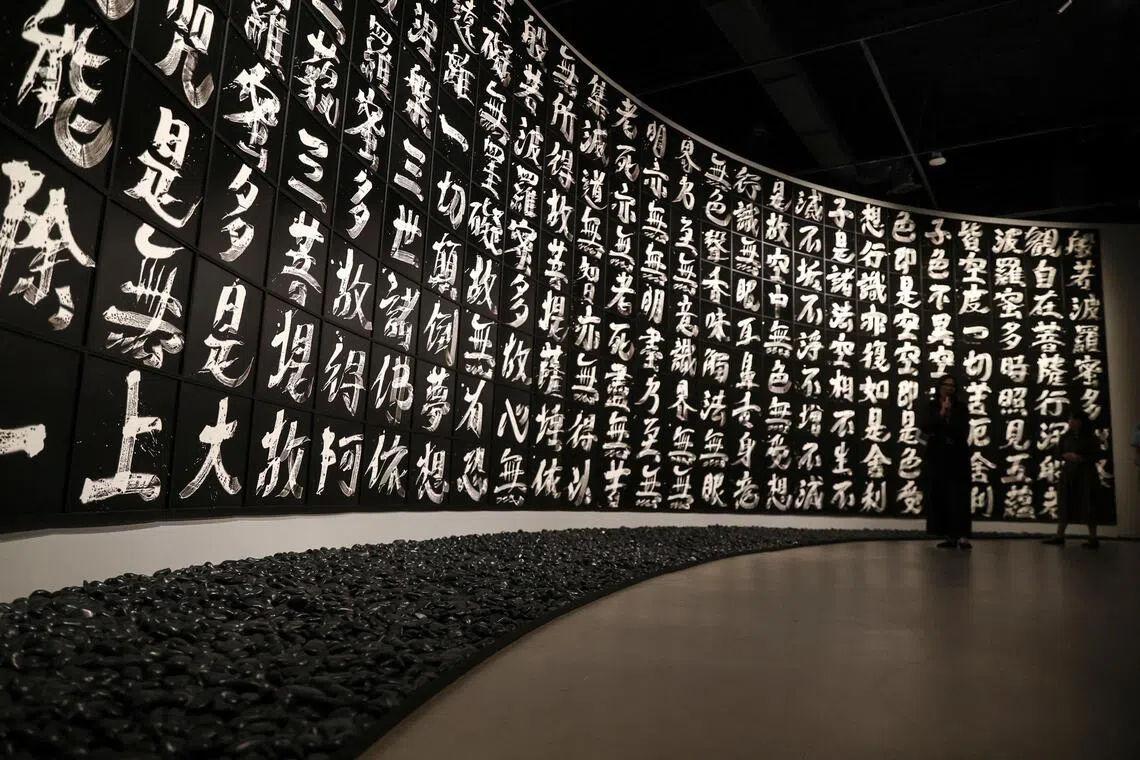
Brush Impression, Heart Sutra (2023).
ST PHOTO: SARAH LEE
While Sugimoto in general prefers to understate, this 4.5m-high wall of 288 calligraphic characters makes no qualms about its intention to envelop, brought home by the curators’ decision to lay the tiles out along a curved wall.
The characters are from Buddhist text The Heart Sutra and include the exhibition’s title Se Ji Shi Kong, Form Is Emptiness, six columns from the right.
Sugimoto wrote all the characters on photographic paper in near darkness with a brush dipped in fixer, an invisible chemical solution. Not able to see what he had written, this was an uncertain process that necessitated great focus and faith in his own calligraphic flow.
The act can be viewed through the lens of performance art, the time-limited medium which he then immortalised by exposing the paper to light. This toggling between time – which he achieves here without using the camera – is signature Sugimoto.
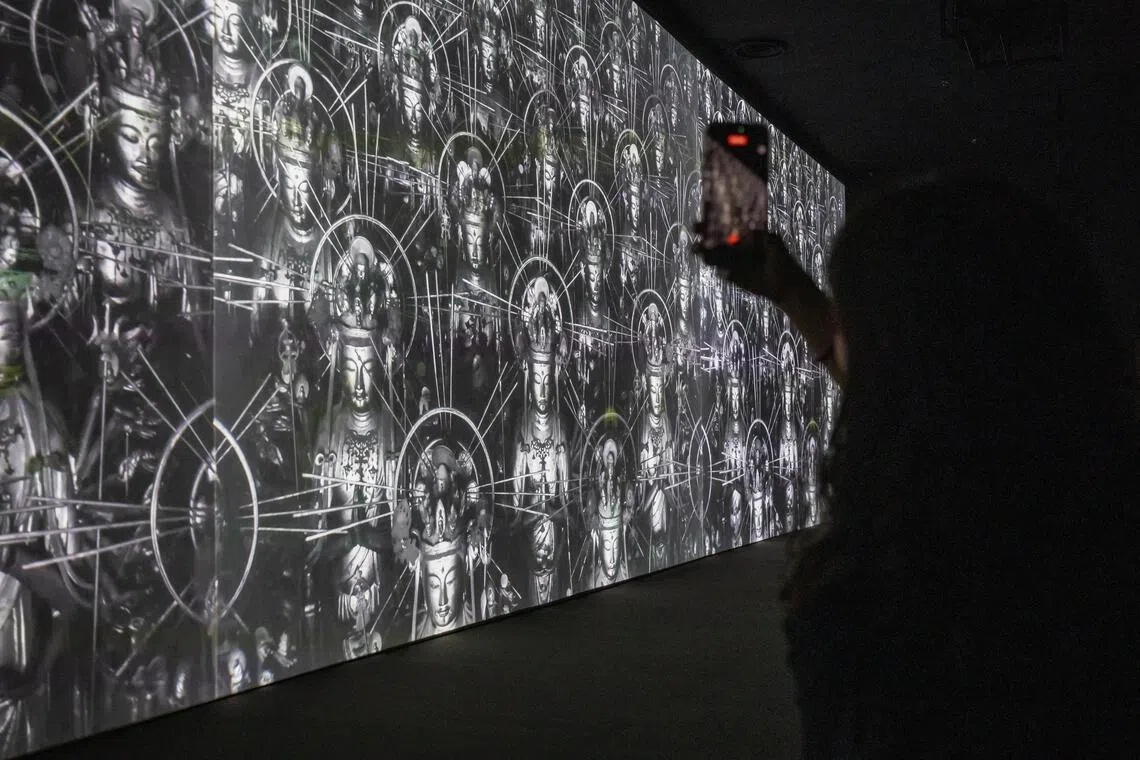
Sugimoto’s video work, Accelerated Buddha (1997 to 2017).
ST PHOTO: SARAH LEE
Another work that makes visible the neglected, underlying structures of time. While Accelerated Buddha itself is a five-minute, 45-second video, its basis is a series of photographs Sugimoto made of 1,001 statues of Guanyin in the Rengeo-in temple in Kyoto, Japan.
This photo series, Sea Of Buddha (1995), has also been included in the inner most sanctum of the mandala at SAM’s exhibition. Sugimoto managed to secure access to these bodhisattvas only after seven years of negotiation, photographing them during a 30-minute interval when the morning sunlight would strike their gold-leaf exteriors just so.
The video work, true to its name, accelerates the images until close veneration of the deities is no longer possible. It reads like a statement on the meaningless clip of the digital age. Sugimoto also observes that civilisations tend to inevitably accelerate before their demise.
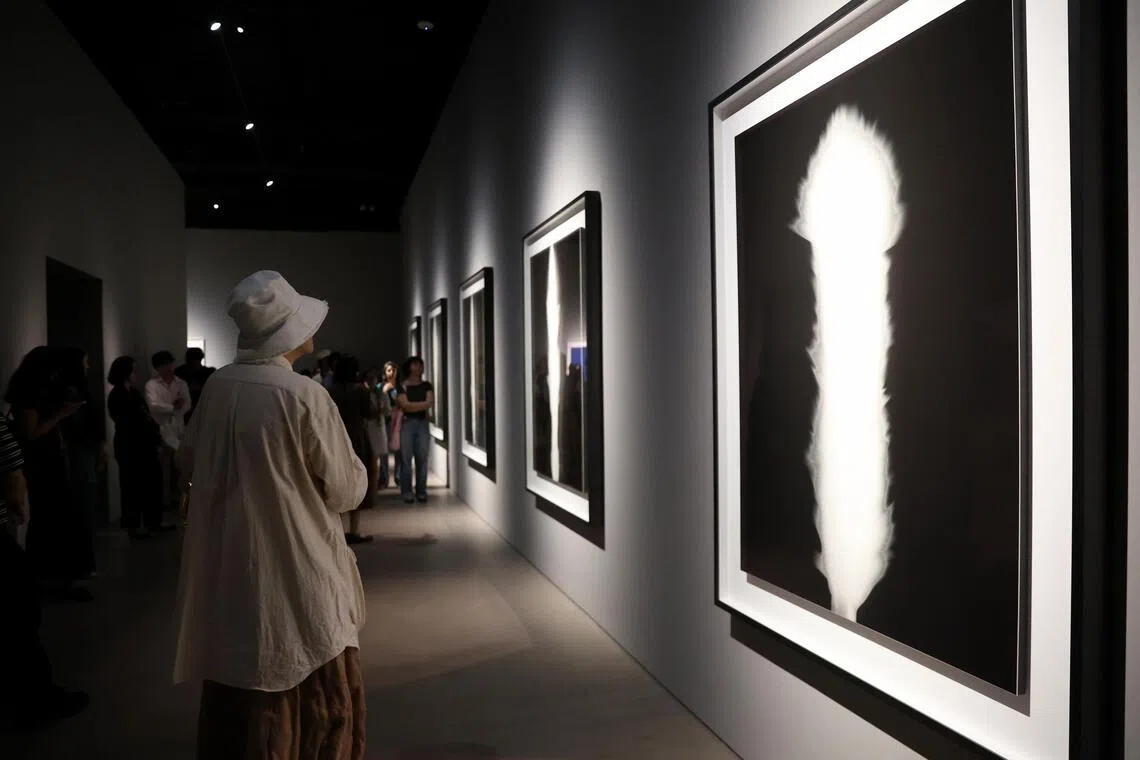
In Praise Of Shadows (1998).
ST PHOTO: SARAH LEE
In the day, Sugimoto’s studio in Tokyo is lit by just a single lightbulb, the only source of artificial light. At night, it becomes the realm of shimmering candles. In Praise Of Shadows is his way of compressing the life of these candles through long exposure photography.
The photo series is titled after Japanese author Jun’ichiro Tanizaki’s 1933 essay, a love letter to the more diffuse beauty of Japanese architecture and lighting before the irruption of modern fluorescent lighting.
Each print holds clues of how volatile or steady a flame was, or events in its burning that left a greater overall mark. They are equally abstractions of light harking back to the primordial creation of the world, or the first glimpse of a foetus emerging from its mother’s body.
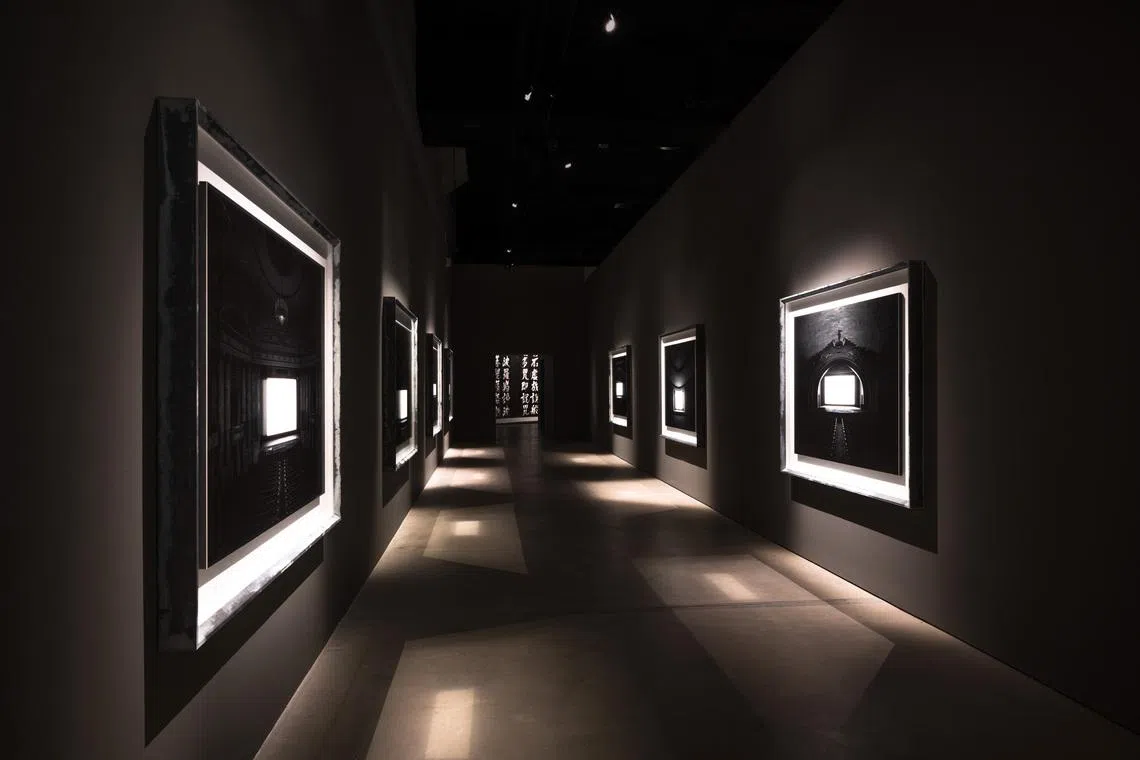
Theaters (1976 to 2014).
PHOTO: SINGAPORE ART MUSEUM
A motif that preoccupied Sugimoto for close to 40 years, Theaters is also a throwback to Sugimoto’s own beginnings: the artist was said to have taken his first photographs in cinemas in high school, British icon Audrey Hepburn inspiring him to train camera on screen.
In Theaters, however, he transcends the personal. Sugimoto, by leaving the shutter open throughout each screening, abstracts films into a portal of light. He believes it distills the films’ essence: comedies end up brighter, while horrors manifest several shades darker.
The architecture of these abandoned cinemas and opera houses are opulently vintage, their hollowed out interiors giving them a surreal quality. This need not be spooky, let the rectangles of reflected light cast in front of each print on the ground light your path.
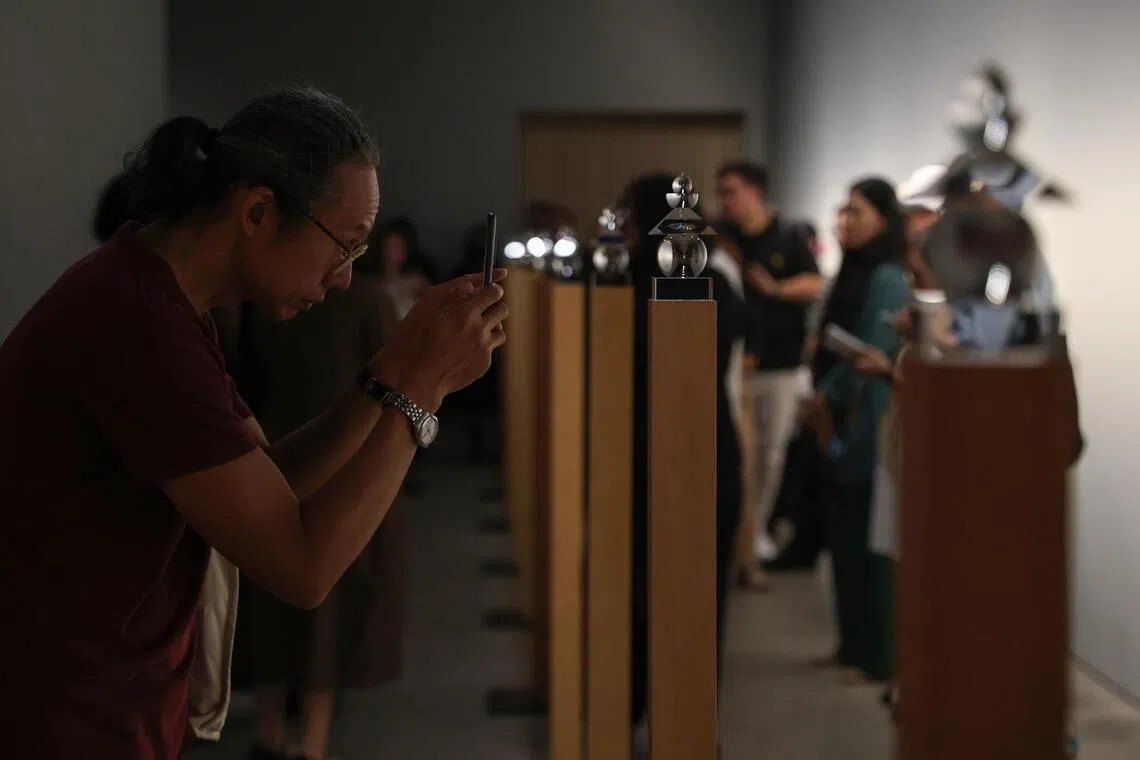
Five Elements (2011 to 2012).
ST PHOTO: SARAH LEE
Lest one assumes this show is all two-dimensionality, curators have also included nine pagodas. These are stupas made of optical glass that the artist has built in partial repayment of the debt he owes the camera.
Their cosmic ambition, with five shapes that symbolise earth, water, fire, air and void, is also a way of honouring the magical ways optical glass can contain all nature and even time.
Each stack is embedded with a photo from Sugimoto’s Seascapes (1990-2013) series that captures the horizon where sea meets sky. This was a formative moment for the artist that he has described as revealing to him the origin of consciousness itself.