
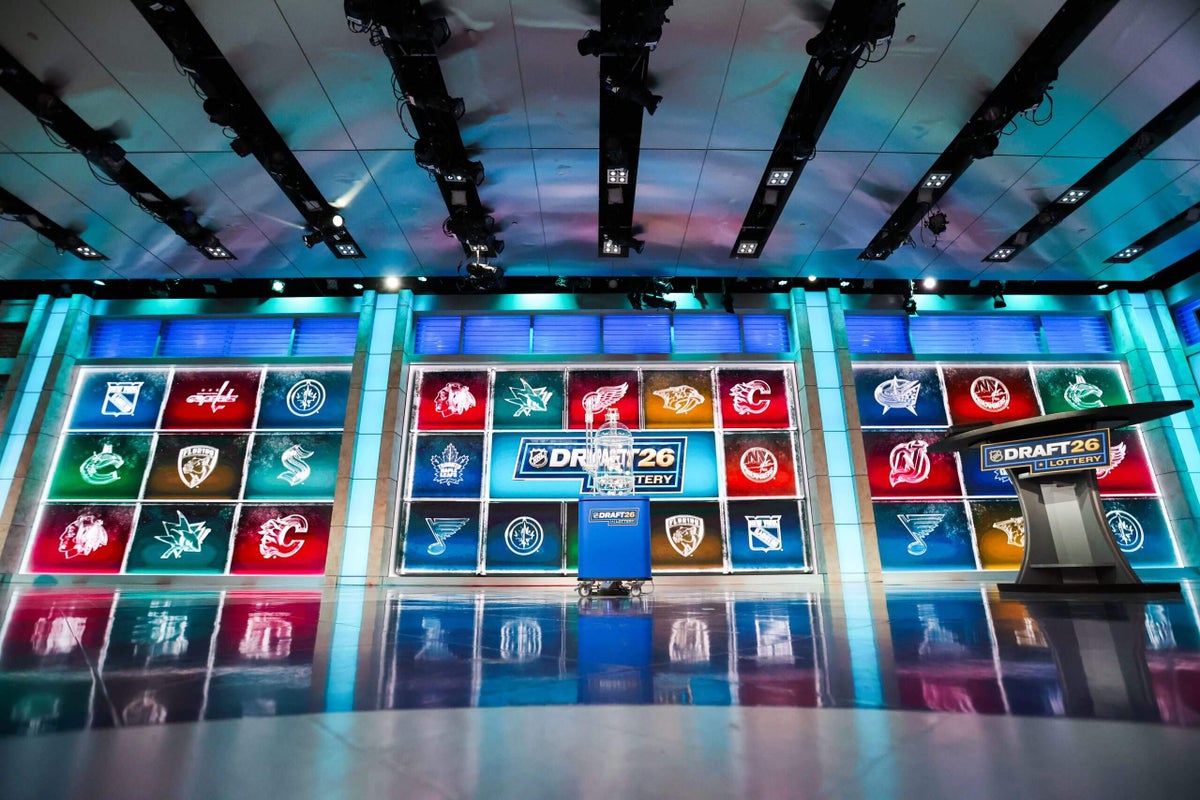
We’re well into NHL mock draft season, and I have to admit, I’m a sucker for it.
That’s especially true this spring. It’s been six years since the New York Rangers held a lottery pick, so I’ve been nerding out on all the possibilities.
I’ve spent time talking to scouts and various people around the league about prospects to watch with the Rangers’ two first-round picks — first at No. 5, then at No. 26. But I also find it fascinating to consider how the entire 2026 NHL Draft could play out. New York holds 11 total selections, its highest number since 2004, presenting a golden opportunity to restock a prospect pool in dire need of reinforcements.
It’s impossible to predict how the first round will unfold, let alone Rounds 2-7. But through the power of the internet, we can have some fun trying.
Mock draft simulators have grown in popularity over the years, with several options for fans who want to play GM. It’s an imperfect science that usually relies on consensus rankings, which don’t necessarily reflect how all teams view these prospects. But I tested a handful in the last couple of weeks and found a few that were user-friendly enough and helped explore different scenarios. Among them were PuckPedia, Upside Hockey and HockeyMockDraft.com, with the last including additional features that I enjoyed, most notably the ability to send and receive trade offers.
So, as an exercise in analyzing which prospects might be available to the Rangers on June 26-27 in Buffalo, I used HockeyMockDraft.com to simulate a complete seven-round draft and put myself in the decision-making chair for every New York selection. Here’s how it went.
First round
No. 5 — Chase Reid, RHD, Soo (OHL)
Before the draft even began, I had two trade proposals waiting. The Florida Panthers offered picks Nos. 9, 40 and 98 to move up to No. 5, while the St. Louis Blues put Nos. 11, 31 and 76 on the table.
Florida’s package added up to 45.29 on PuckPedia’s Perri Pick Value Calculator, which assigns numerical value to each pick, while St. Louis checked in at 45.07. I declined both offers since neither added up to the 50.13 value of the No. 5 pick — but even if they had, I still likely would have said no. The Rangers need top-end talent, and the higher the pick, the better their chance of landing it.
In that spirit, I offered San Jose picks Nos. 5, 63 and 92 to jump up to No. 2, which the Sharks predictably declined. It’s notable that the site doesn’t allow you to offer players, only picks, so I couldn’t get more creative and include someone like defenseman Braden Schneider. But it does have a meter that shows whether a team will accept or reject a proposal before sending, and even packaging Nos. 5 and 26 wasn’t enough to get a “yes” from San Jose. I’m not sure if I would have done that anyway, let alone sweeten the pot even further, so I decided to stand pat.
It worked out pretty well. The forwards I had hoped for all went in the top-three picks — Gavin McKenna at No. 1 to the Toronto Maple Leafs, Ivar Stenberg at No. 2 to the Sharks and Caleb Malhotra at No. 3 to the Vancouver Canucks — but the Chicago Blackhawks threw a bit of a curveball by selecting defenseman Carson Carels at No. 4. That left Reid as a fairly obvious choice with the fifth pick.
While this is considered a “pick your flavor” defensemen class, with teams debating between Carels, Reid, Alberts Šmits and Keaton Verhoeff as the top D available, I’ve increasingly gotten the sense that Reid is edging the pack. The Michigan State commit has the highest offensive upside and may be the best skater among the group — and at 6-foot-2.5, 195 pounds, it’s not like he’s sacrificing size and strength.
I would have loved to snag one of the top forwards, but I wasn’t going to reach for Viggo Björck or Tynan Lawrence at No. 5. The Rangers have needs all over, including on D, which is why they should take the best player available. And in this scenario, while an admitted long shot, Reid was that guy.
No. 26 — Jack Hextall, C, Youngstown (USHL)
Once the fifth pick was in, I knew I wanted to target a forward with my second first-round pick and kept an especially close eye on the centers — a position the Rangers haven’t taken in the first round since 2017.
Björck went No. 7 to Seattle and Lawrence went ninth to Calgary, who traded down in a deal with Florida. (The Panthers jumped up to No. 6 to get Verhoeff.) A run on the next tier of centers started at No. 15 with Oliver Suvanto, followed by Ilia Morozov (No. 17), Egor Shilov (No. 18), Brooks Rogowski (No. 20) and Alexander Command (No. 25). Skilled wingers JP Hurlbert (No. 19) and Nikita Klepov (No. 23) were also off the board, which left me with Hextall, Tomáš Chrenko, Maddox Dagenais and Simas Ignatavicius as the highest-rated centers available.
One of my goals in this draft is to take swings on skill and speed, two areas where the Rangers’ prospect pool is severely lacking. That’s why I was tempted by Chrenko’s upside, but I ultimately leaned on taking the best value in Hextall. He was the top-ranked available center according to both of The Athletic’s prospect writers, Corey Pronman and Scott Wheeler, and seems like the safest bet to develop into a middle-six pivot.
With that, I was 2-for-2 on players committed to Michigan State.
Second round
Trade for No. 45 — Markus Ruck, C, Medicine Hat (WHL)
While I wasn’t able to pull off a first-round trade, I had it in mind that I wanted to use one of New York’s four third-rounders to move up in the second. I watched as Chrenko, Dagenais, Ignatavicius and some of the other forwards I was interested in came off the board, including winger Liam Ruck, but as his twin brother Markus slipped, I decided to pounce.
I traded picks Nos. 62, 77 and 162 (5.88 value, per PuckPedia) to Chicago for No. 45 (6.01 value) and grabbed a center who led the CHL in scoring with 108 points (21 goals and 87 assists) this season. Ruck isn’t considered the strongest skater and clearly must bulk up his 6-foot, 167-pound frame, but the combination of work ethic, hockey IQ and high-level production made him a worthwhile gamble in the middle of the second round.
Third round
No. 67 — Mikey Berchild, LW, U.S. National Team Development Program
There are mixed opinions on Berchild, who’s ranked 57th by Wheeler but didn’t make Pronman’s list. The biggest knock is his size (5-10, 180 pounds), but as mentioned earlier, I’m aiming for skill as we get deeper into the draft, and Berchild checks that box more than most prospects in this range. We also know that the Rangers love their USNTDP products, with this one set to hone his skills at a highly successful University of Denver program. (Those connections will also be themes as we move into the later rounds.)
No. 81 – Ethan MacKenzie, LHD, Edmonton (WHL)
I also said I wanted to target speed, with Pronman labeling MacKenzie “one of the best skaters in this draft.” That sold me on the University of North Dakota commit, who registered just about a point per game in the WHL this season.
No. 92 — Egor Barabanov, C, Saginaw (OHL)
I rounded out the third round with Wheeler’s top-ranked overager. The 20-year-old Russian was highly productive this season, finishing fourth in the OHL in scoring with 91 points (28 goals and 63 assists) through 68 games. He was voted as the league’s No. 1 playmaker in an OHL coaches poll, making the UMass commit feel like a solid skill bet at this stage of the draft.
Fourth round
No picks
Fifth round
No. 131 — Dayne Beuker, C, USNTDP
Another undersized USNTDP product, the 5-10, 165-pound Beuker hasn’t been as productive as Berchild (hence why he was available in the fifth round) but is viewed as a better skater with the kind of motor that could turn him into a useful bottom-sixer. The Denver commit ranked No. 68 for Pronman, who called him “a high-effort, high-tempo center.”
Sixth round
No. 163 — Harrison Boettiger, G, Kelowna (WHL)
Even though the Rangers have Igor Shesterkin entrenched as their No. 1 netminder, I entered the draft planning to take a goalie. There are a couple of reasons for that.
The retirement of Jonathan Quick could open the door for 2020 fourth-round pick Dylan Garand to seize the No. 2 role, but New York has very little coming behind him. The only goalie prospect under contract for next season is Callum Tung, who posted an unsightly .855 save percentage in 16 appearances for AHL Hartford this season and stands as a long shot to reach the NHL. Depth is clearly needed.
The other part is that I think it’s good policy to swing on a goalie at least every other year, especially when you enter with 11 picks. You never know when you’ll hit on the next Shesterkin (2014 fourth round, No. 118) or Henrik Lundqvist (2000 seventh round, No. 205).
Boettiger went 25-10-5 with a .911 save percentage this season, with Pronman describing him as “an athletic, technically sound goaltender (who) displays the ability to make a lot of high-difficulty saves.” He’s the third Denver commit I drafted.
Seventh round
No. 193 — Lucas Ambrosio, LHD, Erie (OHL)
At this point, I’m just throwing darts. I wanted to take one more defenseman, and while the point production and puck-moving ability are areas to improve, the 6-4, 190-pounder has intriguing physical tools.