
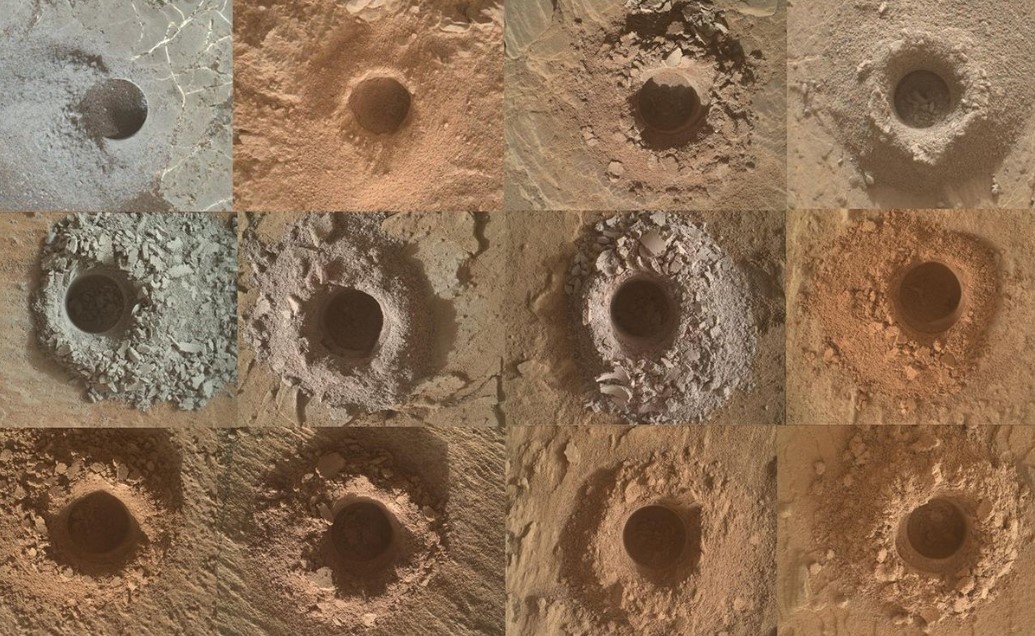
On an announced date, NASA reports new findings from the Curiosity rover about Mars’ ancient climate. The main purpose is to clarify when environmental changes happened that affected how rivers and lakes evolved into dry dunes. The message focuses on mineral clues found in Gale Crater that help pin down those timing questions.
In Gale Crater, the walls reveal a layered record of Mars’ past. Deeper layers preserve earlier conditions, while higher layers show later developments. Scientists studied 20 samples collected by Curiosity at different elevations to track how the environment changed over time. They used data from the rover’s CheMin instrument, which analyzes minerals through X-ray methods. The team looked at hematite, an iron oxide, and observed that its crystallite sizes varied with elevation. They also noted the presence of goethite, another mineral that forms with hematite, was found in higher elevations but not in the deepest samples. These patterns point to changes in temperature and water activity across time, suggesting long-lived, warm groundwater in the deepest layers.
The researchers interpret the results as an indication that warm and wet conditions persisted in buried rock for extended periods, even as the planet cooled overall. In the deepest parts of Gale Crater, groundwater could have remained stable for as long as several million years. If other essential factors were present, these long-lived aquifers might have offered habitable conditions during much of that time.
The study highlights how hematite crystallites serve as a mineralogical marker for climate shifts. The size and shape of these crystals respond to environmental conditions at the time they formed, providing a record that complements satellite observations of surface features. The analysis showed hematite crystals from higher elevations were under 10 nanometers, while those from lower elevations reached up to 65 nanometers. This aligns with the finding that goethite appears in higher locations but is absent in the lower ones.
Experts note that CheMin’s X-ray diffraction patterns enable specific measurements of crystal size and geometry, as well as the presence of related minerals. These details are essential for drawing conclusions about past temperatures and water activity in Gale Crater. The team explains that warmer, neutral-to-slightly alkaline water conditions could transform goethite into hematite and, through a process called Ostwald ripening, help larger hematite crystals grow in deeper layers over time.
At the moment, the study presents a clearer picture of how Mars’ climate shifted, with warmer water persisting beneath the surface in some regions. More to the point, the findings offer a new way to interpret mineral records as signs of ancient environmental change, rather than relying solely on surface geology. The researchers emphasize that their conclusions depend on the specific mineral data gathered by Curiosity and the contextual layers within Gale Crater.
 Published by James Hydzik
James Hydzik is a technology geek focused on the junction of engineering, writing, and coffee. He joined Orbital Today in 2020 to help make sense of the Johnson government’s decision to buy OneWeb. Since then, he has taken on interviewing and editor-in-chief roles. James learned the ropes of editing and writing with Financial Times magazines, The World Bank, PwC, and Ericsson. Thus far, interviewing New Space movers has put the biggest smile on his workaday face. The son of an Electrical Engineer, James understands the value of putting complex topics into clear language for those with a lay person’s understanding of the subject. James is a European transplant from the United States, and as ex-KA3LLL, he now holds European amateur radio licenses. His next radio project is a portable 10GHz EME (moonbounce) station, as it combines his childhood interests in antennas and space.