
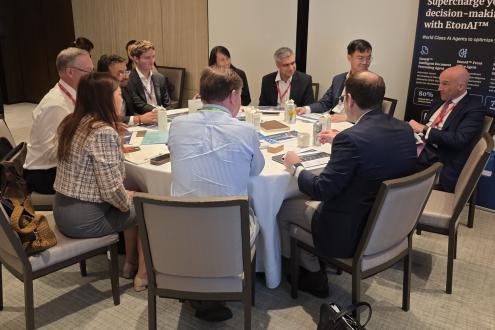
At WealthTHINK Singapore 2026, one of the day’s most operationally focused discussions came in the form of an interactive session hosted by Bryan Henning, President of Eton Solutions, and Dr. Silvio Struebi, Partner at Simon-Kucher. Bringing together participants from private banks, multi-family offices, advisory firms and the wider private wealth ecosystem, the conversation examined how family offices are coping with rising complexity, higher costs, data fragmentation and the growing pressure to professionalise.
The discussion moved beyond the familiar question of what a family office is, and focused instead on what these structures now need to function properly. Participants described an industry in which many families have created institutional levels of wealth, but are still operating through manual workflows, spreadsheets, disconnected bank portals and small teams under increasing strain.
The session suggested that the next phase of family office development will be defined less by formation numbers and more by operating discipline. Technology and artificial intelligence may help, but only if the foundations are in place: clean data, secure infrastructure, clear governance and a realistic understanding of what problems need to be solved.
Family office complexity is rising: Wealth creators are increasingly moving from corporate environments into private wealth structures that lack comparable systems, teams and controls.
Cost pressure is now structural: Staffing, retention, reporting, cybersecurity and regulatory demands are all increasing the cost of operating a family office.
Manual processes remain a major constraint: Many family offices still rely on spreadsheets, bank portals and people-heavy workflows that are difficult to scale.
Technology must start with data hygiene: AI cannot deliver meaningful value if documents, transactions and holdings are fragmented across systems.
The best AI use cases are practical: Portal extraction, document processing, due diligence, reporting and workflow automation offer clearer business cases than abstract innovation projects.
Family offices need secure, single-tenant environments: Privacy, cyber risk and control over confidential data remain central to adoption.
Setting the Scene: What is WealthTHINK?
WealthTHINK is an exclusive, invitation-only forum designed for CEOs and senior management at leading private wealth management firms. It offers a platform for industry leaders to engage in peer-to-peer networking and collaborative discussion, free from product pitches and formal presentations. The event focuses on proactive, table-specific debates around key themes shaping the future of wealth management, including digitisation, AI, regulation, business model profitability, family office development, cross-border structuring and regional connectivity.
By keeping participation senior and the format deliberately interactive, WealthTHINK is designed to encourage honest, commercially grounded exchanges on the issues firms are grappling with in real time.
From Wealth Creation to Operating Complexity
A central theme of the discussion was the gap between the scale of many family offices and the operating models supporting them. Participants noted that families often arrive at a liquidity event after building or selling sizeable businesses. In their corporate lives, they may have relied on enterprise systems, finance teams, chief operating officers, accountants and established reporting processes.
Once wealth is transferred into a family office structure, however, the operating environment can become much less institutional. Large pools of capital may be managed through spreadsheets, manual reconciliations, fragmented portals and small teams. One participant described this as families effectively becoming small and medium-sized enterprises while managing billion-dollar or multi-billion-dollar balance sheets. “The wealth may be institutional in scale, but the infrastructure behind it is often still manual,” said one participant.
This creates a negative feedback loop. As assets become more complex, more people are added to manage reporting, reconciliation and administration. But the more manual the environment becomes, the harder it is to retain good staff, control costs and maintain accuracy.
The Cost Question Is Becoming Harder to Ignore
Participants identified cost as one of the clearest pressure points facing family offices. Staffing costs are rising, talent is harder to find and retain, and the cost of doing business has increased significantly across Asia and other major wealth hubs.
The issue is not only compensation. Family offices are dealing with more jurisdictions, more reporting requirements, more private markets exposure, more cybersecurity risk and higher expectations from principals and beneficiaries. These pressures are global rather than limited to Singapore or Hong Kong, with similar dynamics seen in Dubai, London, Switzerland and the US.
For banks and service providers, this creates both a challenge and an opportunity. If they can plug properly into the family office value chain, provide clean data, reduce manual work and support operational efficiency, they become more useful. If they add friction, require repeated data cleaning or fail to provide usable reporting, they become easier to commoditise. “If a bank cannot reduce the family office’s cost of doing business, the conversation quickly turns back to price,” said one participant.
Manual Work Is Still Consuming the Operating Model
The table repeatedly returned to the amount of non-value-adding work still embedded in family office operations. Participants described teams spending disproportionate amounts of time pulling together bank feeds, logging into portals, reconciling statements, processing invoices, reading capital call notices and preparing reports.
One example involved staff checking dozens of private equity portals each day to see whether new capital call notices, statements or other documents had appeared. This was presented as a clear case where technology can remove routine work and allow people to focus on higher-value activity.
This point was especially relevant for multi-family offices, where scalability is central. Unlike a single-family office, an MFO must serve multiple families with different banks, reporting preferences, asset mixes and governance expectations. Without consistent data and workflow infrastructure, each new client adds complexity rather than scale.
The discussion suggested that technology’s first task is not to replace judgement. It is to reduce the administrative drag that prevents family office teams from spending more time on investment oversight, family governance, wealth transfer and client engagement.
Family Offices Need Data Foundations Before AI
Although the session focused partly on AI, participants were clear that many family offices are not ready to jump straight to advanced use cases. The more urgent issue is data. Documents, transactions, bank feeds, private equity statements, trust deeds, investment prospectuses and partnership agreements often sit across different systems and portals, with no single source of truth.
That creates a simple problem: AI cannot work well without structured, reliable and accessible data. Participants referred to this as the unglamorous but necessary foundation. It may be less compelling than a demonstration of a new AI tool, but it is what determines whether any technology deployment will create value. “Too many organisations want the AI outcome before they have built the plumbing,” said one participant.
For family offices, this means centralising data, protecting it properly, making documents readable, and ensuring the system can understand the family’s own context. Only then can AI support useful workflows such as document processing, data extraction, reporting and query-based analysis.
Security, Privacy and the Cloud Debate
Another major theme was the tension between technology adoption and privacy. Family offices often have high expectations around confidentiality, and some principals remain uncomfortable with cloud-based environments. Participants noted that this can be especially challenging where older wealth creators associate physical servers or internal systems with greater control.
The discussion challenged that assumption. Secure cloud environments, participants argued, may offer stronger protection than poorly maintained on-premise systems, particularly where major providers are investing heavily in cybersecurity. But the family office market still requires education around what secure infrastructure actually means.
The more important distinction was not simply cloud versus on-premise, but whether data is held in a controlled, private environment. Participants contrasted single-tenant systems, where a family’s documents and transactional records sit inside its own protected instance, with multi-tenant or generic AI tools where information may be sent externally and returned.
For family offices, that distinction is critical. Confidential documents, trust deeds, bank statements and investment records should not be processed through unsecured public tools. AI may be useful, but it must operate inside a controlled architecture.
Practical AI Use Cases Are Emerging
The strongest AI use cases discussed were practical rather than speculative. Participants pointed to data extraction, document processing, portal automation, due diligence support, compliance checks, capital call processing, invoice handling and investment document summarisation.
In one example, AI agents can enter portals, retrieve documents and feed information back into the family office system. In another, AI can read trust deeds and assist with distribution workflows. CIOs may also use AI to summarise prospectuses or compare investment documents against internal criteria before investment committee review.
These are not abstract innovation projects. They target specific sources of operational drag. The clearest business case often comes from extraction and summarisation, where AI can reduce manual work and improve the timeliness of reporting. “The business case is not always in the most glamorous use case,” said one participant. “It is often in the extraction work people do every day.”
At the same time, participants were cautious about overpromising. AI still requires context, guardrails and source verification. Organisations need to know where an answer comes from, which document supports it, and whether the output can be defended. In family offices, where decisions can involve sensitive family wealth, trust structures and private assets, explainability matters.
Adoption Depends on the Family Office Profile
The table also explored which family offices are more likely to adopt technology successfully. Participants suggested that newly created family offices, particularly those formed after a major liquidity event, may be more open to building proper infrastructure from the start. These principals may understand enterprise systems from their operating businesses and be more willing to invest in long-term capability.
Established family offices can be harder to move. Some already have manual processes that appear to work, even if they are inefficient. Others have internal gatekeepers who may resist change because new systems expose operational weaknesses or increase the demand for accuracy. If a principal starts receiving daily information rather than quarterly reports, the team must be ready to support that level of transparency.
Participants also noted that smaller family offices may want the efficiency benefits of AI but resist paying for the underlying infrastructure. That creates a mismatch between expectation and investment. They want the outcome, but not always the foundational work required to achieve it.
The Human Role Is Being Reframed, Not Removed
A recurring question was whether AI threatens staff within family offices and MFOs. The discussion suggested a more nuanced answer. For smaller teams already operating beyond capacity, AI is less about cutting headcount and more about freeing people from repetitive work so they can focus on clients, research, governance and oversight.
That is particularly true for MFOs, where teams may already be lean relative to the number of families and structures they serve. In those environments, technology can help the firm handle complexity without simply adding more people.
For single-family offices, the dynamic may differ. Some principals will evaluate technology in terms of whether it saves cost or improves returns. If the benefits are not clear, they may prefer to continue with existing processes. This places pressure on providers to frame technology in business terms, not innovation language.
Banks Can Differentiate by Reducing Friction
The discussion also had implications for private banks. As family offices become more sophisticated, banks risk being judged not only on investment access, lending or custody, but on how well they support the family office operating model.
Participants noted that clean data feeds, usable reporting and integration with family office platforms can become meaningful differentiators. If a bank cannot provide information in a form that reduces manual work, the family office may view it as part of the problem rather than part of the solution.
This does not mean banks must become technology providers in every respect. But they do need to understand how their systems, reporting and data quality affect the family office’s cost and efficiency. In a market where product access is increasingly broad, operational usefulness can become a source of strategic relevance.
Strategic Summary: The Family Office Model Needs an Operating Backbone
The session made clear that family offices are no longer a peripheral feature of Singapore’s wealth ecosystem. They are becoming more influential, more complex and more demanding. But the operating model behind many of them has not yet caught up with the scale of assets they control.
Technology and AI can help, but only where the basics are in place. Data must be centralised, documents must be readable, security must be robust, and workflows must be designed around real operational problems rather than abstract innovation narratives.
For banks, platforms, consultants and advisers, the opportunity is to support the institutional evolution of the family office. That means helping families move beyond spreadsheets, fragmented portals and people-heavy processes towards more disciplined, secure and scalable operating models.
At WealthTHINK Singapore 2026, the table’s message was clear: family offices may be defined by wealth, but their next phase will be determined by infrastructure, governance and execution.