
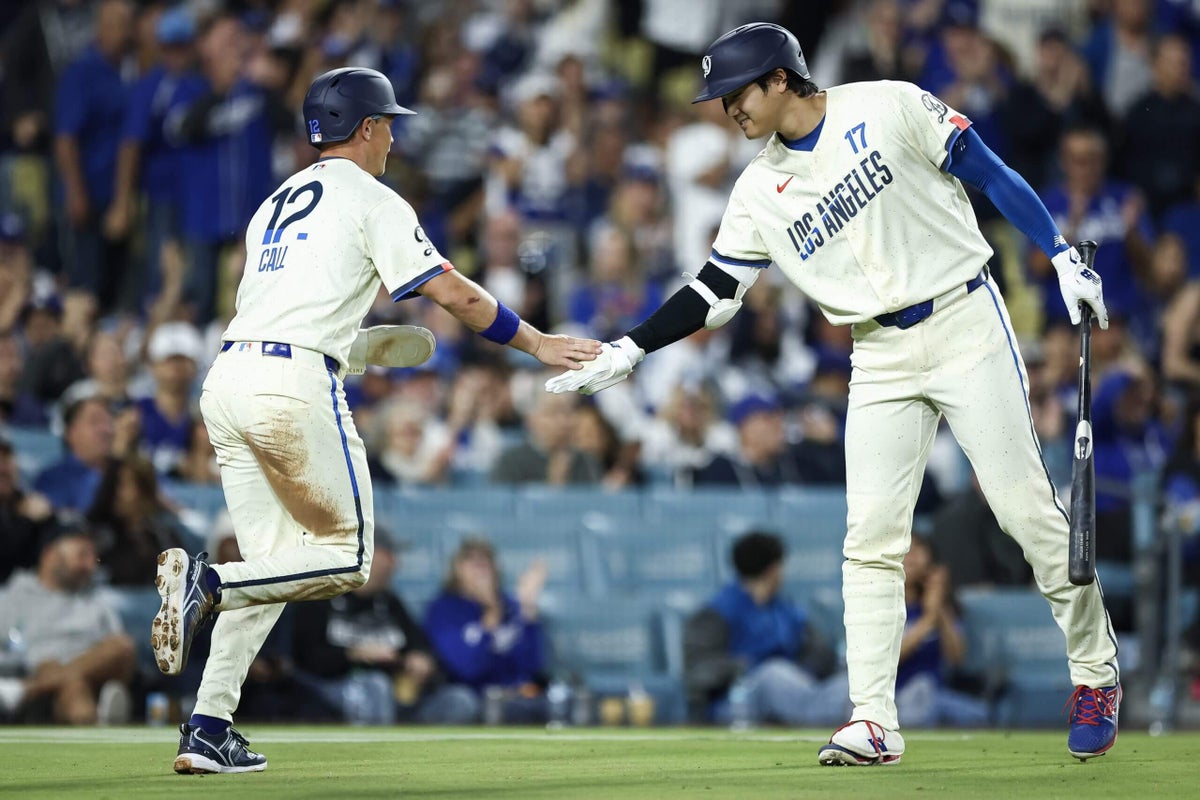
LOS ANGELES — There was no silent treatment after Ryan Ward rounded the bases for his first big-league home run. He’d waited long enough, including 725 games in the minors, before he cleared the fence for the first time. So Andy Pages was there to shower him with sunflower seeds after Ward took Andrew Painter deep to open up a three-run lead in a blowout win. The trip around the bases was a blur.
“Kind of a blackout, if I’m going to be honest with you,” Ward said. “Hit it, and I just went numb.”
A mess of alcohol, condiments, and whatever the rest of the Los Angeles Dodgers could find awaited Ward when he returned to the clubhouse after a 9-1 win over the Philadelphia Phillies.
“I’m probably going to smell for a little bit,” Ward said. “It was all over the place.”
Things are feeling good for the Dodgers, even as injuries have shaken up the roster. Ward is here to play the outfield after Teoscar Hernández strained his hamstring this week.
The Dodgers’ win Sunday was their 14th in their last 17 games, a stretch that includes five consecutive series victories. The Dodgers are playing their best baseball of the year and getting contributions throughout the roster. Sunday, that meant production from Ward and Alex Freeland, two of the newest guys in the lineup.
“Everybody in this locker room is a superstar,” said Freeland, who collected a double and a home run in just his second game back up from Oklahoma City.
Yoshinobu Yamamoto benefitted from some run support, carrying a six-run lead when he exited after 5 1/3 scoreless innings. The right-hander clearly was frustrated with his command and still struck out 10. The Dodgers are cruising.
“I think it just speaks to how we’re playing,” said manager Dave Roberts, who celebrated his 54th birthday with a victory.
From the moment Roki Sasaki signed with the Dodgers, one homework assignment looked potentially unsolvable, even to some in the organization.
For every tweak the Dodgers have made to Sasaki’s arsenal and delivery, the greatest unknown among club personnel was whether Sasaki would rediscover the premium velocity that made him one of the most famous pitchers on the planet.
Sasaki’s three-year odyssey to rediscover his fastball velocity might have its answer.
“It feels like it’s all put together right now,” Sasaki said Saturday through interpreter Kensuke Okubo.
He grunted as he fired a fastball to the Phillies’ Kyle Schwarber to start his night on Saturday, a pitch that Schwarber fouled off. It clocked in at 100.1 mph, the first pitch Sasaki had thrown all season that hit triple digits. That set up the splitter that followed, which Schwarber waved through. And Sasaki was off from there.
Sasaki hit 100 mph again an inning later, a 100.4 mph heater to J.T. Realmuto that clipped the zone but was called a ball. He touched 99 mph or harder 14 times, more than he has in any game in the majors. The 5 1/3 innings of one-run ball he threw against the Philadelphia Phillies could reconfigure what might be possible for him.
His day was officially in the books when Alex Vesia worked his way out of a bases-loaded jam in the sixth unscathed. Vesia could not hide his glee for Sasaki, smacking him on the shoulders and even getting the reserved Sasaki to smile.
This was the type of night Sasaki had waited for since he asked prospective big-league clubs to put together plans to help him get his velocity back.
How did it finally happen?
“Basically, I have kept doing the same thing and then stacking small things,” Sasaki said.
It helps that Sasaki has filled out his frame working alongside strength coach Travis Smith. His delivery is in a good place. His smile perhaps indicates some confidence that has been hard to come by.
“I feel like I was able to pitch the way I wanted,” Sasaki said. “That’s my way.”
Even he was surprised by how much his velocity increased, Sasaki acknowledged.
The right-hander entered Saturday having eclipsed 100 mph as a starter just three times in the regular season over his two years in the majors. Two came in his major-league debut on March 19, 2025, an erratic performance at the Tokyo Dome that would portend the rollercoaster that followed. Another came in September, when Sasaki accepted his new role as a reliever and emerged as a surprise savior for the Dodger bullpen.
He has not looked like he did Saturday night in a start since he was with the Chiba Lotte Marines in Japan. His velocity was the best it’s been in this role for the Dodgers, and now, he might be as equipped as ever to make the most of it. Sasaki’s new slider is a legitimate pitch, getting a swing-and-miss half the time a Phillies hitter swung at it (seven out of 14). He’s played both a splitter and a forkball off his fastball this season. Those steps counted as progress, even if he entered Saturday with a 4.93 ERA.
“I think early this season, after every throw, he was looking at the radar gun to see what the velocity was,” Roberts said. “Now, there’s just a confidence that the throw is good, the feel is good, and that’s his validation.”
Now, that heater looks like it once did. That’s promising.
There was some mild surprise around the batting cage when Kyle Tucker walked up around 3 p.m. on Saturday. The Dodgers leave an option open for hitters to hit off a high-velocity machine in their early work, but Tucker hadn’t deviated from his typical routine until now in his first season with the Dodgers after signing a four-year, $240 million deal this winter.
“That’s very telling, where he’s at,” Roberts said.
Facing the higher velocity is as challenging as training gets, Tucker explained Saturday afternoon. He was trying to find something. Tucker then joined his teammates for a round of on-field batting practice a couple of hours later, his first time doing so this year. After that round, he said he was working on trying to “get it on the barrel,” a fleeting thing for him as he’s struggled to find his footing.
Then Tucker went back down to the cage that night.
He went hitless in four at-bats Saturday against the Phillies. At least one of those balls had a chance to fall in. Tucker kept his swing back long enough to hook a two-strike Jesús Luzardo changeup into right field before Adolis García made a running, diving catch. When Tucker grounded out softly to first base in his next time up, he spiked his helmet when he reached the bag.
Sunday, he went 2-for-4. His single in the third inning was a grounder that kicked off the first-base bag and into the outfield to bring home a run. It’s hardly the contact Tucker’s been trying to make.
Better results came in his next at-bat. He stayed on a slider from Tanner Banks in the fifth inning, squaring it up for a 105.9 mph blast off the right-field wall for a double.
“Today looked more like who he is,” Roberts said.
Tucker’s OPS is .729, as baseball’s highest-paid player ever by average annual value, is tied for 90th among qualified hitters. According to Statcast, he has barreled up just 5 percent of his batted balls this season entering Sunday, a rate nearly half of his career mark.
Some of it is likely tied to the swing, while some of it has to do with Tucker’s swing decisions. He entered Sunday swinging at 49.8 percent of pitches he’s seen, his highest rate since 2022. He’s chasing more as a result. Only one other hitter — Cincinnati’s TJ Friedl — has seen a higher year-over-year increase in frequency swinging at the first pitch (47.5 percent, up from 36.3 percent).
“That’s kind of a red flag,” Roberts said, later adding that “it just seems like he’s much more hyperaggressive than I recall.”
Maybe Sunday’s double off the wall was the sign of a turnaround for the Dodgers’ newest star.
River Ryan commands the Dodgers’ attention, even as the organization continues to downplay his timeline to return to the majors. The club has stressed its desire to build Ryan up slowly. He’s hardly pitched in the last two years due to Tommy John surgery, and he hardly pitched at all after converting from the infield to the mound full-time once the Dodgers acquired him in 2022.
Ryan has made three starts since returning from his hamstring injury, throwing 15 brilliant innings and allowing just one run, striking out 19 with just one walk. He’s showcased some of the best stuff in the minors, moving up to No. 19 on Keith Law’s latest prospect rankings this week.
He’s also 27 years old, turning 28 in August. So, what do the Dodgers need to see?
“The stuff coming out of hand is awesome,” general manager Brandon Gomes said this week. “I think we’re gonna keep building him up and try to build a nice foundation before we look to do anything there.”
The Dodgers don’t have a pressing rotation need after acquiring Eric Lauer. There isn’t an obvious candidate to pluck out in favor of Ryan, who had never completed six innings in an outing until he did so on Thursday. They also would rather have him peak in October than in May or June.
“We have to be mindful of his innings and workload, and not just be shortsighted, like, ‘Oh, well, he’s pitching great now,’” Gomes said. “We also would like him to build that foundation and be a potential option.”