
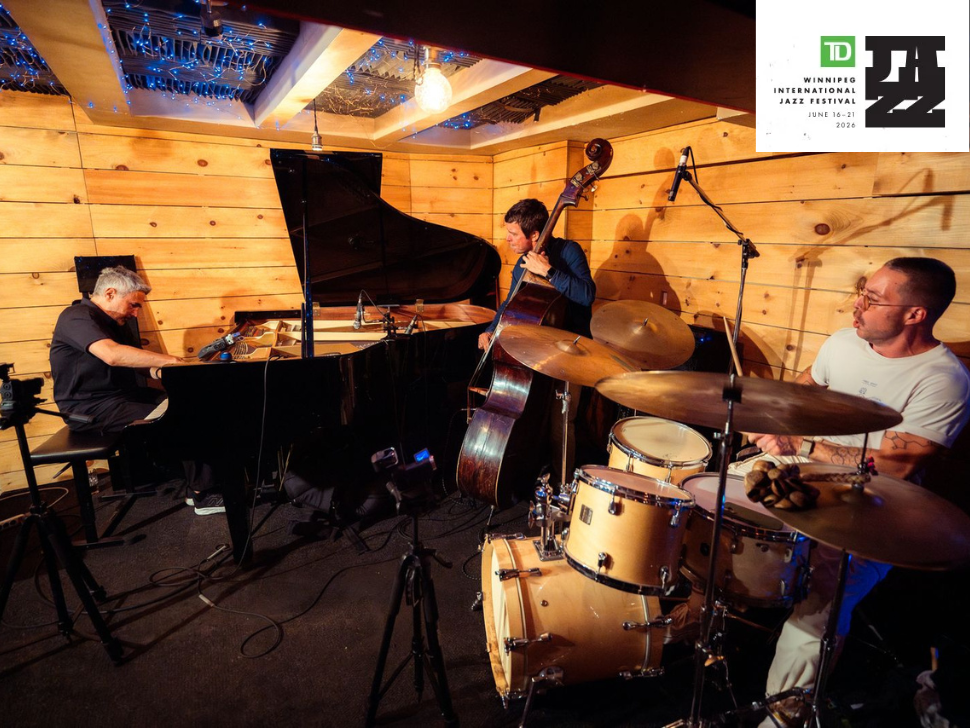
On Saturday, June 20 at 9:30 p.m., audiences attending the TD Winnipeg International Jazz Festival will have the opportunity to experience one of the most adventurous and unpredictable performances of the festival when the Jean-Michel Pilc Trio takes the stage in the Club Room at the Fort Garry Hotel.
Featuring acclaimed pianist Jean-Michel Pilc alongside bassist Morgan Moore and drummer Sam Joly, the concert will offer something increasingly rare in today’s musical landscape: an evening of completely spontaneous music making. There will be no predetermined set list, no rehearsed arrangements, and no roadmap dictating where the music should go. Instead, audiences will witness three master musicians creating in real time, following inspiration wherever it leads.
Pilc has built an international reputation as one of jazz’s most imaginative improvisers. A largely self-taught pianist who has performed in more than 60 countries and collaborated with artists including Michael Brecker, Marcus Miller, Kenny Garrett, Roy Haynes, and Harry Belafonte, he approaches every performance with a sense of curiosity and discovery. For him, music is not something that is simply performed—it is something that is experienced, explored, and shared.
For those planning to attend the June 20 performance, Pilc promises a concert that will be unlike any other.
Music as a Language
At the heart of Pilc’s artistic philosophy is the belief that music functions much like a spoken language. Long before he became an internationally recognized performer and educator, he learned music not primarily through books or theory classes, but through listening.
As a young musician, records became his teachers. When he heard great jazz musicians perform, he did not hear exercises or technical demonstrations. He heard people communicating.
“For me, at the beginning, it’s a language. It’s the way you talk. You talk in music.”
That simple idea shaped the way he developed as an artist. Rather than focusing on scales and theoretical concepts, he immersed himself in recordings, listening carefully to the voices of musicians who inspired him.
“The people that I heard on the record, they were talking to me.”
Pilc recalls hearing artists such AS Louis Armstrong and feeling a desire to join the conversation.
“I could feel like Baker or Armstrong and people like that. They were just talking to me and I was like, how can I respond? I’d like to talk to them now.”
Recordings made that possible.
“And miraculously, there are the recordings that preserve what they had to say. So for me, it made complete sense. It was like, okay, they’re talking. I’m going to talk back.”
That conversational approach remains central to his performances today. Every concert becomes an exchange of ideas between musicians, and audiences are invited to listen in as the conversation unfolds.
Why Improvisation Matters
Pilc’s commitment to improvisation extends beyond jazz. In fact, he sees improvisation as one of the most natural things any musician can do.
Today, as a member of the jazz faculty at McGill University’s Schulich School of Music, he often encourages students to develop fluency before becoming preoccupied with theory.
“What I tell my students is learn how to speak fluently before you get interested in the nuts and bolts.”
While he values music theory, he believes many educational systems place too much emphasis on technical concepts before students have developed a natural relationship with music.
“If you start with the nuts and bolts, you’ll never speak fluently. That’s actually because you do everything upside down.”
Pilc points out that many legendary musicians learned in much the same way he did. He notes that artists such as Django Reinhardt, Wes Montgomery, and Erroll Garner built extraordinary careers despite having limited formal training.
He also believes that improvisation has unfairly become associated primarily with jazz when it was once a common practice among classical composers.
“Mozart and Beethoven” were improvisers, he explains, as were Liszt, Chopin, Brahms, and Schubert.
“It has been lost in the 20th century and Glenn Gould called it a catastrophe and he was right.”
For Pilc, improvisation is simply an extension of everyday life.
“Every musician should improvise. The first thing you should do in the morning when you wake up and you want to play your instrument is just improvise for a few minutes and see what comes out.”
The Chemistry of the Trio
While Pilc’s philosophy provides the foundation for the June 20 performance, the success of the trio ultimately depends on the musicians sharing the stage with him.
Morgan Moore and Sam Joly are not simply accompanists. They are equal partners in the creative process.
“What I love about Morgan and Sam is that they have the same attitude.”
Because the trio performs without a set list or predetermined arrangements, trust becomes essential. Each musician must possess not only technical mastery but also the ability to respond instantly to new ideas.
“You have to be a great instrumentalist. You cannot be hampered by the instrument.”
Pilc praises Moore’s remarkable tone and clarity, qualities that allow every musical idea to be heard clearly.
“Morgan, every note that he plays, his sound is incredible. You can hear the note very clearly.”
That clarity helps create the meaningful musical dialogue that Pilc values so highly.
“I want music to be meaningful and clear.”
Joly brings his own distinctive voice to the group. Pilc hears something unusual in the drummer’s playing.
“Sam has something that I found very rare in drummers is that I hear melodies in his playing.”
Rather than functioning as separate instrumental voices, the trio often operates as a single musical organism.
“So bass drums and piano, they’re like three rivers, coexisting and fusing.”
The chemistry between the musicians is so strong that even fully improvised performances can sound carefully composed.
“I have recordings of our recent concert and I listen to them and I’m like, yeah, this sounds like that sounds like a composition. It sounds like something that could almost have been composed before we even played it.”
A Different Kind of Jazz Experience
One of the most intriguing aspects of the upcoming concert is that neither the musicians nor the audience know exactly what will happen.
Pilc is completely comfortable with that uncertainty.
“We really improvise.”
“When we step on stage the important thing is we have no idea what we’re gonna play… never.”
“There is no set list there is no conversation there is no rehearsal there is no nothing we step on stage and we compose in the moment.”
For some artists, that level of spontaneity might feel risky. For Pilc, it is liberating.
The trio may move from swinging jazz to lyrical passages, from groove-oriented sections to moments influenced by classical music. Nothing is ruled out because nothing has been planned.
“We don’t care. Is it jazz? Is it this? Is it? That’s completely irrelevant.”
Instead, the musicians enter what Pilc describes as “planet music.”
“We’re on in another planet, which is planet music, the planet of sounds.”
For audiences, that means becoming part of a creative process that unfolds before their eyes.
A Journey That Will Never Happen Again
When Pilc reflects on the reactions he receives after performances, a common theme emerges.
Many audience members describe the concerts not as recitals but as journeys.
“They felt like we brought them on a trip, on a journey.”
What makes that experience especially meaningful is its uniqueness.
“That journey will never be reproduced, that they saw something that was very unique.”
Unlike a performance built around a fixed repertoire, every Jean-Michel Pilc Trio concert exists only once. The music created in the moment belongs entirely to that audience, that room, and that evening.
“Every concert is different. Every set is different.”
That sense of discovery is what makes the June 20 performance one of the most intriguing events of this year’s TD Winnipeg International Jazz Festival. Audiences attending the concert will not simply hear a group of exceptional musicians. They will witness a musical conversation being created in real time, shaped by spontaneity, trust, and imagination.
“It’s a trip. It’s a journey.”
And when the final notes fade away at the Fort Garry Hotel, that particular journey will never happen again.
For anyone looking to experience jazz at its most spontaneous, creative, and exhilarating, the Jean-Michel Pilc Trio’s performance on Saturday, June 20 at 9:30 p.m. in the Club Room at the Fort Garry Hotel is not to be missed. Presented as part of the TD Winnipeg International Jazz Festival, this is far more than a concert, it’s a chance to witness three master musicians creating music in real time, guided only by their imagination, intuition, and deep musical connection. With no set list and no predetermined destination, every note becomes part of a journey that can only happen once. Whether you’re a lifelong jazz fan or simply someone who loves great live music, this promises to be one of the festival’s most unique and memorable performances.