
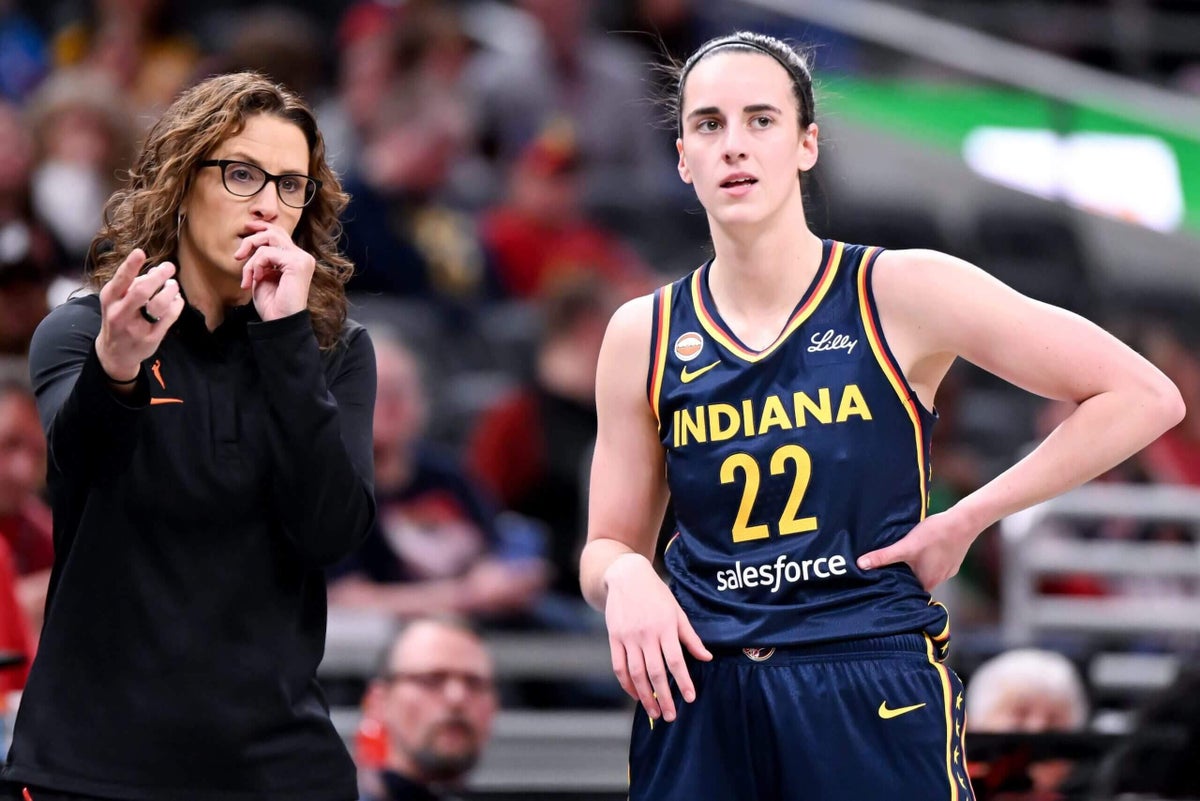
Caitlin Clark and the Indiana Fever are accustomed to being zeroed in on.
Since arriving as one of the WNBA’s pre-eminent stars, Clark has had a 24/7 microscope trained on her. How she’s living up to the hype, rivalries and her health are constant topics for discussion in the mainstream sports landscape.
But three years into Clark’s pro career, she’s seemingly still getting used to the degree to which everything she does has the potential to become a viral moment ripe for speculation and even overanalysis.
A sideline spat with coach Stephanie White during a timeout in Saturday’s loss to the Portland Fire became a widely circulated video on social media, which gave way to enough fodder for fake social media reports that White had been fired, going far and wide enough that Skip Bayless fell victim.
There is no validity to any report that White’s job is in question, multiple sources across the league, including one with direct knowledge of the situation, told The Athletic. And the shared belief from league sources validates Clark and White’s assertion that this type of exchange is not atypical between a player and coach in the heat of competition.
However, the visible tension between Clark and White in that moment was enough to bring their pairing into question, though they defended their relationship and blamed media misinterpretation after practice this week.
“Steph has my back more than anybody,” Clark said.
White said of Clark: “I ride with her.”
Thought Steph left her fire in Connecticut! 🥵 pic.twitter.com/meFefzUAAf
— Mostly WNBA Tweets (@MostlyWNBA) May 31, 2026
White is Clark’s second coach in her short career. She was the person the Fever wanted to lead the Clark era in Indiana, so much so that they fired Christie Sides with two seasons remaining on her contract to make the hire.
White is Indiana’s 1995 Ms. Basketball recipient, a former Fever player and former Fever assistant turned head coach. She was an assistant with the Fever from 2011 to 2014 before being promoted to head coach in 2015. Weeks into the 2016 campaign, it was announced that White was set to become the head coach of the Vanderbilt women’s basketball program after the season concluded.
Nine years later, she returned for what is widely considered the toughest job in the WNBA because of the spotlight that Clark and everyone in her vicinity is under.
The list of players whose star power shines bright enough that it could eclipse the authority of a coach and influence front-office decisions is short. LeBron James is certainly one. Kevin Durant and Giannis Antetokounmpo could be considered two others. In the WNBA, A’ja Wilson, Napheesa Collier, Paige Bueckers, Sabrina Ionescu and Clark are among those with the credentials to sway hirings and firings.
These dynamics aren’t novel to the WNBA. But the heavy scrutiny on player-coach relationships is relatively newer in the modern era, highlighting the significance of star players’ comfort and fit with their coach, not only stylistically but behaviorally, too.
“This isn’t the first time we’ve seen this,” four-time WNBA champion Sue Bird said during an NBC broadcast. “It doesn’t have some deeper meaning to it. I’ve had moments like that with coaches. I think it speaks to relationships, player-coach relationships.”
Navigating these relationships successfully starts with learning behavioral and competitive tendencies. In some cases, it’s organic. Other times, it requires some massaging.
There’s been little to evaluate of Clark and White’s public relationship because injuries limited the two-time All-Star to just 13 games during their first season together. But privately, there seems to be a deep-rooted, developing understanding of each other.
“When I got hurt at the Connecticut game last year, I bawled in Steph’s arms,” Clark said. “That’s somebody I will ride for the rest of my life.”
“We’re both competitive,” White said. “We’re both stubborn. We’re more alike than different. Hopefully, we continue to bring the best out of each other.”
Clark wants to be coached hard, White said. And in return, White wants Clark to help her be a better coach. Both seem comfortable exchanging friendly fire in the heat of competition because, as they explained, it doesn’t linger. But even that is a learned behavior. Though Clark and White might be able to flush that type of exchange without so much as a breath, another player might expect a follow-up.
That kind of fiery back-and-forth has been an everlasting occurrence publicly and privately across all professional team sports. What is different in the modern WNBA is the visibility and access to these moments of perceived disruption.
And therein lies one of the biggest hurdles White might face as the Fever’s coach: managing the effects of the microscope on Clark and consequently the entire organization.
Whether it’s Clark and White, Clark and assistant Briann January or Clark and the officials, her outbursts draw attention and subsequently raise the question of whether there are serious cracks in the foundation. What’s widely understood is that emotional eruptions and negative body language stand to affect a team. However, what’s only visible to said team is the equity a player has in the locker room because of work ethic, relationships with teammates and overall skill, which can stand to make moments like Clark’s or any other player tolerable.
The cure-all is, of course, winning.
Easing the widely observed frustration starts on defense — both Clark’s need to improve and White’s need to help hide her weaknesses on that side of the ball.
The 2025 season provided a small sample to evaluate how Clark is being used in White’s system. Clark’s usage rate (32.3 percent) is the highest it’s been in her career through the Fever’s first eight games. She’s averaging a career-high 20.1 points per game on 15.3 attempts, the most shot attempts she’s averaged in her first three seasons, with only a 2.4 percent drop from her rookie season, during which she was more efficient on fewer attempts. She leads the league in assists per game (8.1) while averaging a career low 4.6 turnovers per game.
Defensively, however, she’s like a sitting duck during hunting season.
“I think I’ve guarded probably the most isolations in the league so far,” Clark said.
Her self-evaluation is correct. Clark has defended 42 iso matchups thus far in 2026, according to Second Spectrum. Minnesota Lynx rookie guard Olivia Miles is next on the list, having defended fewer than half the number Clark’s seen with 19 isolations.
It’s not unusual for offensive Goliaths to be liabilities on defense. Bird talked about it during the same NBC broadcast, saying she countered her own inefficiencies by studying the trends of her opponents and learned to force them into their weaknesses.
In the NBA, Trae Young is widely considered one of the worst iso defenders. James Harden and Jalen Brunson are two more. Brunson leads the New York Knicks in points per game, and Harden was the Cleveland Cavaliers’ second leading scorer, but on defense, it’s part of a team’s responsibility to mask those weaknesses by fighting over screens, cross-matching or even switching to zone.
The Fever have excelled at taking away the 3-point line, giving up the fewest 3-point attempts in the WNBA. But they are seventh in the league in defensive rating, largely because they give up the third-most points in the paint behind the Dallas Wings and the Toronto Tempo.
Clark gave Fire guard Carla Leite a straight line to the basket all night in their 16-point loss. Leite finished with 18 points while shooting 6 of 12 from the field.
“Collectively, it’s about team defense,” White said. “We have to be more disruptive. We have to be able to sometimes send multiple defenders, sometimes just let her know we have her back. Our initial positioning, her initial positioning, where we are on the floor, matters. At times it’s good, and at times it’s not.”
Whether they wanted to acknowledge their latest viral moment was for Clark and White to decide, but how they navigate those instances — in public and private — will influence the success of the Fever in Clark’s third season and beyond.
“We’re under a microscope,” White said. “She’s under a microscope, and it is what it is. But the definition of tense moment is not that. We’ve been through some tense moments as a team, and that’s not it.”