
Breadcrumb Trail Links
Canadians deserve to know how much public money has been committed to the project
Published Jun 03, 2026 • Last updated 1 hour ago • 4 minute read
You can save this article by registering for free here. Or sign-in if you have an account.
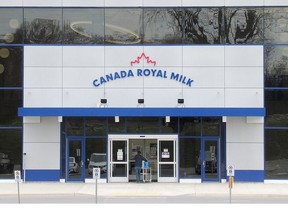 The Canada Royal Milk plant in Kingston, Ont. on Monday, April 25, 2022. Photo by Elliot Ferguson /PostmediaArticle content
See more Toronto Sun on Google — save as a Preferred Source
Advertisement 2
This advertisement has not loaded yet, but your article continues below.

THIS CONTENT IS RESERVED FOR SUBSCRIBERS ONLY
Subscribe now to read the latest news in your city and across Canada.
Unlimited online access to articles from across Canada with one account.Get exclusive access to the Toronto Sun ePaper, an electronic replica of the print edition that you can share, download and comment on.Enjoy insights and behind-the-scenes analysis from our award-winning journalists.Support local journalists and the next generation of journalists.Daily puzzles including the New York Times Crossword.
SUBSCRIBE TO UNLOCK MORE ARTICLES
Subscribe now to read the latest news in your city and across Canada.
Unlimited online access to articles from across Canada with one account.Get exclusive access to the Toronto Sun ePaper, an electronic replica of the print edition that you can share, download and comment on.Enjoy insights and behind-the-scenes analysis from our award-winning journalists.Support local journalists and the next generation of journalists.Daily puzzles including the New York Times Crossword.
REGISTER / SIGN IN TO UNLOCK MORE ARTICLES
Create an account or sign in to continue with your reading experience.
Access articles from across Canada with one account.Share your thoughts and join the conversation in the comments.Enjoy additional articles per month.Get email updates from your favourite authors.
THIS ARTICLE IS FREE TO READ REGISTER TO UNLOCK.
Create an account or sign in to continue with your reading experience.
Access articles from across Canada with one accountShare your thoughts and join the conversation in the commentsEnjoy additional articles per monthGet email updates from your favourite authors
Article content
Canadians pay a premium for dairy products because they have been told that supply management protects Canadian farmers, strengthens domestic production, and safeguards our food sovereignty. Whether one supports the system or not, that has always been the bargain: Consumers pay more in exchange for stability, predictability, and a secure domestic food supply.
Article content
Article content
That is why newly released government records related to Canada Royal Milk in Kingston, Ont. deserve far more attention than they have received.
The story began a few years ago, when construction started on what would become Canada’s largest infant formula manufacturing facility. Owned by Chinese dairy giant Feihe, the project was celebrated as a major investment in Canada’s dairy sector. After years of regulatory reviews and approvals, the company received authorization from Health Canada and the Canadian Food Inspection Agency in March 2024. Production began shortly thereafter, and in July 2024 Canada Royal Milk officially launched its Niuriss infant formula brand.

Your Midday Sun
Thanks for signing up!
Article content
Advertisement 3
This advertisement has not loaded yet, but your article continues below.
Article content
On the surface, it looks like a success story. Jobs were created. Manufacturing capacity was added. Canadian farmers gained another customer for their milk. The company invested heavily in Canada.
But newly released documents reveal a much larger story.
What the documents reveal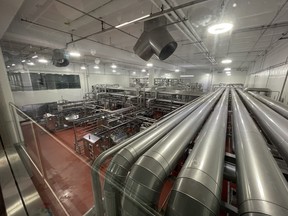 The receiving area where raw milk is first brought into the Canada Royal Milk facility in Kingston, Ont. on Tuesday, August 13, 2024. Photo by Elliot Ferguson /Postmedia
The facility was never primarily designed to serve Canadian consumers. Early planning documents projected that approximately 85% of production would be exported to China. Canada was expected to account for only a small fraction of sales. In other words, from the outset, Kingston was envisioned as an export platform.
The documents also strongly suggest that exports have already occurred to markets including China and potentially the United States.
That fact alone raises important questions. And all of this is occurring while Canada continues to face periodic baby formula shortages and Canadian parents are paying the price. Over the past five years alone, baby formula prices have increased by more than 70% in Canada.
Advertisement 4
This advertisement has not loaded yet, but your article continues below.
Article content
For decades, Canadians have been told that supply management exists to ensure domestic food security, protect Canadian farmers, and reduce dependence on foreign markets. Yet here we have a Chinese-owned processor operating within one of Canada’s most protected agricultural sectors, purchasing milk produced under a quota-protected system while pursuing opportunities beyond Canada’s borders.
The issue is not legality. There is no evidence that Canada Royal Milk has violated any law, regulation, or trade commitment.
The issue is consistency.
How much public money has been spent?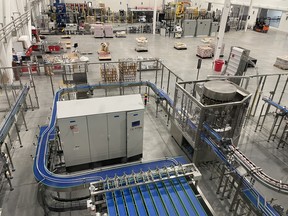 The packaging area at the Canada Royal Milk facility in Kingston, Ont. on Tuesday, August 13, 2024. Photo by Elliot Ferguson /Postmedia
Canadians also deserve to know how much public money has been committed to the project. Public records show that at least $24 million in federal support has been provided. Newly released documents indicate the company sought additional assistance through Agriculture and Agri-Food Canada’s Supply Management Processing Investment Fund, while portions of the records remain redacted.
Advertisement 5
This advertisement has not loaded yet, but your article continues below.
Article content
In other words, Canadians know taxpayers contributed at least $24 million to the project. What remains unclear is whether the actual figure is significantly higher.
That uncertainty matters.
For years, politicians have defended supply management as a shield against foreign competition, particularly from the United States. Food sovereignty has become a common talking point whenever the system is challenged. Yet a Chinese-owned company has become one of the most significant processors in a highly protected segment of Canada’s dairy industry, using supply-managed milk while pursuing export markets abroad.
The optics are difficult to ignore.
They become even more difficult to ignore as Canada prepares for another review of the Canada-United States-Mexico Agreement (CUSMA). American officials have repeatedly criticized Canada’s dairy policies, arguing that the system limits market access and distorts trade. Whether one agrees with those criticisms is beside the point. Ottawa should nevertheless be prepared to explain how a foreign-owned, export-oriented processor using supply-managed milk fits within the rationale Canada routinely uses to defend the system internationally.
Advertisement 6
This advertisement has not loaded yet, but your article continues below.
Article content
Questions that need answers
Canadians deserve answers to a few straightforward questions.
How much taxpayer money has ultimately been invested in the project?
How much supply-managed Canadian milk is being used to manufacture products destined for foreign markets?
What volumes have already been exported, and to which countries?
And perhaps most importantly: If supply management is about food sovereignty, why are Canadians being asked to subsidize a Chinese-owned dairy processor exporting products made from quota-protected Canadian milk?
Read More
EDITORIAL: No use crying over supply management

CHARLEBOIS: Think chicken prices are high now? Just wait
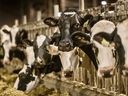
If we don’t reform supply management, Washington will do it for us
Supply management remains one of the most politically protected policies in Canada. Liberals defend it. Conservatives rarely challenge it. The Bloc Quebecois treats it as untouchable. Yet public confidence in any public policy depends on transparency.
Advertisement 7
This advertisement has not loaded yet, but your article continues below.
Article content
Canadians who pay a premium every time they buy dairy products deserve to know who benefits from the system, how it is being used, and whether public investments remain aligned with its original purpose.
This is really an accountability story. And before Canada enters another round of trade negotiations, Ottawa should be able to answer a simple question: If supply management is designed to protect Canadian food sovereignty, why are Canadians helping finance a Chinese-owned dairy plant whose original business model relied overwhelmingly on exports?
At the moment, Canadians only know part of the answer. That should concern us all.
– Sylvain Charlebois is director of the Agri-Food Analytics Lab at Dalhousie University, co-host of The Food Professor Podcast.
Article content
Share this article in your social network