
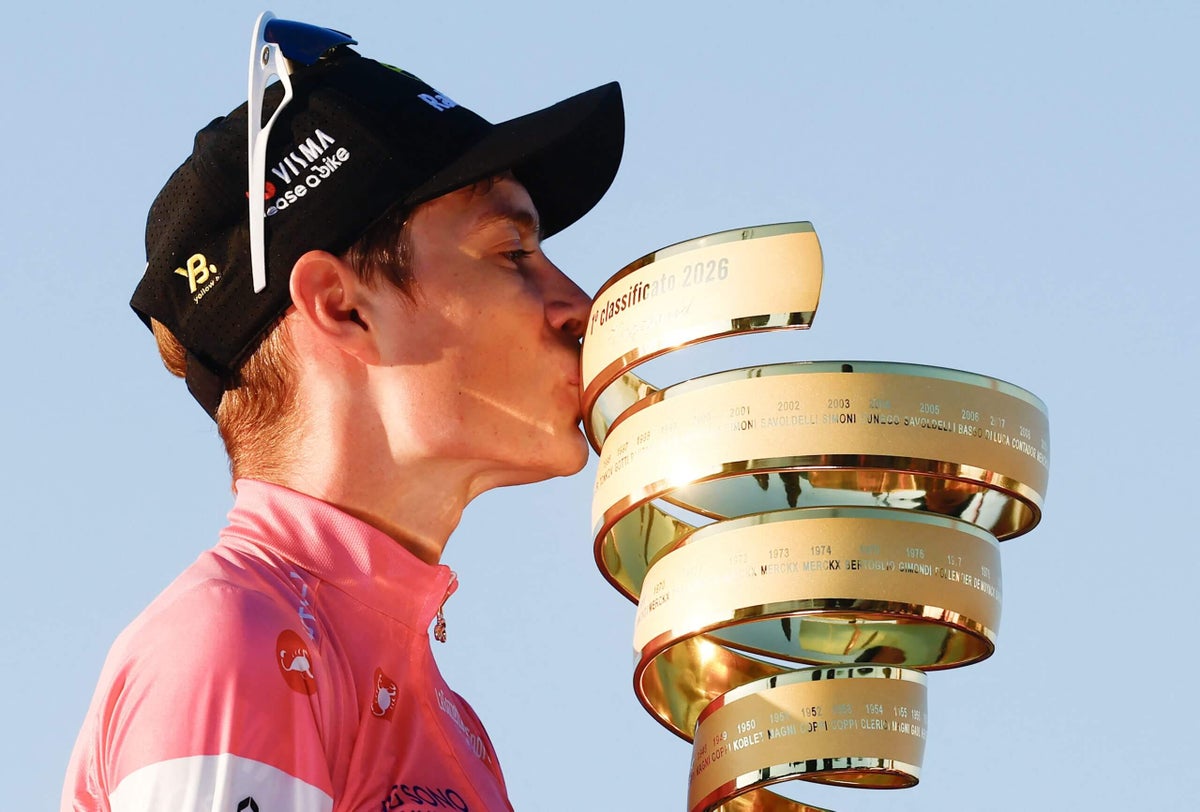
Part one of Jonas Vingegaard’s Giro-Tour double mission is complete. Now he’s turning his attention to part two: winning the Tour de France for the first time since 2023.
The Visma-Lease a Bike rider wrapped up a comfortable GC victory at the Giro d’Italia on Sunday, beating Felix Gall of Decathlon CMA CGM by more than five minutes. During three weeks of racing in Italy, Vingegaard won five of the six mountain stages as he dominated proceedings with apparent ease.
In claiming the maglia rosa, the Dane became only the eighth man in history to win all three of cycling’s Grand Tours.
The 29-year-old is targeting even more history this summer, as he seeks to become just the ninth man to win the Giro d’Italia and the Tour de France in the same year. To do so he must beat his eternal rival Tadej Pogačar, who is going for a joint-record fifth yellow jersey.
At the end of the Giro, Vingegaard confidently declared that “I believe I will be in very, very good shape for the Tour de France.” That belief was echoed by Visma’s head of performance Mathieu Heijboer, who told The Athletic that “for sure, there will be a closer battle between Jonas and Tadej than last year”.
In 2025, Pogačar won four stages and beat Vingegaard by 4:24. “I am really confident we will have a proper fight again,” Heijboer added. “This will be the sixth year in a row that we will see those two fight for spots one and two in the Tour.”
With just over four weeks until the Tour gets under way with a team time trial in Barcelona, The Athletic looks at what Vingegaard needs to do to reduce the pair’s Tour head-to-head record to 3-4.
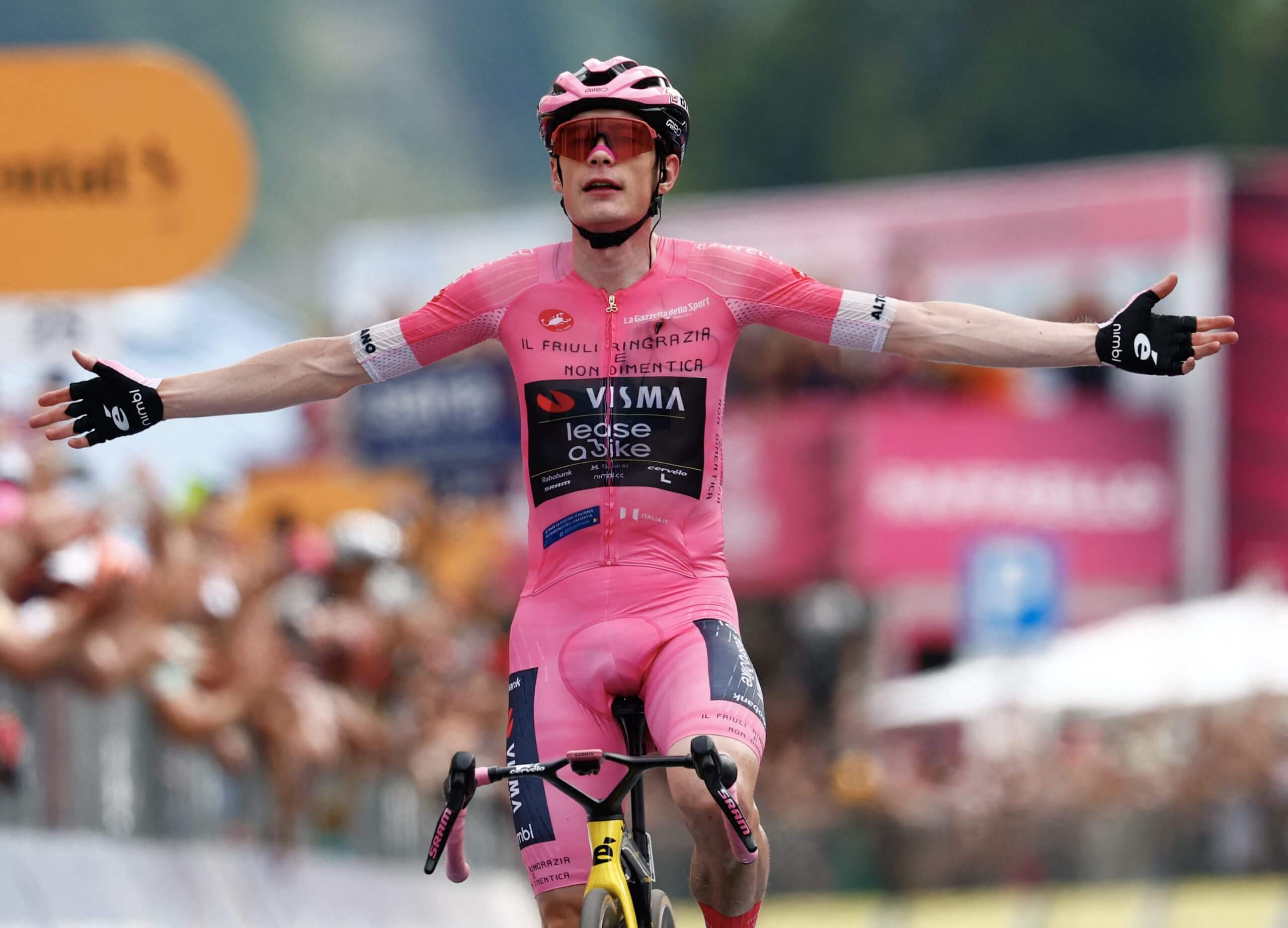
Vingegaard was peerless in the Italian mountains in May – July promises to be significantly tougher (Luca Bettini / AFP via Getty Images)
Conventional wisdom states riding the Giro d’Italia fatigues a GC rider before the Tour de France, and that they enter the second Grand Tour in worse condition than if they had instead spent May training at altitude and warmed up for the Tour with a week-long stage race in June.
History largely supports that case: it took 26 years for a rider to last claim the Giro-Tour double, between Marco Pantani’s 1998 successes and Pogačar’s 2024 victories.
But there are two reasons why Vingegaard has continued to insist that he’s not worried about being in weaker shape come the Tour.
The first is that the two times he’s ridden the Vuelta a España after the Tour (also with a gap of four to five weeks in between) his performance numbers were better. He won last year’s Spanish race, and was probably the best rider in the 2023 race, which was won by his Jumbo-Visma team-mate Sepp Kuss.
The second reason is that he didn’t have a serious rival at the Giro, with many analysts believing he was only riding at 90% of his full capacity. “Definitely,” Heijboer — who since March has been Vingegaard’s coach — responded when asked if Vingegaard could have gone deeper at the Giro.
“I always get asked to compare his top shape or what percentage he is at, but it’s difficult to say. What is key for him and for us is that he was never really pushed to the limit [by others at the Giro]. The only time was when he pushed himself.
“Instead of attacking from kilometre zero to the finish for the win he didn’t have to push himself to defend his position or to track an important move and that makes a huge difference to how he will come out of this race.”
In the stages that he controlled and dominated, Visma witnessed a rider who was operating at his peak. “In the first week Jonas got a little bit affected by the weather, like many others in the peloton, but once he got over this cold the true Jonas was back at work, reaching a very high level,” Heijboer continued.
“We can say that the level he reached, especially on uphill finishes in the last week, was very high, maybe even higher than we expected.”
Better than ever? “With the level he is at now, way better than when he won the Tour,” Heijboer said. “But the sport and especially the elite riders have developed so quickly. It might sound strange to say that he’s now better than before, but Pogačar has developed really fast since 2023; other riders like [Paul] Seixas are coming; Remco [Evenepoel] and [Florian] Lipowitz are doing a great job, too. Everyone’s riding faster so even if Jonas is at his best-ever level it might not be enough because everyone is progressing so fast.”
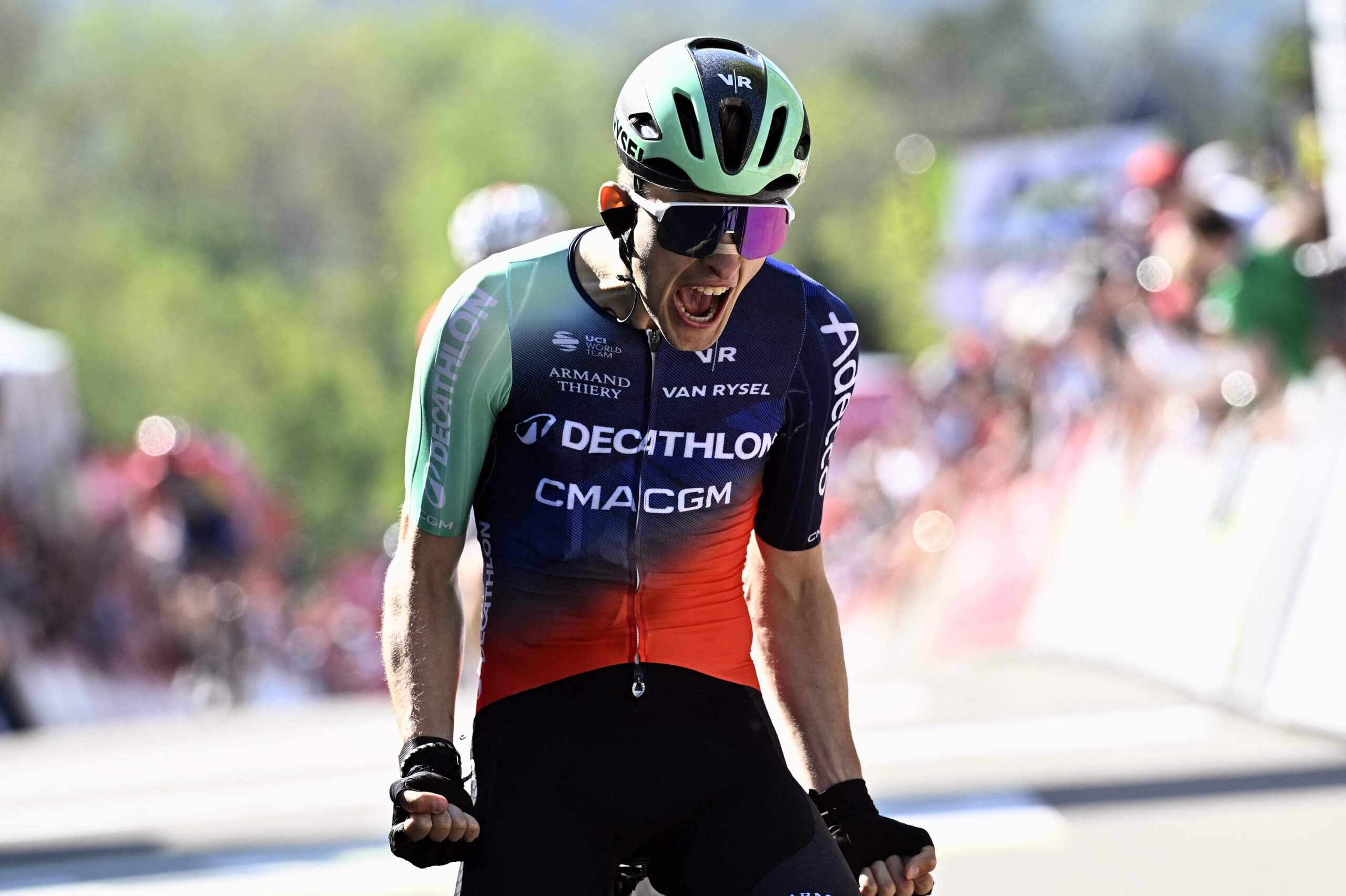
Teenage sensation Paul Seixas is an additional factor for Vingegaard and Pogačar to contend with in this year’s Tour (JASPER JACOBS / Belga / AFP via Getty Images)
It was only two springs ago that Vingegaard, along with other key riders like Evenepoel, crashed hard at the Itzulia Basque Country, breaking his sternum, several ribs and a collarbone, as well as puncturing both of his lungs. He later said that he feared he was going to die in the accident.
He made a remarkable recovery to finish second at that summer’s Tour, and then won 2025’s Vuelta after again placing second in the Tour. But all along Visma’s medical and coaching staff were preaching that Vingegaard wouldn’t fully recover until the 2026 season.
“After the accident we knew we’d need two years to get him back to his level,” his former coach Tim Heemskerk recently told The Athletic. “He did a great job in the 2024 Tour off such a short period of training, but he was tired after that and he needed time to recover from it. We knew he’d need a full season of racing and of putting the hours in for him to be stronger again.”
His performances at the Giro suggest that the lengthy process is now seeing its rewards. “He had a lot of time off the bike after the crash and then spent a lot of energy in rehabilitation rather than in training to become better,” Heijboer explained.
“We and Jonas wanted to make it to the Tour in 2024 and we did so in a controlled but high-pressured manner, but there was no time — not even an hour — for us to lose in that process. The consequence of that was that after he raced the Tour of Poland after the Tour he was extremely tired.
“He took some time off to recover from that but he lost valuable time to grow as his body was still recovering. Apart from a crash at Paris-Nice, he more or less had a full season last year, riding two Grand Tours, and he needed that year of normal racing. They were all building stones to get back to the level he had before he crashed.”
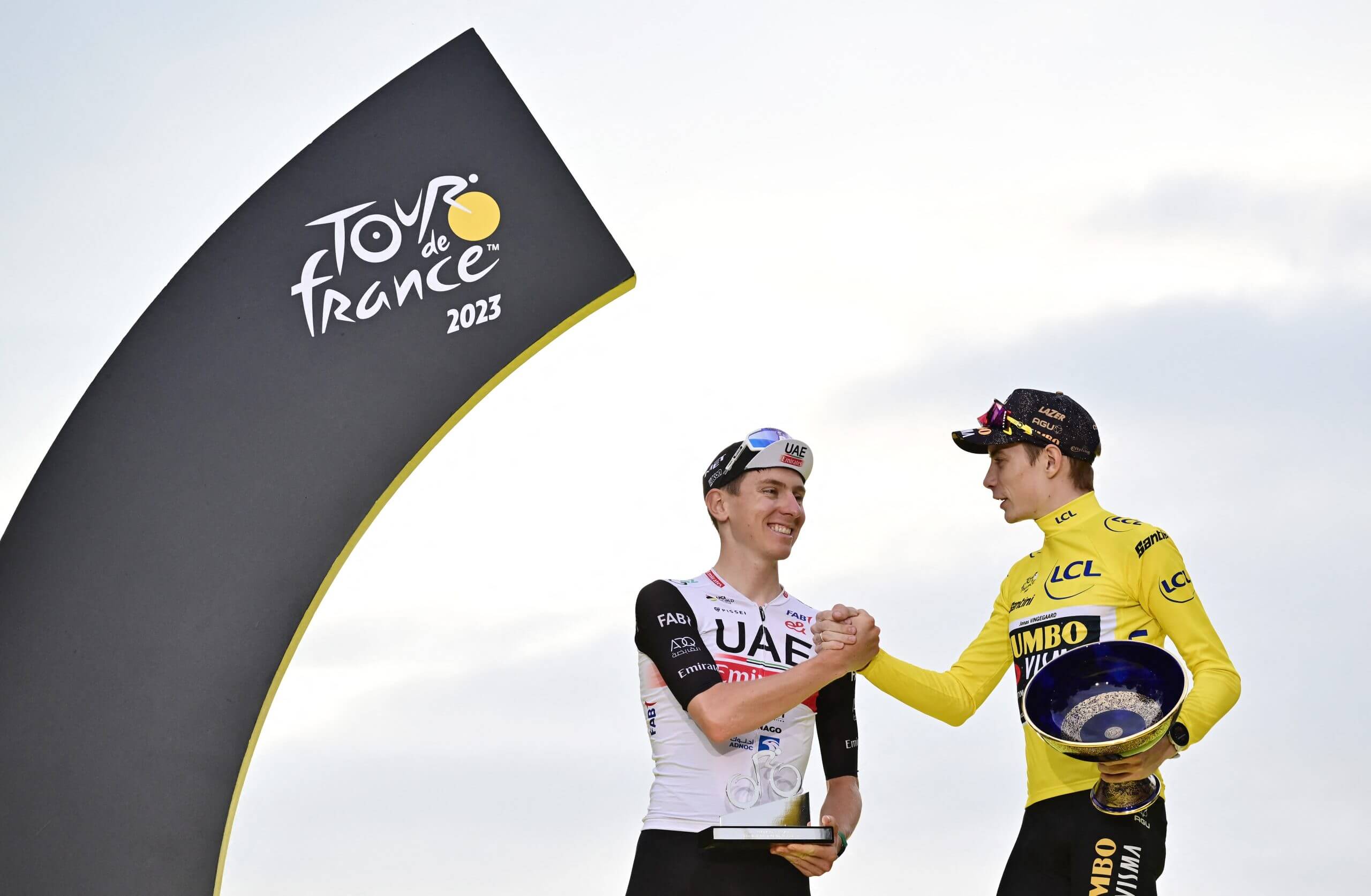
Vingegaard celebrates winning the 2023 Tour de France – his great rival Pogačar has won the two editions since (MARCO BERTORELLO/POOL/AFP via Getty Images)
Vingegaard finished the Giro by promising to spend the ensuing few days living like any other tourist in Italy: eating plenty of pizza and pasta and sampling the local wine (he’s a burgeoning wine collector).
After a few days in Rome with his family, he will then fly back home to northern Denmark where he’ll be based for about two weeks before then flying to Tignes in the French Alps to join up with the rest of the Visma Tour squad for a final altitude camp.
“Jonas is very motivated and eager to go for it in July, but first he needs to take a proper rest and recovery. We’d rather he takes one or two extra days off than start too early,” Heijboer said about the balance of not overtraining Vingegaard in the coming month.
“We have to be very prudent and the data will tell us when he’s back riding if he’s recovered. Then we move on to the training, but we don’t have to add another layer [to his workload]. We can build on the form he has now from the Giro.”
Unlike other riders who have already been on reconnaissance trips of certain key stages, Vingegaard will not go on any scouting missions. “We made the assessment that all the travelling [to recons] wasn’t worth the stress, so the staff will do the recons and Jonas will train in a calm environment at home or at a training camp.”
For just over seven years, Vingegaard was coached by Heemskerk, and together they turned a quiet boy from a fishing village into one of the best riders of his generation. When Heemskerk departed by mutual consent in March, citing a struggle “to apply my creativity and passion”, Vingegaard expressed his sadness.
“He’s one of the best coaches out there,” Vingegaard said, partly crediting the Dutch coach with his wave of success. “I had complete trust in him. Tim is hard to replace.” Heemskerk has since joined rivals Red Bull-Bora-hansgrohe as a coach.
Stepping in to fill Heemskerk’s shoes at Visma was Heijboer, who in his role as head of performance already had an oversight of Vingegaard’s training. “We value Tim really highly, but in this team we have the same training philosophy, so it wasn’t like suddenly a new coach came in to train Jonas completely differently,” Heijboer said.
“How I approach Jonas is maybe a bit different to how Tim did it and I also try to push Jonas to a new level, but it’s not like there’s a completely new reality. We’ve still got the same way of working. And that’s proven because all of the riders who Tim coached have kept on performing since he left, and that’s because of the system and organisation of the team.”
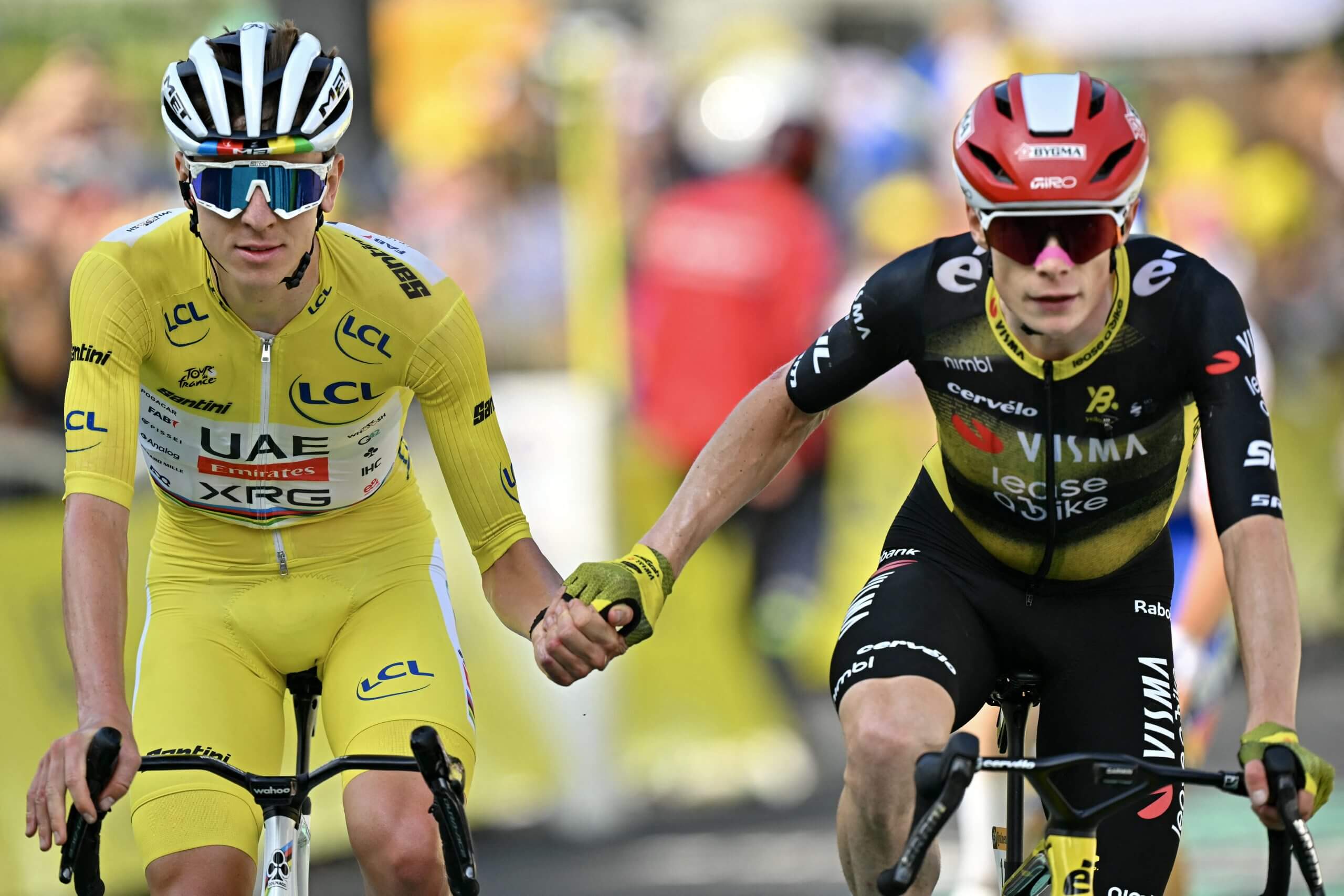
Pogačar and Vingegaard cross the line hand-in-hand during stage 10 of last year’s Tour de France (LOIC VENANCE/AFP via Getty Images)
Speaking at a press conference two days after Vingegaard’s Giro win, Visma general manager Richard Plugge provided some additional detail on the change of trainer.
“He [Vingegaard] is very happy with Mathieu Heijboer as his new coach,” Plugge said. “He wanted to do some new things. We had lengthy conversations in the winter, starting in October, and he was really happy that Mathieu was big time open to these new ideas.
“Together they were working hard on his form and he showed big progress in his numbers in the past [few] months and he feels like there is still progress to be made in the coming weeks to be ready for the start in Barcelona.”
A change of coach is not the only disruption to Vingegaard’s environment. It was announced just this week that Grischa Niermann, the team’s head of racing, would be leaving on August 31 to take on a new role at Lidl-Trek, a team that is undergoing a series of management overhauls.
Plugge said that he was surprised, shocked and saddened when Niermann phoned him a few weeks ago to tell him of the news, and that he tried and failed to persuade the German to stay put.
Nevertheless, Plugge referred to the team’s management structure, insisting that a ready-made successor is ready to step into any role that becomes vacant. Marc Reef, who was the team’s lead sports director at the Giro, will replace Niermann and will be the lead DS at the forthcoming Tour.
According to Plugge, “Jonas in the first instance was surprised” when he heard of Niermann’s impending departure, “but then he’s just won the Giro with Marc Reef sitting behind him [in the car] so he also saw the opportunity to maybe even do even better. This will not hurt us or his preparation.”
The Tour begins with a 19km team time trial in Barcelona, and then there’s a 26km individual time trial on stage 16, which is split into three roughly equal parts: a 9km climb, a 7km descent and a 10km flat sector.
Vingegaard smashed Pogačar by more than 90 seconds to win a mountainous time trial to Combloux in the 2023 Tour, but since then his time-trialling performances have been a little less consistent. At last year’s Vuelta, he ceded time to his main GC rival João Almeida in a 12km test against the clock, and three other GC riders posted a better time than he did during the recent Giro’s 42km TT.
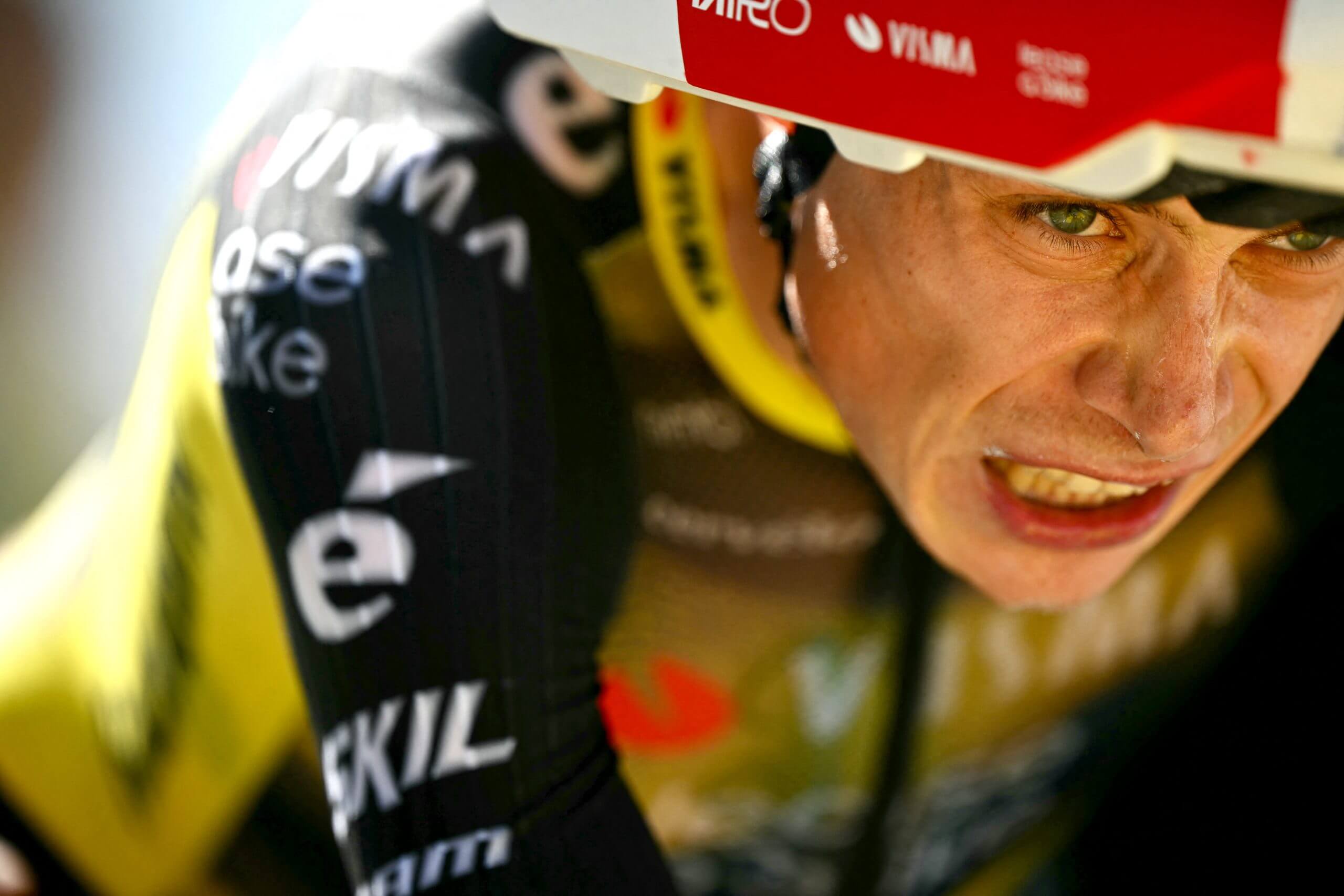
Vingegaard shipped over a minute and a half to Pogačar in the two time trials that were part of last year’s Tour (LOIC VENANCE/AFP via Getty Images)
Pogačar, meanwhile, has won three of his last six Grand Tour time trials, while Evenepoel is the reigning world and Olympic champion in the discipline. Up against his expected Tour rivals, time-trialling appears to be Vingegaard’s weak spot.
“In a really flat TT where absolute power counts, Jonas as a 59-60kg rider is definitely at a disadvantage compared to the likes of Almeida and Pogačar who are a bit heavier and push way more watts on the flat,” Heijboer said.
“The learning from the Giro TT was that it could have gone better, but a flat course wasn’t a good one for him, and we could see that he had been affected by the weather in the first week.
“It’s not correct to say that he’s very inconsistent, but obviously a flat TT is not a good course for Jonas. Then we have to make up for it in the mountains. Thankfully the TT in the Tour has quite a big climb in it.”
Since the first Tour battle between Pogačar and Vingegaard in 2021, the Slovenian has earned, on average, 50 bonus seconds in each edition, most of them accrued by winning stages where positions one, two and three are awarded 10, 6 and 4 bonus seconds. Vingegaard has averaged 29 bonus seconds — 21 fewer than Pogačar.
If this year’s Tour is to be as closely fought as many hope and Visma are predicting, then bonus seconds could play a crucial role in determining the eventual winner of the race. Heijboer accepted that this is a problem for Visma to address.
“We tried to pay a lot of attention to this last year and Jonas was significantly more explosive compared to other years,” Heijboer said. “You could see it on the first stage of the [Critérium du] Dauphiné [last year] when he did a very good sprint, and he also attacked on punchy stages during the Tour.
“He was better than in the past because he was able to follow Pogačar, but in the end if it comes to a finish-line sprint between them both we have to accept that nine times out of 10 Pogačar will unfortunately be the winner.
“It’s a balance for us because we don’t want to sacrifice Jonas’s other characteristics, especially his ability to climb at a very high level for 30-plus minutes.”
So how will the 2026 Tour play out? Will Pogačar march towards his third consecutive title, or will Vingegaard claim his third? Perhaps even teenage debutant Seixas will spoil the party for both of them.
What Heijboer can predict is that his star rider will be in better shape than at any other point in the past. “I’m really confident that Jonas will not have bad days like he had last year, which was a consequence of his preparation and what happened in the months and years before,” he said. “Jonas has a better level right now than he did last year and we truly believe that he can do even better.
“Let’s hope that Pogačar hasn’t increased his level again by 10 per cent but we’ve seen in the past in the Tour that they both push one another to new levels because they’re both so good.”