

NVIDIA recently used Computex and GTC Taipei to unveil RTX Spark, its first AI PC superchip co‑developed with Microsoft and MediaTek, alongside the Vera CPU and rack‑scale Vera Rubin platform for agentic AI factories now ramping into full production.
These launches push NVIDIA beyond GPUs into end‑to‑end AI infrastructure for both data centers and Windows PCs, tightening ecosystem ties with hyperscalers, OEMs, chipmakers, and software providers across industries from healthcare to autonomous vehicles.
We’ll now examine how NVIDIA’s move into AI PCs with RTX Spark and Vera CPUs may influence its AI infrastructure‑driven investment narrative.
Invest in the nuclear renaissance through our list of 88 elite nuclear energy infrastructure plays powering the global AI revolution.
NVIDIA Investment Narrative Recap
To own NVIDIA today, you have to believe its AI “factory” thesis stays intact: that GPUs, now joined by Vera CPUs and full Vera Rubin racks, remain the default platform for agentic AI across cloud and enterprise. Computex / GTC Taipei reinforces that catalyst rather than changing it, by showing Vera Rubin and RTX Spark moving from roadmap to shipped systems. The biggest near term risk still looks external: export controls and hyperscaler in house silicon efforts that could soften demand, despite this week’s strong ecosystem signals.
Among the latest announcements, the Vera Rubin platform ramping into full production matters most for the AI PC and Vera CPU story. Rubin ties Vera CPUs, Rubin GPUs, BlueField-4 STX storage and Spectrum-X photonic Ethernet into a single POD scale system that CoreWeave, Dell, GMI Cloud and others are already preparing to deploy. If investors see consistent orders and utilization on Rubin racks, that could reinforce the AI infrastructure driven narrative behind RTX Spark PCs and ease some worries about custom ASIC and CPU competition.
Yet while Rubin and RTX Spark look encouraging, investors should also be aware that…
Read the full narrative on NVIDIA (it’s free!)
NVIDIA’s narrative projects $676.2 billion revenue and $363.6 billion earnings by 2029.
Uncover how NVIDIA’s forecasts yield a $296.81 fair value, a 38% upside to its current price.
Exploring Other Perspectives 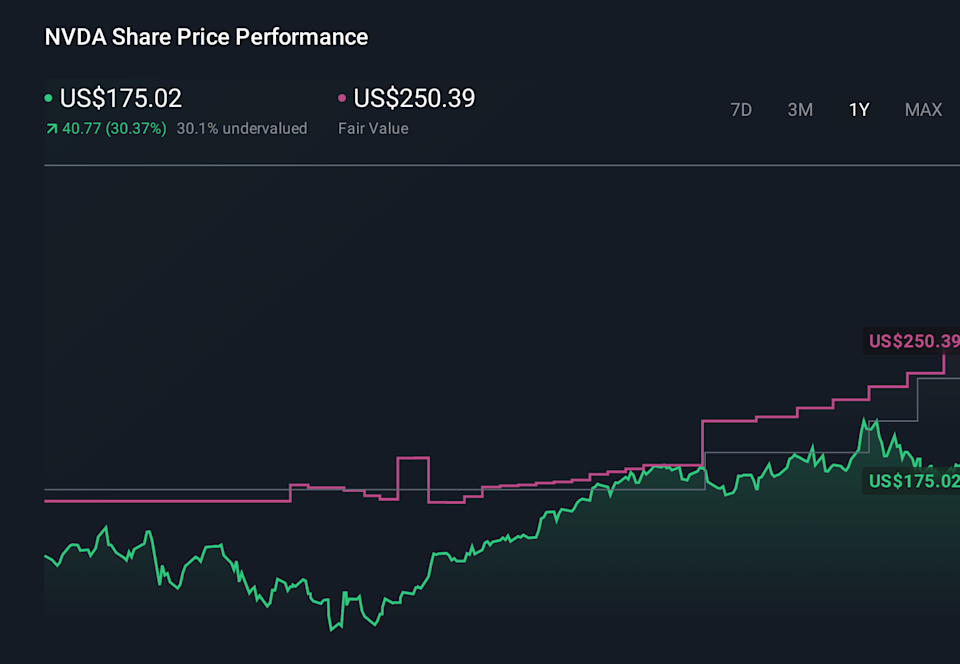 NVDA 1-Year Stock Price Chart
Some of the lowest estimate analysts were already modeling NVIDIA earnings of about US$185.6B by 2029 and a lower 32x PE, so compared with the more upbeat view that networking growth like Spectrum X and Rubin scale out could offset export risks, their narrative is much more cautious and might shift again as these new AI PC and data center products actually ship.
Explore 204 other fair value estimates on NVIDIA – why the stock might be worth 22% less than the current price!
The Verdict Is Yours
Don’t just follow the ticker – dig into the data and build a conviction that’s truly your own.
Want Some Alternatives?
Right now could be the best entry point. These picks are fresh from our daily scans. Don’t delay:
This article by Simply Wall St is general in nature. We provide commentary based on historical data and analyst forecasts only using an unbiased methodology and our articles are not intended to be financial advice. It does not constitute a recommendation to buy or sell any stock, and does not take account of your objectives, or your financial situation. We aim to bring you long-term focused analysis driven by fundamental data. Note that our analysis may not factor in the latest price-sensitive company announcements or qualitative material. Simply Wall St has no position in any stocks mentioned.
Companies discussed in this article include NVDA.
Have feedback on this article? Concerned about the content? Get in touch with us directly. Alternatively, email editorial-team@simplywallst.com