

Prime Minister Mark Carney officially unveiled Canada’s long-awaited artificial intelligence strategy on Thursday, saying his government’s approach will ensure the technology is built with safety, reliability and sovereignty in mind.
The details were first reported by CBC News earlier this week after it obtained a draft version of the document. The official strategy contains most of the information earlier reported, with minor changes.
“The question is not whether AI will transform our lives. It will,” Carney said as he unveiled the strategy in Toronto. “The question is will it improve the lives of all Canadians or benefit only a few.”
According to the official strategy, Canada aims to do the following, among other goals:
Protect Canadians and children against the risks from AI and online harms.Provide Canadians access to free AI literacy training, including reaching one million entry-level post-secondary students.Support creating up to 250,000 new jobs through AI adoption by 2031.Boost Canada’s business adoption of AI from 12 per cent today to 60 per cent by 2034.Build a world-leading supercomputer as part of significantly enhanced sovereign infrastructure by 2031.Build a multilateral alliance so Canada moves from reliance to resilience by having sovereign autonomy in key AI capabilities.
The strategy promises at least two billion dollars of new investments to achieve its aims.
 Artificial Intelligence Minister Evan Solomon arrives for a meeting of the federal cabinet on Parliament Hill in Ottawa on June 2. (Justin Tang/The Canadian Press)
Conservative deputy leader Melissa Lantsman panned the strategy in a news conference in Ottawa, arguing her party doesn’t believe the Liberals can create jobs for young people — a key element — when youth unemployment is already high.
NDP Leader Avi Lewis also took issue with the strategy and said the document “proposes a massive boost to business adoption of AI, with no concern for the consequences this will have for workers, especially young workers who are already watching careers vanish before their eyes.”
Valérie Pisano, CEO of Montreal AI institute Mila, says her organization is “very happy to see everything that’s in the strategy.”
“To us, it’s a balanced, robust, complete strategy, and certainly it gives us momentum to keep going on the things that we care about.”
Light on AI safety
In his remarks, the prime minister acknowledged that Canada has to “be honest about the risks AI poses to Canadians,” including deepfakes, AI-generated disinformation and privacy concerns.
Carney also noted Canada “ranks near the bottom of countries in AI training, literacy and trust.”
The strategy highlights key actions Canada will take to address the issue, including modernizing consumer privacy legislation, introducing online safety laws, working on watermarking AI-generated content as well as a broader commitment to protecting elections and reviewing the Privacy Act.
WATCH | More about potential age restrictions:
Canada ‘very seriously’ considering social media, AI age restrictions, Miller says
Minister of Canadian Identity and Culture Marc Miller said the federal government is ‘very seriously’ considering a restriction on young Canadians’ access to social media and artificial intelligence chatbots. At its national convention on Saturday, the Liberal Party of Canada agreed on a non-binding resolution to set 16 as the age of majority for Canadians’ social media use.
However, like the draft version of the strategy, there are no details on specific actions.
The federal government has previously said it’s “very seriously” considering age restrictions for social media and AI chatbots, but no official decision has been made.
In a statement given to CBC News earlier in May, a spokesperson for Culture Minister Marc Miller said Ottawa “intends to act swiftly to better protect Canadians, especially children, from online harm.”
“No decisions have been made and we will have more details to share in due course.”
The strategy does highlight that Canada will invest $50 million to expand the capabilities of the Canadian AI Safety Institute to track risks, advance technical research and transparently evaluate AI models.
Plus, Canada will “create a Canada Trusted AI Certification program to help Canadians identify trustworthy AI products in the marketplace.”
Pushing AI literacy and jobs
The strategy aims to get people learning about AI through a National Literacy Initiative, which will offer entry-level training meant to be accessible to all Canadians.
That content is intended to reach one million entry-level postsecondary students, and Ottawa also plans to train more than 3,000 educators with AI learning kits in the classroom.
There are also initiatives to help young people find employment as AI disrupts the job market. Ottawa plans to create up to 90,000 AI-related job opportunities through programs like the Student Work Placement Program and Canada Summer Jobs.
WATCH | Workers should fear AI-related job losses, says professor:
Workers ‘better be worried’ about AI taking their jobs, TRU prof says
As more tech companies create generative AI advancements, there are concerns that many humans could lose their jobs. Vivek Kumar, a computer science professor at Thompson Rivers University, said it’s imperative that people brush up on their “soft skills” like collaboration and creativity in the years to come.
Ottawa will also “assess training and upskill offerings for mid-career workers, including in skilled trades, to scale up employer-led training nationwide with a strong priority on AI-related skills.”
The federal government projects that AI adoption can help create up to 250,000 new jobs by 2031.
Some Canadian groups are taking issue with the labour aspects of the strategy.
In a statement sent to CBC, the Canadian Union of Public Employees (CUPE) argued it is “putting the profits of Big Tech billionaires ahead of workers and the public by soft-pedalling protections against the risks of AI.”
In a technical briefing for reporters before the announcement, senior government officials were asked whether Ottawa has an estimate on how many jobs could be lost to AI. They did not provide one.
However, the officials said the government will continue to monitor potential job losses. The strategy notes Canada will use Statistics Canada’s Artificial Intelligence and Technology Measurement Program to assess the impacts of AI.
That program, previously referred to as “TechStat,” was allocated $25 million over six years in the last federal budget.
Scaling up AI adoption, Canadian champions
The AI strategy aims to increase Canada’s business adoption from 12 per cent today to 60 per cent by 2034 through “boosting [small and medium-sized enterprises] and business adoption supports.”
Key actions there include utilizing the Business Development Bank of Canada’s LIFT program to help Canadian SMEs access financing to incorporate AI tools in their operations.
Plus, Ottawa will invest $500 million to expand and enhance its Regional Artificial Intelligence Initiative, meant to help AI startups and growing firms scale up and address common challenges with AI adoption across critical sectors.
WATCH | AI funding announced in B.C. last month:
Ottawa announces funding for AI, new data centres in B.C.
Artificial Intelligence Minister Evan Solomon says the federal government will provide $66 million in funding for Canada’s artificial intelligence sector. On Monday, Solomon said there would be three data centres built in B.C.
It’s also going to add $700 million to the AI Compute Access Fund.
The fund, which currently has a total budget of $300 million, supports projects with compute costs ranging from $100,000 to $5 million. AI Minister Evan Solomon announced the first round of winners earlier this month at Web Summit Vancouver.
The fund covers two-thirds of eligible costs for Canadian cloud-based AI compute services, or half of eligible costs for non-Canadian equivalents. Solomon mentioned at the summit there had been a significant volume of applications for the fund.
Canada will also launch a new AI Missions Program for projects “that deliver significant public good and demonstrate meaningful improvements in Canadians’ lives.” The first mission will commit $200 million to improve Canadians’ health outcomes.
WATCH | AI shows promise in ER diagnoses, says new research:
AI shows promise in emergency room diagnosis
New research shows that not only can AI reason like human doctors when making correct diagnoses, but it outperformed them in five studies. But experts say human judgment is still key to ensuring safety and patient outcomes.
As for scaling up top Canadian companies, the federal government is establishing a $500-million Canadian Tech Growth Fund, which would provide flexible capital and investment support and allow Ottawa to take equity stakes in “the most promising Canadian AI firms.”
“This will help them attract private capital, compete globally, retain talent and intellectual property, and remain anchored in Canada,” the strategy said.
Canada will also leverage its recently announced sovereign wealth fund “where appropriate” to further support Canadian champions, the strategy adds. The details of how the fund will work have still not been released.
Canadian AI sovereignty
Carney highlighted Canada’s need for a sovereign AI ecosystem, but brushed off questions over whether doing so could irritate already-intense trade relations with the United States.
“This is a strategy any sentient country is taking,” Carney told reporters. “This is fundamentally strategic.”
Senior government officials said Canada doesn’t see itself moving completely away from a relationship with the United States on AI, but is trying to allow itself to scale in areas where it has a competitive advantage.
WATCH | Carney on Canada’s push for AI sovereignty: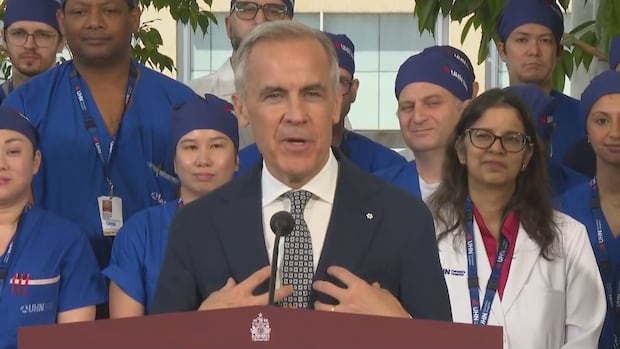
Sovereign cloud computing is something ‘any sentient country’ is pursuing, Carney says
Prime Minister Mark Carney says the government wants to store Canadians’ data and national security data in Canada. ‘We will make the laws here and we will also grow our capacity here, our physical compute capacity, so that we can protect Canadians,’ Carney said.
Ottawa plans to build a world-leading public supercomputer, according to the strategy, meant to give Canadian researchers and SMEs access to compute for “cutting-edge public and industry-driven innovation.”
Plus, Canada will work with private capital to build data centres that can scale to at least 100 megawatts.
On data, which the strategy says must be treated as a “strategic national asset,” Canada plans to invest $100 million to launch the Health Sector Data Space to link secure, private and standardized datasets to strengthen clinical trials.
The federal government is also looking to expand Vital, a collaborative health data platform, to five additional provinces. Ottawa plans to spend $100 million on that file.
Under the sovereignty pillar is also Canada’s plan to attract and retain talent. The document says the federal government will strengthen Canada’s network of national AI institutes and increase the number of Canada CIFAR AI Chairs from 130 to nearly 200 researchers.
Ottawa also plans to expand its Global Talent Stream permit program to accelerate the entry of highly skilled AI workers and “align measures for permanent residency to retain the talent Canada recruits.”