
California studio, two production trucks, global distribution system are combined to produce NBA, WNBA, NWSL, and, in Canada, NHL Monday Night Hockey
Amazon Prime Video has spent the past decade building its live-sports portfolio, and its inaugural NBA season marked a watershed moment for the streamer’s in-house production ambitions.
The just-completed campaign — the first under an 11-year rights deal — combined a state-of-the-art studio in Culver City, CA, two coast-to-coast Game Creek Video mobile units, and an intricate globally distributed production ecosystem, and ended with a Sports Emmy for the studio team. That momentum is rolling directly into the WNBA, which tipped off in May, as Prime Video edges ever closer to producing its entire sports slate on its own.
“We’re at a place now where we don’t need to rely on third parties anymore because we’ve built the infrastructure,” says Ken Miller, director, live sports, Prime Video. “We’ve built out our roster with a great mix of staff and strong producers and directors. And with great leadership in place, we’re very comfortable with where we are, controlling our own destiny in terms of production.”
Five years ago, when Prime Video began building an in-house live-sports-production operation in the U.S., it did so largely around a single Thursday Night Football package and largely relied on third-party production partners. Today, Prime Video produces its own live game coverage and studio programming end-to-end for its NBA, WNBA, NWSL, and NHL Monday Night Hockey (in Canada) packages.
Reflecting on NBA: Emmy-Winning Studio, Bird and Magic, Multilingual Feed
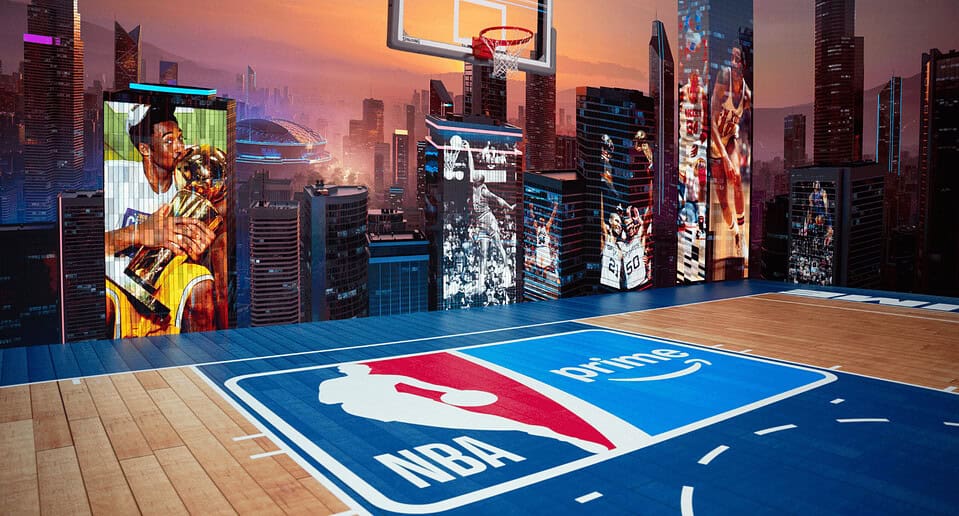
The centerpiece of NBA on Prime Video was its state-of-the-art Culver City studio, which delivered the season’s signature hardware: a 2026 Sports Emmy for Outstanding Technical Team: Sports Studio.
“From a studio perspective, I could not be more pleased,” says John Ward, head of global tech ops, Prime Video. “The entire technical package — video wall, the robotics, the graphics, and overall look — we had a great season in the studio.”
As for game coverage, Game Creek Video’s Bird and Magic mobile units handled the East Coast and West Coast games, respectively. The native 1080p HDR A/B expando units are carbon copies of each other and feature a series of flex-space workstations that can be used for a variety of positions, including graphics and replay.
“All of our producers were pinching themselves to have these kinds of facilities that were specifically catered to their needs,” says Miller. “Even down to the interior: Bird was green, and Magic was purple. It truly felt like they were built specifically for this. Obviously, there are going to be bugs launching a new facility, but we had everything we needed to put on a world-class show.”
Arguably the most daunting undertaking for Prime, however, was the international side. In a first for the league, the streamer brought under one roof all its distribution outside the U.S., which meant that its technical team was tasked with developing an efficient workflow to deliver games in 14 languages across more than 220 territories and countries.
Prime Video’s European sports footprint — built on its work on Premier League, Roland-Garros, and rugby — had a mature infrastructure in London, and the company used that base to spearhead the global-content effort, bringing in production partners 21 Productions and Sunset+Vine. Ward credits Prime Video Head of Systems Engineering Michael Drazin with designing the look and feel of an English feed distributed to the rest of the world, with commentary replaced remotely and replays inserted during commercial breaks and at halftime.
“Honestly,” says Ward, “the international shows were as big as anything we did domestically because of the complexity and everything involved. During those international windows, we had two control rooms in London dealing with four and five games each from the middle of the night until 8:00 in the morning.”
The season was not without a scare. During the broadcast of the Miami Heat vs. Charlotte Hornets opening Play-In Tournament game, Prime Video experienced a temporary disruption due to a hardware failure in the truck. Prime’s team restored the feed as quickly as possible to ensure fans could watch the conclusion of the game, but two minutes of key action were blacked out for viewers. Prime conducted a thorough internal review to determine the cause of the outage and made adjustments to ensure it won’t happen again.
The highs, though, significantly outnumbered the lows during Prime Video’s inaugural season of NBA coverage, and the viewership numbers prove it. NBA on Prime’s regular-season schedule averaged 1 million U.S. viewers across 67 regular-season games — a solid showing for the league’s first-time streaming-only rightsholder. Prime also registered the NBA’s youngest audience in six years and the youngest audience across all major U.S. sports properties. Beyond the U.S., NBA on Prime regular-season games were viewed on 227 million devices for more than 13.1 billion minutes in more than 200 countries and territories.
“Launching something like this from scratch — whether it’s TNF or the NBA — is an unbelievable undertaking,” says Miller. “But we couldn’t have been happier with the result.”
Eyes on the WNBA: 31 Games, Onsite Production, First-Ever Playoff Package
With the NBA campaign in the books, Prime Video’s focus has shifted to its WNBA package, which tipped off with a doubleheader on May 14. The slate — primarily Thursday nights, with four Saturday games and one Tuesday contest — features 31 exclusive regular-season games (including the Commissioner’s Cup Championship) and three playoff games — a first for Prime Video.
New for 2026, every game is preceded by WNBA on Prime Pregame, a 30-minute show live from Amazon Studios in Culver City, and followed by WNBA Nightcap, a postgame show with player interviews and analysis. On doubleheader nights, The Crossover bridges the two games with continued live studio coverage, all anchored by a team of analysts and broadcasters bringing championship experience and deep basketball knowledge to each night.
Prime’s WNBA production will deploy Bird and Magic units when the schedule permits and a mix of other Game Creek Video facilities throughout the season. Apart from graphics and scorebug operators, who are located in Culver City, the entire production team will be onsite for all WNBA productions this season.
“Operationally, we’re following the same philosophy,” says Miller. “Whether it’s Thursday Night Football, the NBA, or the WNBA, we have all our talent, producers, and directors onsite. It’s important for them to be there for shootarounds and meetings because you’re able to get interviews and storytelling opportunities in those cities that you simply wouldn’t get [remotely].”
Prime Video is also covering the WNBA with the same big-event mentality it brings to the NBA, complete with designated “go-big” games for games featuring Caitlin Clark and the Indiana Fever. It has reworked the NBA graphics package, tailoring the color schemes and design to the WNBA. In Culver City, the NBA studio, court, and, largely, crew are also involved in WNBA pre/postgame and halftime coverage. Additionally, Prime has committed to licensing high-end popular music — including Beyoncé — for its broadcasts.
Building the Roster: In-House Team of ‘Genuine All-Stars’
All the while, Miller and Ward continue to build out the in-house operation and compose a team of people they had admired throughout their careers.
“We have been able to curate a team of people that are genuine All-Stars in this business,” says Ward. “What makes it special is the varied backgrounds and experience that everyone brings to the table. These are the kind of people you build organizations around. Having this team in place gives us a lot of confidence moving forward on our own two feet.”
Prime Video VP, Global Sports Production, Jared Stacy oversees all domestic and international live production. In addition to Ward and Drazin, the tech/engineering ops effort is led by Mike Francis, head of global technology and engineering; Scott Swim, principal, tech graphics; Bjorn Estlund, lead technical OPERATIONS Manager; Steve Leotta, principal, remote engineering; Chris Ruiz, head of studio engineering; and Anthony Violanto, head of studio operations.
In addition to Miller, other key members of the game production team are Andrew Hornet, director, live production, EU; Eric Mosley, coordinating producer; Travis Henderson, coordinating director; Andrew Greenhouse, director; Ro Das, producer; Bettina Shore, producer; Erron Banks, producer; Josh Freedenberg, producer; Emma Fruhling, associate producer; John Heffner, international CP, US; and Sam Trusty, international CP, EU.
On the studio side are Mike Muriano, executive producer; Amina Hussein, head of U.S. sports on-air talent; Spoon Daftary, senior coordinating producer; Brandon Lowe, producer; Michael Kaplan, producer; Kevin Cottrell, associate talent producer; Alyssa Christope, talent coordinator; David Faller, senior coordinating director; and Tyler Pickel, broadcast associate.
Global production operations are headed up by Le An Soto, and her team consists of Justine DeLuco, production operations manager; Madison Rubino, production operations manager; Sarah Meneely, senior production operations manager; Tenley Kokich, senior production manager; Kendrick Crittenden, production manager; Carolina Bodmer, international production manager; Taylor Smith, production coordinator; and Elsa Pena, production coordinator.
Graphics are led by Marc Mata, head of creative services, and Clay Lipski, senior creative services manager; Jeff Porter, senior creative producer; Jeff Wilkov, senior creative producer; Abby Ra, graphics production; Christian Thompson, graphics associate producer; jayme hui, graphics coordinator; Danielle Goodman, graphics producer; Diana Guardado, graphics production associate; and Darryl Mar, graphics.
For an operation that began with a single football package and a roster of outside partners, the trajectory is unmistakable: Prime Video is increasingly standing on its own two feet.
“It’s amazing how much we’ve grown in such a short amount of time,” says Miller. “And I think we’re just getting started.”