
Merve Aydogan
04 June 2026•Update: 04 June 2026
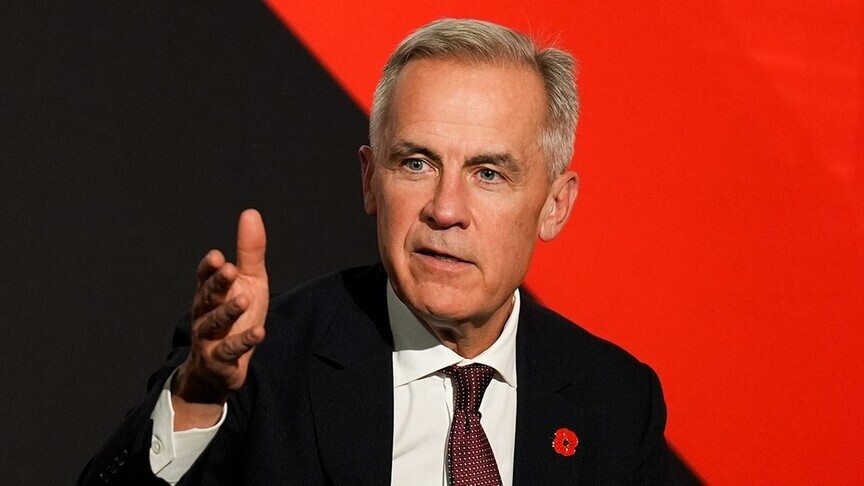
Prime Minister Mark Carney announced a sweeping national artificial intelligence (AI) strategy Thursday to strengthen Canadian sovereignty, protect citizens’ data and create tens of thousands of jobs in the growing AI sector.
Carney warned that Canada’s dependence on foreign technology infrastructure poses serious risks to national security and economic competitiveness.
“We are highly dependent on foreign suppliers for the infrastructure that powers AI, from compute to cloud to data storage, that creates real risks that foreign entities could access Canadian data, deploy AI products that shape Canadian lives without reflecting our values, and tilt the playing field against Canadian firms,” he said at a news conference in Toronto.
Carney cautioned that AI could be turned against Canada, much like other forms of cross-border integration created vulnerabilities in the past.
“Prosperity and sovereignty in the age of AI belong to those nations that can build, adopt and govern AI on their own terms,” he said.
Carney outlined three guiding principles underpinning the new strategy — trust, opportunity, and sovereignty. He pledged new legislation to modernize privacy laws and online safety rules, and said his government would expand Canada’s AI Safety Institute to track emerging risks.
On the economic front, the strategy targets CAN$200 billion ($144 billion) in additional economic growth and 250,000 new AI-related jobs over five years, with up to 90,000 positions and work placements specifically for young Canadians.
The Carney government will also invest CAN$500 million through the Regional AI Initiative and add CAN$700 million to the AI Compute Access Fund to give small and medium-sized businesses access to affordable domestic computing power.
A new CAN$500 million Canadian Tech Growth Fund will take equity stakes in promising AI firms to help them “succeed globally, while remaining proudly Canadian,”he said.
The strategy also targets research, with nearly CAN$350 million earmarked to expand AI institutes in Montreal, Toronto and Edmonton. Carney acknowledged that “most of our data that’s used in AI goes across our border or is governed by privacy regimes of other countries.”
To counter that, Canada is deepening international partnerships, including a new Sovereign Technology Alliance with Germany.
He said Canada has secured 20 economic and security partners over the past year, 12 of them focused on AI, with further partnerships planned across Europe, Asia, Australia, and the Middle East.