
Breadcrumb Trail Links
The Parliamentary Budget Officer projects federal deficits will average $4.6 billion higher annually than the Carney government’s April projections
Get the latest from Lorrie Goldstein straight to your inbox Sign Up
Published Jun 04, 2026 • Last updated 3 hours ago • 3 minute read
You can save this article by registering for free here. Or sign-in if you have an account.
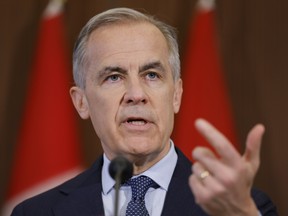 Prime Minister Mark Carney takes part in a press conference on Parliament Hill in Ottawa April 14, 2026. Photo by Blair Gable/PostmediaArticle content
See more Toronto Sun on Google — save as a Preferred Source
Advertisement 2
This advertisement has not loaded yet, but your article continues below.

THIS CONTENT IS RESERVED FOR SUBSCRIBERS ONLY
Subscribe now to read the latest news in your city and across Canada.
Unlimited online access to articles from across Canada with one account.Get exclusive access to the Toronto Sun ePaper, an electronic replica of the print edition that you can share, download and comment on.Enjoy insights and behind-the-scenes analysis from our award-winning journalists.Support local journalists and the next generation of journalists.Daily puzzles including the New York Times Crossword.
SUBSCRIBE TO UNLOCK MORE ARTICLES
Subscribe now to read the latest news in your city and across Canada.
Unlimited online access to articles from across Canada with one account.Get exclusive access to the Toronto Sun ePaper, an electronic replica of the print edition that you can share, download and comment on.Enjoy insights and behind-the-scenes analysis from our award-winning journalists.Support local journalists and the next generation of journalists.Daily puzzles including the New York Times Crossword.
REGISTER / SIGN IN TO UNLOCK MORE ARTICLES
Create an account or sign in to continue with your reading experience.
Access articles from across Canada with one account.Share your thoughts and join the conversation in the comments.Enjoy additional articles per month.Get email updates from your favourite authors.
THIS ARTICLE IS FREE TO READ REGISTER TO UNLOCK.
Create an account or sign in to continue with your reading experience.
Access articles from across Canada with one accountShare your thoughts and join the conversation in the commentsEnjoy additional articles per monthGet email updates from your favourite authors
Article content
A new report by the Parliamentary Budget Officer says Prime Minister Mark Carney can define his annual federal deficits any way he likes, but the fact is they’re going to be higher for the next five years than the Liberals predicted in their spring mini-budget just 37 days ago.
Article content
Article content
PBO Annette Ryan, in her economic and fiscal update for June, estimates last year’s deficit will be $72 billion (2.2% of GDP) when the final numbers come in for the 2025-26 fiscal year (April 1 2025 to March 31 2026).
That’s double the $36.3 billion deficit (1.2% of GDP) the Liberals reported in 2024-2025 and $5.1 billion higher than the $66.9 billion deficit Finance Minister Francois-Philippe Champagne projected on April 28, the PBO reports, “as modest revenue growth is outpaced by growth in expenses – largely reflecting the introduction of new measures.”
For the next five years, the PBO projects, federal deficits will average $4.6 billion higher annually than the government’s April projections, “reflecting lower revenues, particularly personal income tax, and higher program expenses, partially offset by lower public debt charges.”

Your Midday Sun
Thanks for signing up!
Article content
Advertisement 3
This advertisement has not loaded yet, but your article continues below.
Article content
The PBO says this year’s federal deficit (2026-2027) will come in at $71.8 billion, compared to the government’s spring projection of $65.3 billion; $68 billion for 2027-2028 compared to $63.1 billion; $60.4 billion for 2028-29, compared to $57.7 billion; $59.7 billion for 2029-30 compared $56.2 billion; and $58.2 billion in 2030-31 compared to $53.2 billion.
Read More

GOLDSTEIN: Mark Carney and the magical, mystery decreasing deficit
TERRAZZANO: Carney’s overspending fails fiscal responsibility
OPINION: Carney government doubling down on Trudeau’s failed fiscal policy
Carney promising to balance operating deficit by 2028-29
Carney has announced he is separating the operational costs of the government from capital spending and has promised to balance the operating deficit by 2028-29.
But Ryan’s predecessor, interim parliamentary budget officer Jason Jacques, warned last November that the Carney government misclassified $94 billion worth of operating expenses in its November budget as revenue-generating capital investments, contrary to standard accounting practices.
Advertisement 4
This advertisement has not loaded yet, but your article continues below.
Article content
If that $94 billion was properly reclassified as government operating expenses, Jacques said, the Prime Minister will fail to achieve his promise to balance the government’s operating budget by 2028-29.
Ryan said that in order to support greater transparency, she plans to do an independent assessment of Carney’s capital budgeting framework in an upcoming report.
“Due to persistent budgetary deficits of on average 1.8% of GDP over the projection horizon,” Ryan wrote, “the federal debt-to-GDP ratio (the lower the number the better) is anticipated to increase from 41.3% in 2025-26 to 42.5% in 2030-31.”
Noting that the International Monetary Fund recently urged the federal government to reinstate the debt-to-GDP ratio as its primary fiscal anchor to “strengthen discipline, transparency, and credibility,” Ryan said based on the calculations in her report, there is only a 39.6% chance the federal debt-to-GDP ratio in 2030-31 will be lower than its 2025-26 level.
Advertisement 5
This advertisement has not loaded yet, but your article continues below.
Article content
RECOMMENDED VIDEO
We apologize, but this video has failed to load.
Play VideoInterest on federal debt will be $58.9 billion this year
According to the PBO, the cost of paying interest on the total federal debt of $1.41 trillion this year will be $58.9 billion – more than the $57.4 billion the federal government will transfer to the provinces for health care.
By 2030-31, the cost of servicing the projected $1.66 trillion federal debt, the PBO report says, will be $80.2 billion, money that doesn’t go to better public services or lower taxes. It doesn’t even lower the debt, because it only covers the cost of the interest on it.
Ryan also projects that due to continuing trade uncertainty with the U.S., Canada’s real GDP growth will be 1.1% this year – down from 1.7% in 2025 – and 1.6% in 2027, down from an earlier prediction of 1.8%.
Article content
Share this article in your social network