

Listen to this article
Estimated 3 minutes
The audio version of this article is generated by AI-based technology. Mispronunciations can occur. We are working with our partners to continually review and improve the results.
An odour like rotten grass has plagued southeast Calgary for years, according to resident complaints to the city. Now, after a year of monitoring, a source of the stench may have been identified.
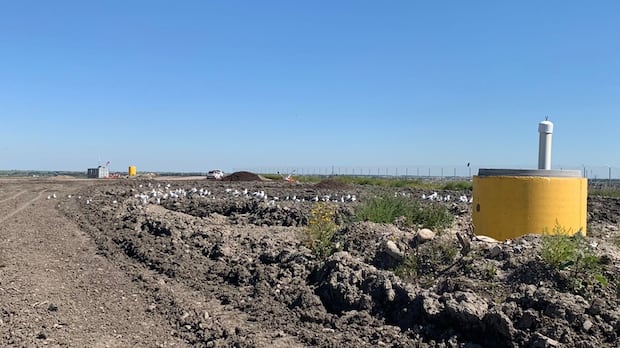
Monitoring air condition near the Shepard Landfill for the past year has helped the city discover the landfill’s leachate system is a possible contributor. The leachate system of pipes collects liquid trickling through the landfill over time to send for wastewater treatment.
Gases escape into the air through access points created to install the pipes when the landfill was constructed. The landfill essentially burps, explained Sharon Howland, leader of program management for the city’s waste and recycling services.
“Our leachate system is all about protecting the groundwater from this garbage juice making its way into aquifers,” said Howland.
“It’s what Calgarians might find in the bottom of their black cart after a rainy period, and it seeps through the garbage or the bottom of their green cart as the rain has seeped through the food and yard waste in there.”
LISTEN | City official on how ‘garbage juice’ is polluting the air in Calgary:
Calgary Eyeopener6:32Stinky southeast
We hear the latest in a years-long investigation into what’s making parts of Southeast Calgary so stinky.
Howland said the city has known for years bad odours in the area were naturally coming from the Shepard Complex, which includes the landfill, a composting facility and the biosolids lagoons. Nearby agriculture work and wetlands have also contributed foul odours to the area.
But complaints from residents in southeast neighbourhoods like New Brighton, McKenzie Towne, Copperfield, Douglasdale and Douglas Glen peaked in 2022, prompting the city to set up a new air monitoring system.
In the past year, more than 100 sampling stations have measured compounds in the air. When combined with weather data, wind direction and Calgarians’ feedback through 311 that describe the stenches they’re sniffing, the city can triangulate an odour’s source.
The monitoring helped Howland and her staff discover the leachate system problem, and they responded by sealing off the access points in May, where gas was escaping.
 The city has received a high number of complaints in recent years about a rotten grass odour in neighbourhoods near the Shepard Landfill, like McKenzie Towne. (Bounce Imaging)
John Lee, president of the New Brighton Community Association, said residents knew when they moved to the area they would have to live with some odour problems due to the landfill. But he said the smell worsened in recent years, and his organization worked with the city to find a solution.
“Some days it’ll smell like dead, wet grass. Some days it smells like a city dump. Some days it could be compost. And there’s other times where we just can’t distinguish what the smell is,” said Lee, who has lived in New Brighton for 11 years.
Howland said because August and September are historically the months with the most odour complaints, due to heat and stagnant air, the city will know how successful its work has been by the end of the summer.
She said the city intends to expand its monitoring system to help detect other problematic odours in the area.
“Odour is very complex,” said Howland.
“What you might experience when you’re out on your back patio, you might consider a real nuisance and it chases you inside, versus your neighbour isn’t bothered at all by it.”