
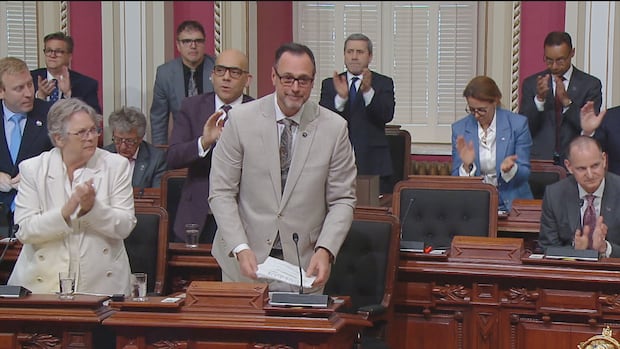
The Quebec government tabled a bill Thursday to expand the province’s language regulations to adult and vocational education centres.
If the Charter of the French Language — commonly known as Bill 101 — is expanded under the new legislation, students who are not considered part of the province’s “historic anglophone” community would no longer be able to access English-language education.
“The bill is ambitious and important,” Jean-François Roberge, the minister responsible for French in Quebec, told reporters Thursday at the National Assembly.
“Studying in French means working in French, shopping in French, and living in French. We see there’s a loophole right now: adult general education and vocational training,” he said.
“We’re correcting that situation.”
Roberge said his bill will do this while still respecting the rights of the historical English-speaking community.
He said a two-year phase-in period will give English school boards time to adapt.
WATCH | What’s in Bill 8, and why the CAQ is pushing to get it passed quickly: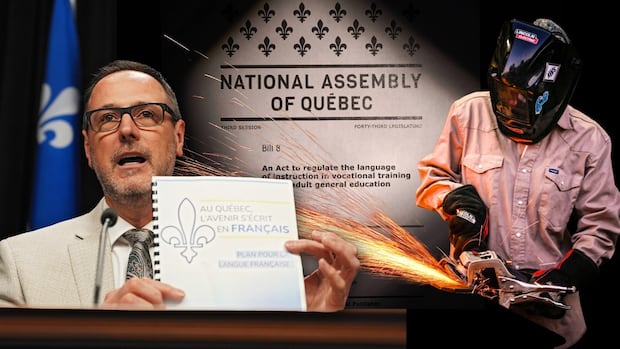
Quebec wants to ban thousands from English vocational schools, but the election may come too soon
The CAQ government has tabled Bill 8 at the National Assembly to extend the Charter of the French Language to another part of the education sector: adult education and vocational training. As many as 27,000 students would have to transfer from the anglophone to the francophone school system, but the bill is unlikely to pass before the upcoming provincial election.English school boards slam bill
The Quebec English School Boards Association, QESBA, condemned the bill.
“We have been talking for weeks about the detrimental impact that this bill would have on Quebec’s economy, on the the labour shortage, on the fact that immigrants who come here who already can’t get French classes because they’re on long waiting lists are now going to be put on a waiting list to learn a trade,” QESBA president Joe Ortona told CBC.
“It’s going to increase the dropout rate and increase the unemployment rate,” he said.
Roberge told reporters he would work with English school boards to ensure the impact of the changes will be minimal.
But Ortona said QESBA has requested meetings with both Roberge and Education Minister Sonia LeBel to discuss the bill and never heard back.
“There is no communication with us of any kind from them, and for them to suggest otherwise is absolutely shameful. It is false,” he said.
Judy Kelley, chair of the Lester B. Pearson School Board, previously told CBC she estimates half the students at her board would not be able to continue their studies.
“It’s not going to help anyone in the society,” Kelley said.
“It doesn’t mean we can’t find ways to work together to enhance what students learn, but we should not be restricting their choices.”
Unions, business groups raise concerns
In a statement, the Fédération autonome de l’enseignement (FAE) teachers’ union said it supported the goals of the bill, but worried the Coalition Avenir Québec (CAQ) government was rushing it through without considering the consequences.
The FAE noted the province is facing a chronic shortage of teachers, including those who teach French as a second language.
The Conseil du patronat du Québec, which represents large employers in the province, said in a statement it sees the reform as unnecessary and detrimental to the English-language training network.
“The real solution lies in better supporting people in their French learning, while enabling them to acquire the skills sought in the job market,” CEO Michelle LLambias Meunier said.
“French-language training should facilitate qualification, not become an obstacle to it,” she said.
The group also raised the issue of the labour shortage, saying any measure slowing access to training risks exacerbating recruitment challenges faced by employers.
Roberge said the two-year phase-in period will give the government time to address all these concerns.
Opposition sees ‘red flags’
One area of confusion has been how many students will actually be affected by the law.
In May, Roberge said as many as 27,000 students could be affected, while Premier Christine Fréchette previously put the number at 10,000.
Asked about the discrepancy at a news conference on Wednesday, French language commissioner Benoît Dubreuil told reporters that he’s had discussions with the Education Ministry to determine the exact number.
Québec Solidaire MNA Alexandre Leduc said the inconsistency is a problem.
“I think the fact that the minister didn’t give the same number as his premier on who’s going to be affected by this eventual bill is already a big red flag,” Leduc told CBC Thursday.
Speaking alongside Roberge Thursday, LeBel said the discrepancy was easy to explain.
She said Roberge was referring to the number of students currently enrolled in adult and vocational education programs who might be affected, while Fréchette was referring to the number who graduate each year.
Liberal MNA André Fortin said the CAQ purports to protect the French language, but has struggled to ensure there are enough available places in French-language classes for adults.
“There are people out there willing to learn French, who know that they need French in their daily lives here in Quebec and who were not able, who still are not able to access francisization,” Fortin said.
Bill up against the clock
Roberge needs the support of opposition parties if he hopes to pass the bill without invoking closure before the end of this legislative session.
There are only six working days left in the session — the last before next fall’s election — and the CAQ government is trying to ram through several new laws.
“You cannot adopt all these bills without consulting anyone, without giving, you know, a voice to people,” Parti Québécois MNA Joel Arsenau said Thursday.
“It’s not realistic to think that we can adopt them all,” he said.
Roberge, for his part, said “we have to use the time we have in the best way possible.”
“If everyone agrees, I think we can move forward. I don’t see who would be opposed, not even the Liberals.”
All the opposition parties said Thursday they would study the bill but would not commit to ensuring it gets adopted before the end of the session.
WATCH | Quebec government looks to pass an ambitious number of bills: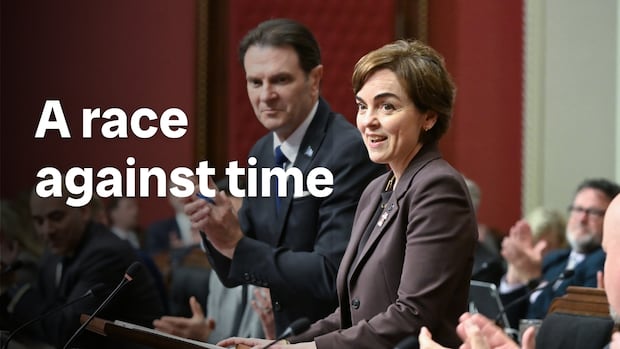
Quebec constitution back in play as Fréchette looks to ‘do the maximum’ in coming weeks
Premier Christine Fréchette plans to maintain a fast pace during a five-week legislative session at the National Assembly. Fréchette listed her priorities in an opening speech, which include measures aimed at addressing the rising cost of living, the housing crisis, homelessness, conjugal violence, language, and a proposed Quebec constitution.