

Make better investment decisions with Simply Wall St’s easy, visual tools that give you a competitive edge.
Microsoft (NasdaqGS:MSFT) has launched new healthcare and life sciences AI collaborations, including a frontier clinical reasoning model co-developed with Mayo Clinic.
The company also announced partnerships with Cortechs.ai, First Foundation Labs, and Causaly to embed advanced AI into clinical workflows and R&D.
Microsoft introduced seven new in-house AI models, including its first reasoning model, MAI-Thinking-1, developed by its superintelligence team.
The company restructured its OpenAI partnership, ending exclusivity and allowing OpenAI to work with competing cloud providers.
Microsoft (NasdaqGS:MSFT) is trading at $441.31, with the stock up 6.1% over the past week and 6.5% over the past month. Over 3 years and 5 years, returns of 35.4% and 82.1% respectively show how closely many investors have tied the stock to large scale AI and cloud shifts in the wider market.
These new healthcare collaborations and in-house reasoning models position Microsoft as a deeper technology partner for regulated sectors, not just a general cloud provider. The updated OpenAI agreement reduces dependence on a single model source, which could matter for readers who care about long term platform resilience and choice in AI tools.
Wall Street’s queuing for one rocket. While SpaceX counts down to its IPO, other companies tied to the new space race are already in orbit. → 20 Compelling Space Companies watchlist · Global Space Race Investing Ideas screener · Scan the sector by valuation on Rocket Lab’s valuation page.
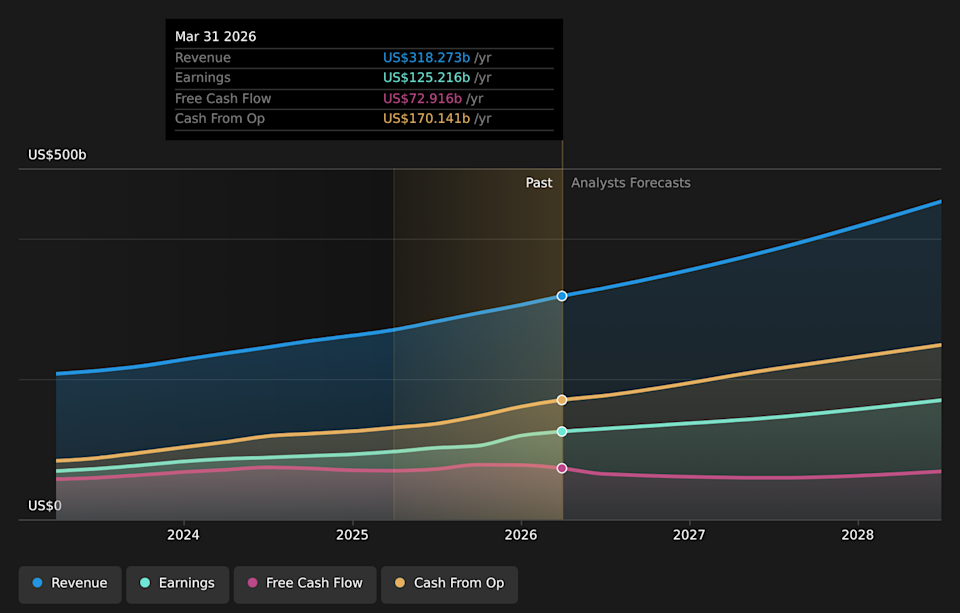 NasdaqGS:MSFT Earnings & Revenue Growth as at Jun 2026
📰 Beyond the headline: 1 risk and 5 things going right for Microsoft that every investor should see.
For you as an investor, these healthcare AI partnerships and the new in-house reasoning model point to Microsoft trying to move up the stack from general cloud hosting into domain-specific, high-governance workloads. Deals with Mayo Clinic, Cortechs.ai, Causaly, and First Foundation Labs plug Microsoft Discovery and Azure more deeply into clinical decision support, imaging, and drug development workflows where reliability, audit trails, and regulatory compliance are non negotiable. That fits with the push to reduce reliance on OpenAI by building internal reasoning models like MAI Thinking 1 while still distributing partner models through Azure. The reworked OpenAI agreement, which ends exclusivity, makes Microsoft look less exposed to a single supplier and more like a neutral platform that can host its own and third party models, in a similar way to how it treats databases or security tools. For long term holders comparing Microsoft with peers such as Alphabet, Amazon, and Oracle in healthcare and life sciences, this news is really about who becomes the default AI operating layer for regulated industries rather than just who has the biggest general purpose model.
How This Fits Into The Microsoft Narrative
The focus on AI powered healthcare, life sciences R&D, and reasoning models supports the narrative view that Microsoft is deepening AI usage across Azure, Copilot and sector specific workloads, which is one of the key growth catalysts for higher usage intensity and recurring revenue.
Owning frontier models like MAI Thinking 1 and distributing a Mayo owned clinical model slightly challenges earlier concerns in the narrative around dependency on external AI partners, but it also adds execution risk if model performance, safety, or regulation do not track expectations.
The narrative highlights AI, cloud, and security generally; what is not fully captured is how verticalized offerings in healthcare and biopharma could behave differently from broad enterprise workloads in terms of adoption curves, pricing, and required capital.
Knowing what a company is worth starts with understanding its story. Check out one of the top narratives in the Simply Wall St Community for Microsoft to help decide what it’s worth to you.
The Risks and Rewards Investors Should Consider
⚠️ Healthcare and biopharma AI have tight regulatory and safety requirements, so if Microsoft or its partners face setbacks in validation, privacy, or model governance, adoption could slow and weigh on expected AI related usage of Azure and Microsoft Discovery.
⚠️ Building, hosting, and running reasoning models for complex clinical and scientific tasks adds to already large AI and data center spending, which analysts have flagged as a source of margin pressure if revenue from these workloads does not keep pace.
🎁 These collaborations create embedded positions in critical workflows such as clinical reasoning, radiology reporting, and target identification, which can be sticky and may support long contract durations and high switching costs versus other providers like Amazon and Alphabet.
🎁 The shift to a less exclusive OpenAI relationship, combined with Microsoft’s own models, gives customers more model choice on Azure, which can make the platform more attractive for enterprises that want multi model strategies and resilience.
What To Watch Going Forward
From here, it is worth watching how quickly Mayo Clinic’s frontier model and tools from Cortechs.ai, Causaly, and First Foundation Labs show up in customer case studies, reference wins, and disclosed workloads on Azure. Pay attention to any detail Microsoft provides on healthcare and life sciences contributions to AI revenue or Azure growth, and how that compares with efforts from Alphabet and Amazon in similar domains. It is also useful to monitor updates on AI infrastructure spending and model development costs, plus any regulatory commentary around healthcare AI use, since those factors will influence how these partnerships flow through to earnings and cash generation over time.
To ensure you’re always in the loop on how the latest news impacts the investment narrative for Microsoft, head to the community page for Microsoft to never miss an update on the top community narratives.
This article by Simply Wall St is general in nature. We provide commentary based on historical data and analyst forecasts only using an unbiased methodology and our articles are not intended to be financial advice. It does not constitute a recommendation to buy or sell any stock, and does not take account of your objectives, or your financial situation. We aim to bring you long-term focused analysis driven by fundamental data. Note that our analysis may not factor in the latest price-sensitive company announcements or qualitative material. Simply Wall St has no position in any stocks mentioned.
Companies discussed in this article include MSFT.
Have feedback on this article? Concerned about the content? Get in touch with us directly. Alternatively, email editorial-team@simplywallst.com